
The Business Case for a Dedicated Beach Product Mix in Wholesale Buying
Building a dedicated beach-oriented product mix is a commercial decision that more independent boutiques are making deliberately for summer 2026, rather than treating beach-adjacent product as incidental to the broader summer assortment. The commercial logic is straightforward: customers purchasing for beach and holiday occasions are high-intent buyers with a specific need to solve, a defined purchase window and a willingness to invest in product that meets their functional and aesthetic requirements. A boutique that positions itself as the destination for well-sourced, Italian-made beach and resort product can build a loyal customer segment with strong repeat purchase behaviour, particularly in markets with coastal or warm-climate demographics, or in urban boutiques serving a customer base with active holiday lifestyles.
The Italian wholesale circuit, and Prato’s pronto moda district specifically, is particularly well-suited to supplying this category. The district’s production infrastructure is built for speed and variety, which means buyers can access a broad selection of kaftans, sarongs and lightweight sets within a single sourcing session covering multiple warehouses. The fabric and print quality available at mid-market wholesale price points from Italian suppliers is consistently above what comparable supply chains in other markets offer at equivalent cost, a structural advantage that boutiques can convert into margin and positioning differentiation at retail.
Kaftans: The Anchor Piece of Any Beach-Oriented Wholesale Order
The kaftan is the defining product in beach-adjacent womenswear and the highest-volume category in this segment within Italian wholesale production for SS26. Its commercial dominance reflects a combination of factors: broad silhouette appeal across body types, strong visual presence on the shop floor and in social media content, high perceived value relative to wholesale cost, and a retail price architecture that allows comfortable margin at mid-market positioning. Italian producers in Prato are manufacturing kaftans for SS26 across a range of constructions, from simple gathered viscose in bold tropical prints to more structured styles with embroidered or beaded trim that justify a higher retail price and attract customers looking for something beyond the basic beach cover-up. The broader landscape of lustrous and textured fabrics trending in SS26 Italian production provides useful context for buyers considering more elevated beach-adjacent product that bridges beach and evening occasion.
For wholesale buyers, the selection criteria for kaftans centre on three factors: fabric drape and weight, print scale and resolution, and construction at key stress points. Drape determines how the garment presents on the shop floor rail and moves on the body, both critical to the customer’s purchase decision. Print scale needs to be calibrated to the retail market: large-scale tropical prints work well in markets with bold aesthetic preferences, while more restrained botanical or abstract prints suit markets where understatement is a quality signal. Construction at the neckline, sleeve openings and hem needs to be clean and durable, as kaftans are subjected to repeated pulling and stretching in everyday beach use.
Sarongs and Pareos: A Versatile Addition to the Beach Wholesale Mix
Sarongs and pareos occupy a different commercial position in the beach product mix from kaftans: lower wholesale and retail price points, higher volume potential, and a customer base that skews younger or more price-conscious. Their commercial function in a boutique assortment is to increase floor accessibility and basket-building opportunity, a customer who might not be ready to commit to a full kaftan purchase can add a sarong to a dress buy without materially increasing the transaction size. They also serve as effective visual accessories on the floor: draped over a chair or displayed alongside a swimwear or resort dress fixture, they extend the boutique’s beach narrative without requiring dedicated fixture space.
Italian wholesale production of sarongs and pareos for SS26 follows the same print and fabric directions as the broader beach category: printed viscose in botanical and abstract motifs, cotton voile in tonal or striped constructions, lightweight cotton in natural and earthy tones. The price architecture allows for retail positioning that is accessible without being promotional, and the absence of complex construction makes these pieces reliable in terms of quality consistency across a production run. Buyers who include sarongs and pareos in their beach product mix tend to report stronger average transaction values on beach-occasion purchases compared to orders that consist solely of higher-investment pieces.
Lightweight Coordinated Sets: The Growing Force in Beach Wholesale SS26
Coordinated lightweight sets, two-piece combinations of a top and bottom in matching beach-appropriate fabric, are the fastest-growing format in the beach and resort wholesale category for SS26. Their commercial appeal is driven by the same logic that has made coord sets a dominant format in the broader womenswear market: they provide a solved outfit, they sell as a unit at a combined retail price that delivers strong margin, and the components can be separated for individual sale if one piece sells faster than the other. For Italian wholesale buyers, the availability of coordinated beach sets from Prato suppliers in linen, printed viscose and cotton gauze constructions makes this format a natural core element of a beach-oriented order. Linen’s position as a hero fabric for SS26 reinforces the case for linen-based beach sets as a fabric-story anchor within a broader beach assortment.
The most commercially effective beach coord sets from Italian wholesale for SS26 pair a relaxed blouse or bandeau top with a wide-leg beach trouser or a midi pareo-style skirt, in a fabric that provides appropriate coverage for the beach-to-lunch transition. This product format is positioned deliberately between pure swimwear cover-up and casual resort dress, it addresses the customer who wants to move from beach to a coastal restaurant or boutique hotel terrace without changing, a real-life occasion that the purely beach-specific product mix does not serve. Buyers who recognise this transition-occasion market tend to allocate more depth to coord sets than to single-use beach pieces, with better sell-through outcomes.
Building the Product Mix: Balance, Depth and Price Architecture
A well-constructed beach-oriented wholesale product mix is not simply a collection of beach-adjacent pieces, it is a curated assortment with a deliberate internal structure that maximises floor productivity and minimises markdown risk. The foundational principle is that anchor pieces with the highest commercial confidence should carry the greatest depth, while more experimental or design-forward pieces are ordered in tighter quantities to provide visual variety without proportionally increasing inventory risk. For most mid-market boutiques, this means two or three kaftan silhouettes at meaningful depth, a range of sarongs and lightweight sets at accessible depth, and a small selection of elevated pieces that provide aspirational visual anchoring without requiring significant stock commitment.
Price architecture across the beach product mix needs to span enough range to serve different purchase occasions and budget levels without creating gaps that leave customers without an option at the moment of decision. A range that runs from accessible sarongs and pareos through mid-tier coord sets to full-length embroidered kaftans provides the boutique with a coherent narrative and a complete range of entry points. The Italian wholesale offer from Prato supports this price architecture naturally, the variety of product types and fabric specifications available in the district means buyers can construct a complete price range within a single consolidated sourcing session.
Operational Considerations for Beach Wholesale Sourcing from Prato
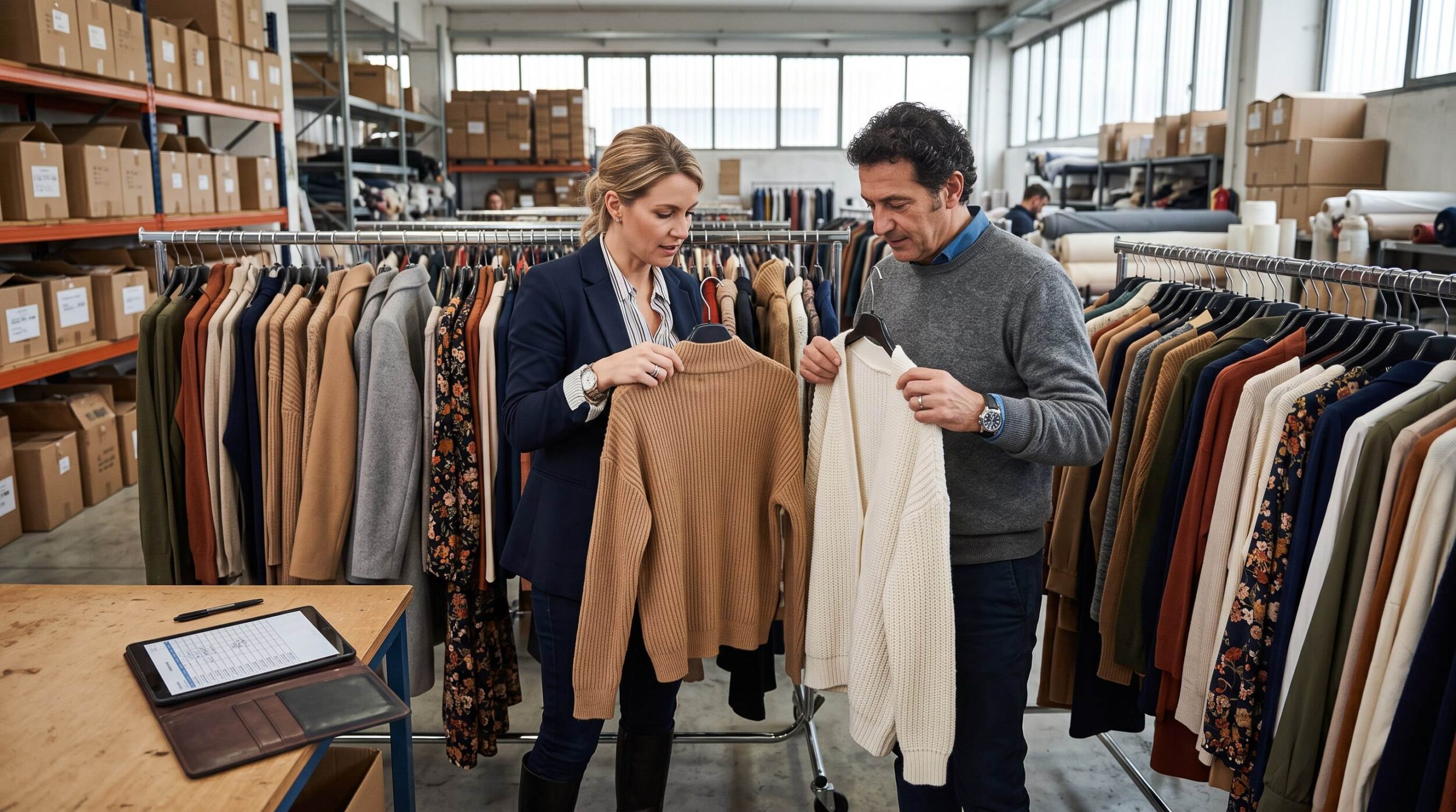
The operational workflow for a beach-oriented wholesale buy from Prato follows the standard fashion sourcing purchasing process: initial brief, supplier pre-screening, live video session covering multiple warehouses, consolidated invoicing and single-shipment export. For beach product specifically, the pre-screening stage is particularly valuable, because the category spans suppliers with very different specialisations, some strong in printed kaftans, others in coordinated sets, others in plain or tonal beach separates. A sourcing session that goes in without prior filtering can result in significant time spent in showrooms that don’t match the buying brief. For buyers new to the Prato beach category and considering private label production italy options alongside ready-to-wear wholesale, the application process at italianfashionsourcing.com/interview/ is the entry point for exploring a structured sourcing approach with pre-screened supplier access.
Timing for beach wholesale orders from Italy is among the most consequential operational decisions in the buying calendar. The commercial peak for kaftans, sarongs and beach sets in most international markets runs from late April through July, with a secondary window in resort and tropical markets extending into August and September. For goods to arrive at the boutique before the April window, sourcing needs to be completed by late January or early February at the latest, accounting for consolidation, international freight and customs clearance. Buyers operating in distant markets, North America, Australia, the Gulf states, should factor four to six weeks of logistics time into their delivery planning to avoid arriving at retail after the peak window has opened.
If you’re building a beach-oriented product mix for summer 2026 and want access to pre-screened Italian suppliers in kaftans, sarongs and lightweight sets, Italian Fashion Sourcing works with a selected number of international boutiques each season. The process starts with an initial interview to align on your buying brief, apply at italianfashionsourcing.com/interview/.