Corduroy trousers, bouclé jackets and brushed-finish knitwear are giving AW26/27 italian fashion wholesale collections a tactile dimension that flat, smooth fabrics cannot replicate, and Prato manufacturers are reporting that texture-driven pieces are outperforming plain alternatives even within the same colour and silhouette. This is a noticeably different sourcing conversation from the colour and cut decisions already shaping this season’s structured tailoring and knitwear categories, since texture works as an independent selling point that customers respond to through touch as much as sight.
For boutique buyers, this matters because texture-led pieces often justify a slightly higher price point than their flat-fabric equivalents, and customers who handle a bouclé jacket or a corduroy trouser in person are measurably more likely to complete a purchase than when browsing the same silhouette in a smooth, less tactile fabric.
Why texture is becoming a selling point in its own right
Several Prato suppliers describe this season’s texture emphasis as a direct response to several seasons of relatively flat, minimal fabric treatments across mid-market pronto moda production. Customers are responding strongly to pieces with visible, touchable texture, and manufacturers have adjusted production accordingly, expanding bouclé, corduroy and brushed-finish lines that were previously a smaller, more niche part of their AW offering.
This shift also connects to how boutiques are merchandising in-store, since texture-led pieces photograph differently under store lighting than flat fabrics, often creating a more dimensional, tactile-looking display that retailers report drives more in-person engagement than flat-fabric alternatives positioned in the same way.
This pattern mirrors what several boutiques already observed during recent SS26 seasons with textured linen and viscose pieces, suggesting that the appetite for tactile fabric treatments is not limited to winter weight materials but reflects a broader shift in customer preference across the full year.
Corduroy trousers and skirts returning to relevance
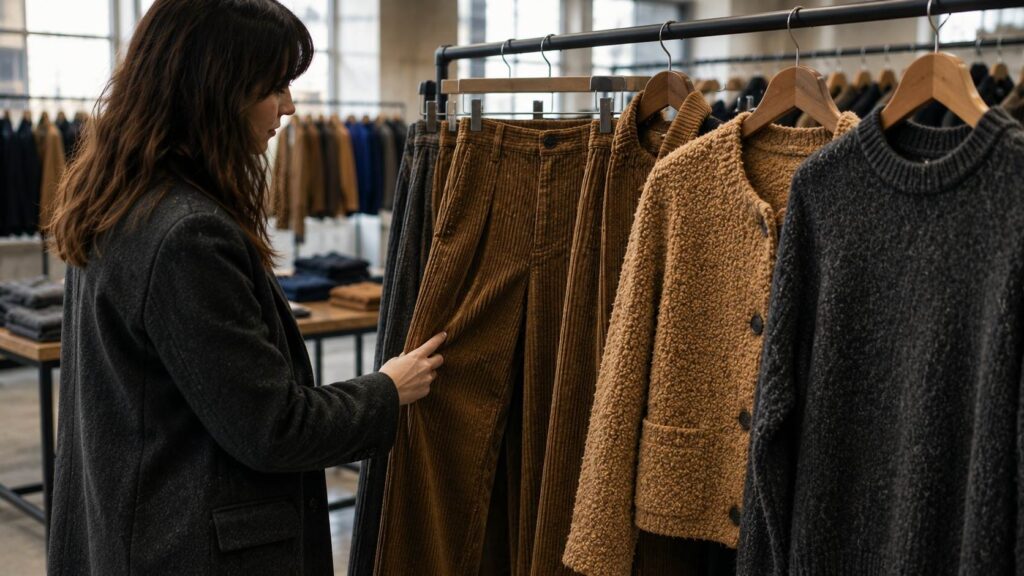
Wide-wale corduroy trousers are the standout texture piece across Prato showrooms this season, generally cut in the same structured wide-leg silhouette driving this season’s denim direction, which lets boutiques merchandise the two categories together as complementary options for the same customer. Corduroy skirts in midi lengths are performing as a secondary but meaningful category, particularly in camel and charcoal tones that align with the season’s broader colour direction.
Wale width, meaning the spacing between the fabric’s ridges, varies noticeably between suppliers and affects both the visual weight of the finished garment and its price point, with wider wales generally reading as more casual and narrower wales working better in pieces aiming for a slightly dressier finish.
Several manufacturers are also offering corduroy in unconventional colours beyond the traditional camel and brown tones associated with the fabric, including a muted charcoal corduroy that integrates more naturally into this season’s broader colour direction than the warmer, more classic corduroy palette of previous years.
Bouclé jackets bringing texture to outerwear
Bouclé jackets, characterised by their looped, textured surface, are moving from a primarily occasion-wear category into everyday AW26/27 outerwear this season, with Prato manufacturers producing cropped and waist-length versions alongside the more traditional longer silhouettes. This expansion into more casual lengths is making bouclé accessible to a wider range of boutique price points than in previous seasons, when it was concentrated mainly in premium, occasion-driven pieces.
Colour application on bouclé tends toward softer, more muted tones than the saturated cobalt driving other categories this season, since the texture itself already provides visual interest and a brighter colour can read as overwhelming when combined with bouclé’s naturally busy surface.
Lining quality matters more in bouclé jackets than in smoother fabric outerwear, since the looped surface texture can catch on a poor-quality lining during wear, creating visible pulls or snags that become a common source of customer complaints if a supplier has not paired the bouclé shell with an appropriately smooth interior fabric.
Brushed and garzato finishes on knitwear and outerwear
Brushed-finish fabric treatments, known locally as garzato, are appearing across both knitwear and lighter outerwear this season, giving pieces a soft, slightly fuzzy surface that reads as warmer than the underlying fabric weight might otherwise suggest. This treatment is particularly effective on lighter wool blends, where the brushing process adds perceived warmth and visual depth without requiring the heavier fabric weight that genuine technical warmth demands.
Buyers should note that brushed finishes can wear differently over time than smooth alternatives, with the surface texture sometimes flattening with repeated washing or wear, which is worth discussing directly with a supplier when evaluating long-term garment performance rather than judging quality purely from an unworn sample.
Garzato treatments are particularly common on this season’s camel and charcoal knitwear, where the brushing process enhances the perceived richness of these neutral tones in a way that a flat knit finish does not achieve to the same degree.
Quality checks specific to textured fabrics
Texture consistency across a production run is the primary quality concern with these fabric treatments, since variations in wale depth on corduroy or loop density on bouclé between samples and bulk production are more common quality issues than with flat, smooth fabrics. A buyer should request to see fabric swatches from the actual production batch rather than relying solely on an early sample garment, since texture treatments can vary meaningfully between small sample runs and full production.
Colour saturation also behaves differently on textured surfaces than on flat fabric, since the texture itself catches and scatters light differently, which means a colour that looks one way on a flat swatch can appear noticeably different once applied to a heavily textured surface like bouclé or wide-wale corduroy.
Buyers should also ask suppliers about care instructions specific to each texture treatment, since corduroy, bouclé and brushed finishes often require different washing or dry-cleaning guidance than standard smooth fabrics, and passing this information accurately to the end customer reduces the likelihood of premature wear from improper care.
How texture connects to this season’s broader material strategy
This texture emphasis builds directly on the broader material conversation already underway this season, where wool, velvet and jersey pieces moving through Italian wholesale are increasingly produced with deliberate textural variation rather than uniform, flat finishes.
A buyer who has already reviewed material options for the season will recognise that velvet itself is part of this same texture-forward direction, sitting alongside corduroy and bouclé as part of a coordinated seasonal emphasis on tactile, dimensional fabric treatments across nearly every garment category.
Sourcing texture pieces through a live showroom session
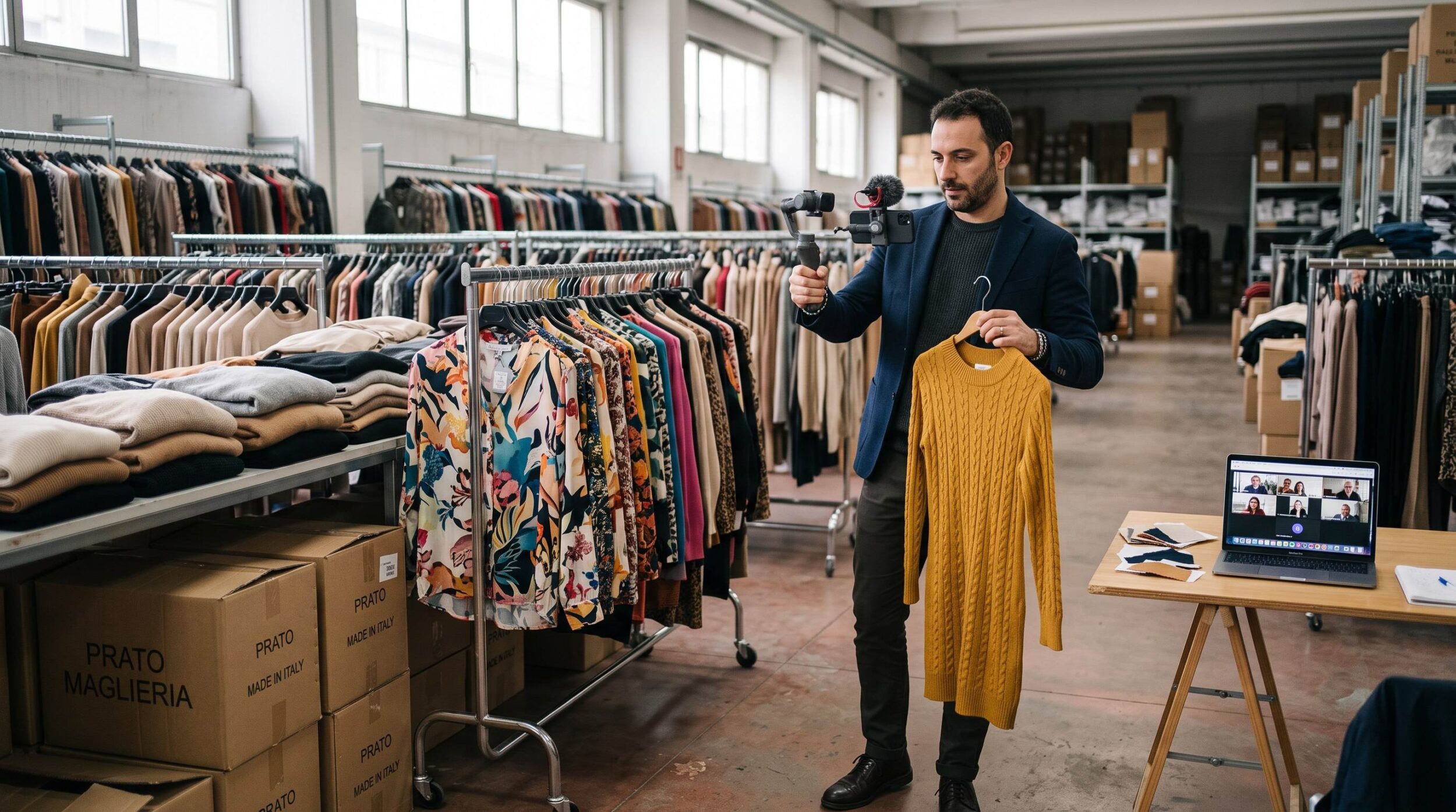
Texture is one of the categories where a live sourcing session provides the clearest advantage over catalogue-based ordering, since photographs consistently fail to convey how a bouclé surface or a corduroy wale actually feels and reads in person. Buyers moving through an AW26 sourcing session in Prato benefit specifically from being able to handle texture samples directly rather than guessing from a flat digital image.
This advantage compounds when comparing texture treatments across multiple suppliers in a single session, since subtle differences in wale depth, loop density or brushing quality become immediately obvious side by side in a way that sequential email exchanges with individual suppliers rarely capture as clearly.
Allocating budget toward texture within a full AW26/27 order
A workable approach for incorporating texture into a broader AW26/27 order is treating it as an accent strategy across multiple categories rather than a single standalone purchase, with a handful of corduroy pieces, a bouclé jacket or two, and a few brushed-finish knitwear styles distributed across the order rather than concentrated in one place. This spreads the slightly higher per-unit cost typical of texture pieces across the assortment while still giving the boutique enough tactile variety to differentiate the store experience.
Boutiques targeting a more fashion-forward customer can justify a heavier texture allocation, potentially building entire capsule displays around bouclé or corduroy, while more conservative retailers may prefer to use texture more sparingly as a complement to the season’s core cobalt, camel and charcoal colour story.
It is worth tracking sell-through on texture pieces separately from the rest of the AW26/27 assortment during the early weeks of the season, since these pieces often behave differently from flat-fabric equivalents in the same colour and silhouette, and that early data can usefully inform reorder decisions later in the winter.
Conclusion
For boutiques building out their AW26/27 italian fashion wholesale order this summer, texture deserves consideration as a distinct sourcing decision rather than an afterthought layered onto colour and silhouette choices already made. Corduroy, bouclé and brushed-finish pieces are giving Prato collections a tactile dimension that customers are responding to directly, and the suppliers producing the most consistent texture treatments are worth identifying early, before the strongest production runs are committed to faster-moving buyers.
Get Started
Texture is genuinely difficult to judge from photographs, which makes a live buying session especially useful when sourcing corduroy, bouclé and brushed-finish pieces for AW26/27. Start with a short interview at italianfashionsourcing.com/interview/ and we will pre-scout the Prato manufacturers producing the most consistent texture treatments still available this season.