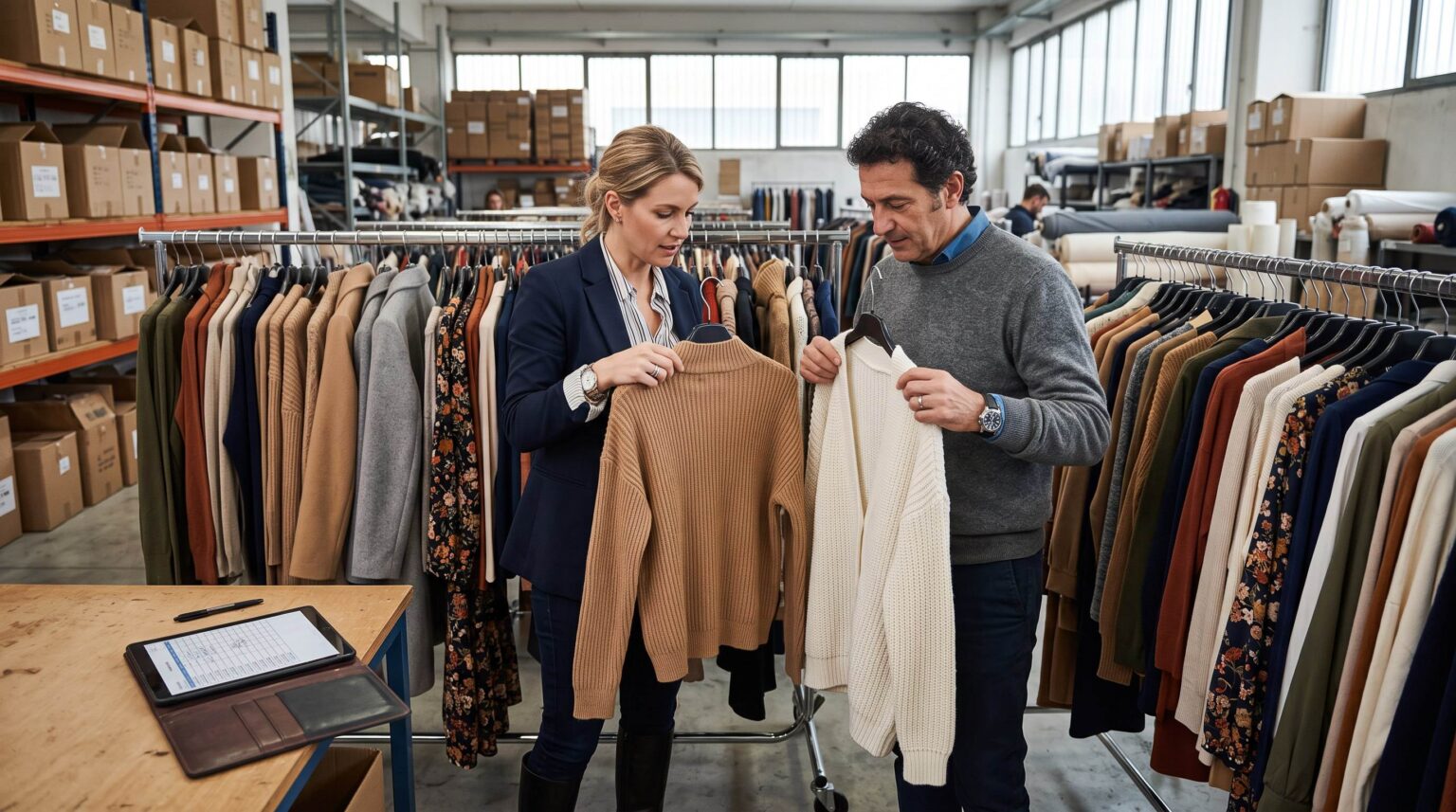
Two boutique buyers and an Italian sourcing agent leaving a café in Prato at the start of a sourcing trip to Italy

How It Works

The How It Works section is the operational core of the Italian Fashion Sourcing editorial programme. Every article in this section exists to answer a practical question that a buyer asks before, during or after a Prato sourcing session.

We cover the full sourcing cycle: how to prepare a buying brief, how minimum order requirements work in the Italian pronto moda market, what happens between session and shipment, how customs documentation and export logistics are handled, and what to expect when your goods arrive. We also explain the mechanics of private label production, timelines, minimums, sample approval, quality control, for buyers who want to move beyond ready-to-wear into original brand development.

The articles in this section are written for buyers who are new to Italian sourcing and need a reliable operational map, as well as for experienced buyers who want a clearer picture of how a specific part of the process works. We don’t write to impress, we write to be useful.

If you are planning your first session and want to understand the process end to end, this section is where to begin.

How It Works

Planning a Buying Trip to Prato From Abroad: Days, Suppliers and Ordering on the Spot

A sourcing trip to Italy gives a boutique owner something no catalogue can: the chance to touch fabrics, check finishing and choose from a supplier’s full range. Prato rewards preparation, though, and a buyer arriving from abroad needs to plan days, routes and suppliers before landing. This article explains how to organise a buying trip to Prato, from the first call to the last appointment, based on the visit of a multi-brand boutique from Kuwait City that spent two and a half days in the district and placed its autumn-winter order on the spot.

How It Works

Custom Hang Tags Ordered Together With Your Wholesale Order

Custom hang tags are easiest to produce when they are planned together with the wholesale order they will dress. This article explains how a boutique buying ready-to-wear in Italy can brief, approve and receive its own tags in step with the purchase, using the experience of a Kuwait City boutique that sourced its autumn-winter assortment in Prato. It covers artwork files, proofs, quantities for more than one season, who attaches the tags and why spare tags and labels are better kept out of the shipping cartons.

How It Works

Hang Tags for Clothing: What Goes on the Tag When the Label Is Too Small

Hang tags for clothing carry the information that a neck label is too small to hold, from the importer’s address to sizes, barcodes and origin. This article explains what a boutique selling Italian ready-to-wear under its own name should print on its tags, starting from a real case: a Kuwait City boutique whose address could not fit legibly on its neck label and moved to a tag instead. It also covers format, paper weight, attachment and the information that must stay on the garment’s own care label.

How It Works

Custom Woven Labels for Clothing: Size, Wording and the Proof You Approve Before Production

Custom woven labels for clothing look simple until the first proof arrives and the buyer has to decide on weave, size, fold, colours and every word on the tape. This guide explains the choices behind a good label for Italian ready-to-wear sold under a boutique’s own name, drawing on the label a Kuwait City boutique approved for its autumn-winter order from Prato. It covers the difference between woven, embroidered and printed labels, what a small format can carry legibly and how to check a proof against real garments.

How It Works

Custom Neck Labels on Wholesale Clothing: Putting Your Boutique’s Name on Italian Ready-to-Wear

Custom neck labels let a boutique sell Italian ready-to-wear under its own name without commissioning a full private label collection. This article follows a real autumn-winter order placed in Prato by a multi-brand boutique from Kuwait City, from the choice of wording to the moment the labels were sewn into the garments. It explains which suppliers accept relabeling, how size and legibility limit what fits on a neck label, how long production takes and why the label has to be planned before the buying trip ends.

How It Works

From Confirmed Order to Shop Floor: What Happens in the Three Weeks After You Buy

The weeks between a confirmed buying session and the arrival of the goods follow a fixed sequence, and most first-time buyers have no visibility over it. This article walks through the wholesale order process in Italy step by step: proforma, payment of goods and commission, collection from the suppliers, consolidation, piece count and sample quality control, packing and weighing, the separate freight payment, and the handover to the courier. It also sets out the delays that genuinely occur, from Italian holiday closures to stock sold in the meantime, so a boutique or an e-commerce buyer can plan the calendar realistically.

How It Works

Certificates of Origin and Consular Legalisation: Shipping to Markets With Heavy Customs

Some destination markets do not accept a standard commercial invoice and export declaration on their own. They require a non-preferential certificate of origin issued by the Chamber of Commerce, and in certain cases consular legalisation on top of it. Each step adds time and cost, and neither is included in the sourcing service. This article explains where the extra documentation fits, why every parcel sent by a different carrier needs its own customs file, and why the check belongs to the order phase rather than to the moment the goods are ready to ship.

How It Works

Peak Season on the Floor: Why Deciding During the Session Beats Deciding Later

In the Italian pronto moda districts stock rotates and is not reproduced indefinitely, so a garment seen during a session may no longer exist a few days later. September and October sharpen that effect, because the same warehouses serve many buyers inside the same weeks. This article explains how to structure a buying day that actually produces decisions, why a long list of maybes costs more than a mistake on a few units, how booked goods wait for payment rather than being reserved indefinitely, and what can realistically be added once suppliers have packed. It also states the reverse side plainly: deciding quickly is not buying everything, it is entering the warehouse with a criterion.

How It Works

Paying for an Italian Order: Prepayment, Card Limits, Currency and Bank Costs

Payment is the part of an Italian order buyers ask about first and plan for last. This article sets out the six accepted methods, the full prepayment rule and its 24 to 48 hour window, the deposit and balance structure used for private label production, and the second payment that covers shipping once the cartons have been packed and weighed. It also explains why booked pronto moda stock is not reserved stock, how euro invoicing shifts currency and bank costs onto the buyer, and how proforma, final invoice and VAT are handled.

How It Works

What Quality Control Actually Covers on an Italian Wholesale Order

Quality control on an Italian wholesale order is decided before buying, not after the cartons open. This article sets out what the standard inspection covers on every order, how the method combines a detailed check on part of the volume with a visual check on the rest, and when dimensional control applies. It states the defect tolerance openly at the low-cost end of pronto moda and explains how a problem is handled before shipment and after delivery.

Italian fashion supply, curated and delivered to your inbox.

Join the Insider List

Be the first to access ready-to-wear drops, supplier insights and private label tips. No noise—only what helps your business buy smarter.
Need help?
Chat with us