Custom Neck Labels on Wholesale Clothing: Putting Your Boutique’s Name on Italian Ready-to-Wear
12 October 2026
Trend Report
Linen was the fabric of summer 2026, and the signals for the following year point the same way. When Italian mills presented their spring-summer 2027 fabrics at Milano Unica in January 2026, linen was the material that dominated the fair, from lightweight blends for tailoring to washed canvases and open weaves for casual pieces. For boutique buyers, linen fashion trends 2026 are therefore not a passing story but the base of the next two seasons, and the useful question is no longer whether to carry linen but which shapes, colours and compositions deserve space on the rail and in the budget.
This report is written from the point of view of a buyer working with Italian wholesalers. It covers the linen styles that sold through in 2026, the textures and colours that are evolving for 2027, the move of linen into tailoring and the growing importance of blends. The last part explains how to translate these directions into an assortment, with links to our more detailed articles on single categories, and the report is updated every season as new collections reach the Prato showrooms.
Linen is firmly in style, and with more depth than in previous cycles. It is no longer limited to the beach shirt and the vacation dress. In 2026 it moved across resortwear, workwear and evening, at every price level from entry-level pronto moda to premium collections. Hotter summers in most markets explain part of this, but the bigger driver is a way of dressing that is relaxed and still polished, which linen delivers better than any other summer fabric, and customers who want natural fibres with a credible origin. Neither driver is likely to fade in 2027.
Search data tells the same story from the customer side. Questions such as whether linen pants or linen suits are still in style keep growing every spring, and they are asked by people who already own linen and want to know how to wear it now. For a retailer, this means the category has moved from novelty to wardrobe staple. Staples need replenishment, a clear price architecture and a few fresh details each season, rather than a complete reinvention, and that is the logic that should guide linen buying for both 2026 and 2027.
Coordinated sets were the strongest linen category of 2026. A shirt with matching trousers or shorts, a waistcoat with a wide-leg pant, a cropped jacket with a midi skirt: the set sells as an outfit and as separates, which gives the boutique two chances to make the sale. Our guide to Italian linen co-ords explains why they perform so well, and the format is now present in almost every Prato showroom from April to July. Linen dresses came close behind, especially midi shirt dresses and easy wrap shapes, which we look at in our piece on the versatility of the linen dress.
Linen trousers deserve a separate mention because they were the most searched linen item of the year. Wide-leg and palazzo shapes with an elastic or drawstring waist sold to the broadest age range, while straight and pleated trousers moved better in city stores. Linen suits had a strong season too, both as full sets in sand, olive and cream and as separate blazers worn over denim, a category we cover in our article on linen blazers and smart casual sets. Printed linen remained smaller in volume but useful to lift the rail, as our analysis of printed linen in Italian collections shows.
Linen pants are firmly in style for 2026 and for the seasons after it, and the shape is what has changed. The slim, cropped linen trouser of a few years ago has given way to wide legs, soft pleats and higher waists, cut long enough to touch the shoe. These shapes look deliberate rather than casual, so customers wear them to work and to dinner as well as on holiday. For the buyer this means wide-leg linen trousers in two or three neutral colours can be treated as a core replenishment item through the whole summer, with fewer markdowns than most seasonal categories.
Linen suits follow the same logic. A matching blazer and trouser in sand, olive or cream reads as smart without the weight of a wool suit, and the customer can split the pieces and wear the jacket over jeans or a dress. The suit also solves a problem many boutiques face in summer, when office customers look for something more structured than a dress but cooler than synthetic tailoring. Unlined or half-lined jackets work best for hot climates, and they should be checked carefully for internal finishing, since a jacket without lining shows every seam as soon as it is opened.
Wrinkles remain the objection customers raise most often, and they are best handled on the shop floor rather than avoided in the buying. Creasing is part of the look of pure linen, and staff who explain that it softens with every wash and is meant to be visible usually turn the objection into a reason to buy. For customers who want a cleaner finish, a linen and viscose or linen and cotton version of the same shape is the right answer, and keeping both options on the rail lets the boutique serve both types of customer with the same style.
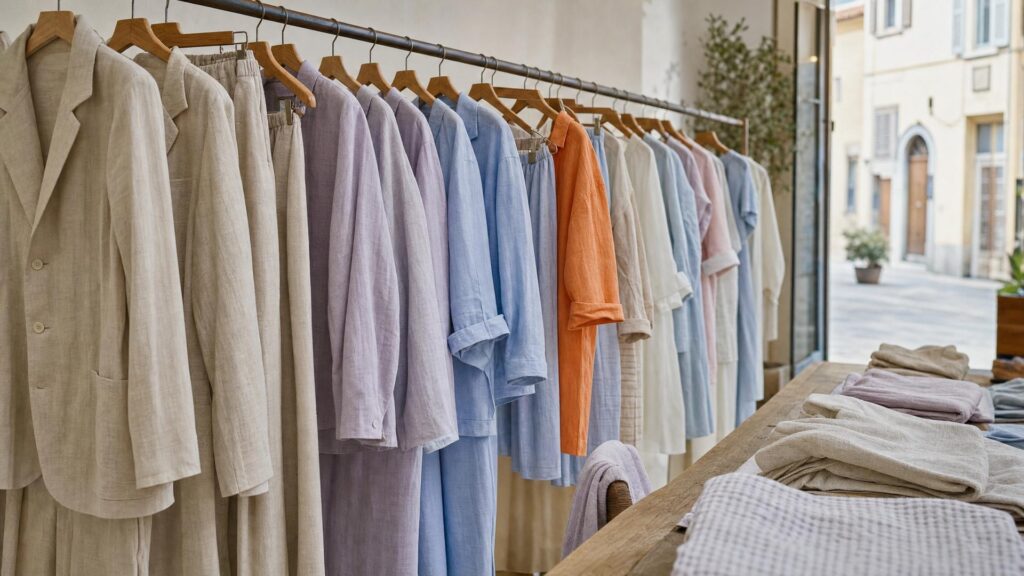
Natural tones remain the core of every linen assortment. White, ecru, sand, stone and taupe sold steadily in 2026 and will continue to, because they are what customers expect from linen and they are easy to combine. The change for 2027 lies in the accent colours. The mills that presented the new season at Milano Unica showed linen in softened, faded pastels such as lavender, pale blue and powder tones, alongside browns and creams, with stronger accents of red, bright blue and orange used in small doses. For a boutique this suggests keeping the neutral base and refreshing the accent colours rather than chasing a single trend shade.
Texture is where linen will look most different. The 2027 fabric collections put weight on washed linen canvases that stay structured but feel softer, open weaves, slub effects, seersucker and honeycomb constructions, and linen twills for lighter jackets. These surfaces photograph well and justify a higher retail price because the customer can see and feel the difference on the hanger. Pronto moda wholesalers usually translate mill trends into garments within a season, so buyers should expect these textures to appear in Prato showrooms during the 2027 spring buying window and to become widespread by the following year.
One of the clearest signals for 2027 is linen moving into tailoring on its own terms. Mills are producing firmer yarn-dyed linens and linen twills designed for jackets and trousers that hold their shape, and blends of linen with wool, silk or cotton for summer suits. For boutiques this opens a category that used to belong to menswear and formal brands: the unlined linen blazer, the pleated linen trouser, the waistcoat worn as a top. These pieces sell at higher price points than casual linen and appeal to customers who need office clothing for a hot summer.
Blends are the other half of the story. Linen mixed with viscose drapes more softly and creases less, linen with cotton feels crisper and more stable, and a small share of elastane makes trousers and fitted dresses more comfortable. Customers who love the look of linen but dislike its wrinkles are often won over by a good blend, and our comparison of breathable summer fabrics explains how linen, cotton and viscose behave in hot weather. Reading the composition label correctly is part of buying well, because a blend priced like pure linen is a poor deal for the retailer.
Trends become profitable only when they are translated into a balanced rail. A practical structure for a womenswear boutique gives around half of the linen budget to proven staples such as sets, trousers and shirt dresses in neutral colours, a third to pieces carrying the current season’s details in colour or texture, and the remainder to a few statement items that draw attention in the window. Our article on the linen womenswear pieces a boutique needs goes into the category mix in more detail, and the same approach can be adapted to any price level.
Price architecture matters as much as style. Linen sells across very different budgets, and our analysis of how Italian linen performs across boutique price points shows how to position entry, core and premium pieces on the same rail. Versatility is the other lever, since customers buy more readily when a piece works from day to evening, a topic covered in our guide to versatile linen styles across occasions. Boho shapes, with relaxed fits and earthy prints, remain a strong niche for resort and lifestyle stores, as our look at the boho-linen crossover explains.
Following linen trends is easier in Prato than almost anywhere else, because pronto moda wholesalers react to demand within weeks and put new versions of successful styles in the showroom while the season is still running. The best moment to buy the core of a linen collection is between March and May, with a second, smaller buy in late June or early July. Everything about minimums, payment, quality checks and shipping is covered in our complete guide to Italian linen wholesale, which is the companion to this trend report on the buying side.
Boutiques in Australia, New Zealand and South Africa read these trends with a six-month delay, since their linen season starts in November. That can be an advantage: by the time they place their spring order in Prato, the styles that sold best in Europe are already visible. Our guide to buying Italian linen for the southern summer explains how to plan that calendar. For buyers who cannot travel, our buying process is built around live video sessions in the showrooms, where trends can be checked on the real garment instead of a photograph.
Linen fashion has become a long-term category rather than a seasonal story, and the evidence from both the shop floor and the textile fairs supports that view. The linen fashion trends 2026 that sold best, from co-ord sets to wide-leg trousers and relaxed tailoring, will remain the backbone of summer assortments in 2027, refreshed by softer pastels, more visible textures and a stronger presence in structured pieces. Boutiques that keep a solid neutral base and update details each season will get the most out of the fabric without the risk of chasing every short-lived trend.
Italian fashion supply, curated and delivered to your inbox.
How can we assist?
See our services