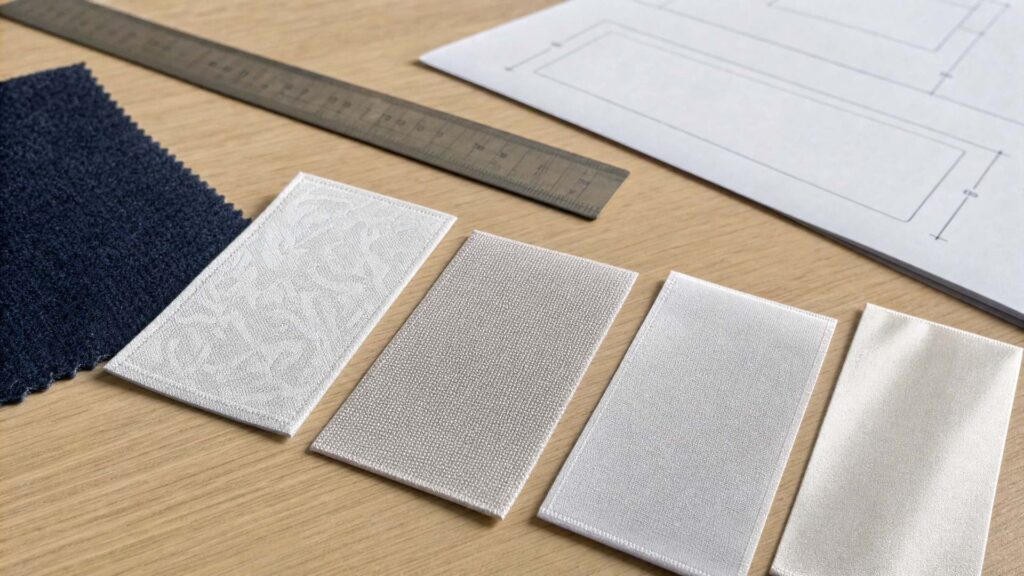
Custom Woven Labels for Clothing: Size, Wording and the Proof You Approve Before Production
14 October 2026

Sourcing Strategy
The commercial argument for sourcing clothes made in Italy is ultimately a margin argument, and it operates differently from how most buyers initially frame it. The standard framing, Italian quality justifies a higher price, is correct but incomplete. The more precise version is this: clothes made in Italy allow a boutique to set a retail price that is structurally above the level they could achieve with equivalent garments from commodity sourcing markets, and the gap between that higher retail price and the higher wholesale cost is, in most market contexts, wider than the equivalent gap for non-Italian sourced product. That is the margin case, stated plainly.
The retail price ceiling for a garment, the maximum price a boutique customer will accept before they decide the item is overpriced, is determined by multiple factors, but origin is one of the most reliably tested. In markets where independent boutiques compete for a customer who could also shop at premium department stores, online multi-brand platforms or international fast-fashion retailers, the Made in Italy label is a credible signal of value that allows the boutique to price above what an unbranded or non-origin-labelled equivalent would support.
The premium that Made in Italy supports in retail pricing varies by product category and market. For womenswear separates, dresses, tops, trousers, the premium over a comparable non-Italian garment in a mid-market independent boutique context is typically 25 to 40 percent. A linen dress that would retail at EUR 75 without origin labelling retails at EUR 95 to EUR 105 with a credible Made in Italy claim. For occasionwear, the premium is higher, often 35 to 50 percent, because the customer’s decision-making process for event clothing involves more research and more deliberate comparison. For knitwear in autumn-winter collections, Italian-origin product commands some of the strongest premiums of any category in the boutique market.
The core of the commercial argument for clothes made in Italy is that the wholesale cost premium over commodity sourcing, typically 20 to 50 percent higher per unit, is more than offset by the retail price premium the boutique can extract. The net result is a higher absolute margin in euros per unit sold, even before accounting for sell-through differences. A worked example makes this concrete: a jersey dress sourced from a Turkish wholesale market might wholesale at EUR 14 and retail at EUR 55, producing a gross margin of EUR 41. The Italian equivalent wholesales at EUR 22 and retails at EUR 85, producing a gross margin of EUR 63. The Italian garment costs more to buy, but it generates EUR 22 more gross margin per unit sold at full price.
The landed cost calculation refines this further. Adding the proportional logistics, duty and service fee costs to both examples narrows the gap somewhat, but does not close it. For most categories of womenswear, the Italian-origin retail premium outpaces the landed cost premium by a margin of 1.2x to 1.6x, meaning that for every additional euro spent on sourcing Italian rather than non-Italian, the boutique recovers between EUR 1.20 and EUR 1.60 in additional gross margin. This is the mechanic that makes clothes made in Italy commercially compelling for a boutique that is positioned above the mass-market price point.
Retail margin per unit sold is only part of the equation. The other critical variable is what percentage of the order sells at full price, because every unit that requires markdown to sell reduces the average realised margin across the order. Clothes made in Italy consistently achieve higher full-price sell-through in independent boutiques than equivalent garments sourced from commodity markets, for a reason that is structural rather than aesthetic: the customer who shops at a well-positioned independent boutique is specifically there because she values origin, quality and distinctiveness. Made in Italy product speaks directly to that value set.
The practical consequence is that an Italian-sourced order with a full-price sell-through of 80 percent produces a better season-end return than a commodity-sourced order with a full-price sell-through of 60 percent, even if the per-unit margin at full price is identical. When the per-unit margin advantage of Italian sourcing is combined with the sell-through advantage, the season-end return differential becomes very significant. Boutiques that have made the full transition to Italian-sourced womenswear consistently report that their end-of-season markdown burden is materially lower than it was when they were sourcing from multiple commodity markets.
The margin case for clothes made in Italy is not equally strong in every market context. It is strongest in markets where the boutique customer has a high level of fashion awareness and a strong price reference for Italian goods, Northern Europe (particularly Scandinavia, the Netherlands and Germany), the Gulf states, Australia and the high-end segments of the North American market. In these markets, the Made in Italy label is a meaningful purchase driver, and boutique customers are willing to pay the premium it commands without extensive justification from the sales floor.
The case is weaker, though not absent, in markets where Italian origin is less actively signalled at the boutique level, or where the boutique’s customer base is primarily price-sensitive rather than quality-sensitive. In these contexts, the wholesale cost premium of Italian sourcing is harder to recover fully at retail, and the margin advantage narrows. Buyers evaluating whether the Italian market is the right sourcing channel for their specific boutique context will find useful comparative framing in the IFS analysis of the Italy versus China fashion supply chain, which puts the cost and quality differentials in a structured comparative context.
The retail margin premium that clothes made in Italy support depends partly on the boutique’s ability to communicate the origin effectively to its customers. A Made in Italy garment displayed on a rail with no supporting context, no label visible, no origin mention in product descriptions, no staff trained to reference it, will not achieve the full price premium the origin could support. The translation of wholesale origin into retail value is a commercial skill, and boutiques that do it well, through clear labelling, staff training, product descriptions, and social content that references the Prato or Italian sourcing story, consistently outperform those that source Italian but do not leverage the story at the point of sale.
The sourcing story itself has become more commercially powerful in recent years, as customers have become more interested in the provenance of the clothes they buy. A boutique that can tell customers that its womenswear comes directly from the Prato wholesale district in Italy, that the pieces were selected by a buyer who visited the showrooms, that they carry a genuine Made in Italy origin, is offering a differentiated retail experience that platforms and mass-market retailers cannot replicate. This is the commercial context explored in more depth in the IFS article on why Made in Italy matters from a global boutique perspective. Boutiques that are ready to build that story into their buying can begin with the Italian Fashion Sourcing purchasing service, whether through their standard italian fashion sourcing process or through private label production italy for boutiques seeking custom designs. Many buyers are also exploring italian fashion wholesale online platforms that provide direct access to Italian manufacturers.
Italian fashion supply, curated and delivered to your inbox.
How can we assist?
See our services