Why Luxury Yarn Knitwear Wholesale Deserves a Line in Every Winter Budget
Luxury knitwear wholesale is the category where Italian sourcing shows its clearest advantage over any other supply channel. Kid mohair sweaters, baby alpaca cardigans and cashmere blend knits sit at the exact intersection international boutiques struggle to fill: garments that feel unmistakably premium on the hand, photograph beautifully for social channels, and still arrive at a wholesale price that supports a 2.5x retail markup. In the Prato district, where knitwear manufacturing has been a specialisation for generations, these pieces are produced as finished ready-to-wear garments in pronto moda cycles, meaning collections refresh every three to four weeks throughout the autumn and winter season.
The commercial logic is straightforward. A boutique customer who hesitates over a €180 pure cashmere crewneck will often commit without hesitation to a €95 kid mohair blend sweater that delivers a comparable sensory experience. That price point is only achievable when the wholesale cost sits in the €20 to €45 band, which is precisely where Prato knitwear in noble fibre blends operates. Boutiques buying through marketplaces or northern European agencies typically pay 30 to 60 percent more for equivalent compositions, because each intermediary layer adds margin to a garment that left the same Italian workshop.
This guide covers the three noble fibres that define the premium end of Italian pronto moda knitwear, what each one costs in the showroom, how to read composition labels before committing, and how ordering, private label production and worldwide shipping actually work when you buy these garments through the Prato district. Everything described here refers to finished garments ready for the shop floor, sourced directly from the wholesale showrooms where Italian and international retailers place their seasonal orders.
Kid Mohair Knitwear: Halo, Loft and the Silhouettes That Sell
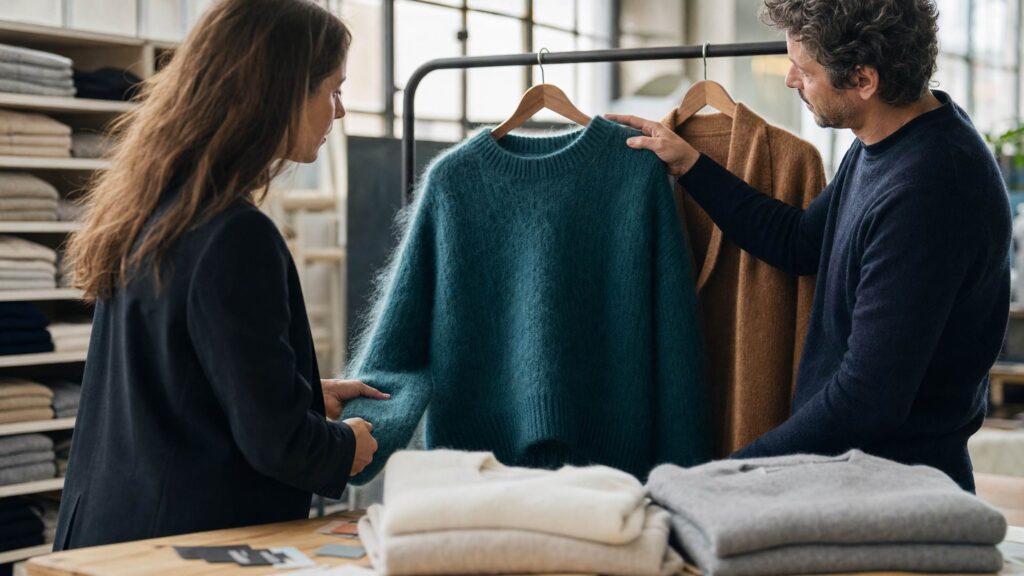
Kid mohair comes from the first shearing of the Angora goat, and the fibre’s defining property is its halo: the soft, luminous cloud of surface fibres that catches light and gives a sweater visible depth. In Prato showrooms, kid mohair almost always appears in blends, typically 25 to 40 percent kid mohair with polyamide and wool making up the balance. This is not a compromise. The polyamide core gives the garment structural memory, so an oversized kid mohair sweater holds its silhouette through a full retail season instead of stretching at the cuffs after three wears.
The silhouettes performing strongest in wholesale showrooms are the oversized crewneck in saturated jewel tones, the cropped cardigan with statement buttons, and the V-neck vest layered over shirting. All three formats share a quality that matters enormously at retail: they look expensive on a hanger. The halo effect reads instantly as premium, even to a customer who has never heard the word mohair. Buyers assembling a winter wall should treat kid mohair as their colour vehicle, because the fibre takes dye with an intensity that flat merino or acrylic knits cannot match, a point explored in more depth in our analysis of winter texture trends in Italian pronto moda.
One operational note on handling: kid mohair sheds slightly during its first weeks on the shop floor, which is normal fibre behaviour rather than a defect. Suppliers in Prato steam-finish these garments before packing, and boutiques should advise customers to store them folded. In the showroom, a simple quality check is to run a flat palm against the knit direction; a well-made kid mohair blend releases almost no loose fibre, while a poorly spun one leaves visible residue on dark clothing immediately.
Baby Alpaca Knitwear: Warmth Without Weight for Transitional Retail
Baby alpaca refers to the fineness grade of the fibre, not the age of the animal: it measures around 22 microns, placing it between merino and cashmere on the softness scale. Its commercial superpower is thermal efficiency. Alpaca fibre is hollow-core, so a lightweight baby alpaca blend cardigan delivers the warmth of a much heavier wool garment. For boutiques in markets with long transitional seasons, from Scandinavian autumns to North American springs, this translates into a longer selling window than any other knitwear fibre offers.
In the Prato wholesale district, baby alpaca appears most often in blends of 30 to 50 percent alpaca with wool and polyamide, worked into long cardigans, coatigans, ribbed turtlenecks and knit dresses. The coatigan deserves particular attention from international buyers: it functions as light outerwear, retails between €120 and €160, and occupies the gap between a sweater and a coat that most boutique assortments leave empty. Prato manufacturers produce these in undyed natural tones, from ivory through camel to deep taupe, which aligns with the quiet luxury palette dominating the current autumn and winter direction.
Handle is the giveaway in the showroom. Baby alpaca has a distinctive dry, silky slip that is different from the springy grip of lambswool, and once a buyer has felt genuine baby alpaca a few times, misdeclared compositions become easy to spot. During a sourcing session it is worth comparing the same silhouette across two or three suppliers, because alpaca percentage varies significantly between workshops at similar price points, and a ten percent difference in fibre content is often invisible on the label price but obvious on the hand.
Cashmere Blend Knitwear: Reading the Label Before You Buy
Misto cashmere, the cashmere blend, is the largest of the three categories by volume in Prato and also the one requiring the most buyer literacy. A typical Prato cashmere blend contains 5 to 20 percent cashmere combined with viscose, wool and polyamide. At 5 percent, cashmere functions as a marketing term more than a sensory one. At 15 to 20 percent, the difference is genuinely perceptible: the knit gains the dense, buttery softness customers associate with pure cashmere at roughly one quarter of the wholesale price. Knowing where a garment sits on that spectrum before ordering is the single most valuable skill a knitwear buyer can develop.
The composition label is legally required on garments sold in the European Union, and reputable Prato wholesalers display fibre percentages openly on swing tags. During a buying session, our team checks three things on every cashmere blend before recommending it: the declared percentage against the hand feel, the tightness of the knit gauge at the elbows and underarms where pilling starts, and the finishing of seams inside the garment. A blend with honest composition, a fine gauge and clean linking will outperform a higher-percentage garment with loose construction every time it goes through a customer’s washing machine.
Where cashmere blends earn their place in a boutique order is the basics wall. Crewnecks, fitted turtlenecks and simple V-necks in misto cashmere wholesale between €15 and €30 in Prato, retail between €49 and €89, and reorder reliably across the whole season because they anchor outfits rather than lead them. A boutique that builds its knitwear foundation on cashmere blend basics and layers kid mohair and baby alpaca statement pieces above them achieves both margin stability and visual excitement, which is the balance the strongest performing Italian knitwear wholesale programmes for sweaters and cardigans consistently show.
What Luxury Knitwear Wholesale Actually Costs in Prato Showrooms
Price transparency is where the Prato district separates itself from every intermediated channel. Finished knitwear in noble fibre blends occupies a wholesale band running from roughly €15 for a fine-gauge cashmere blend basic to €45 for a heavy baby alpaca coatigan or a high-percentage kid mohair statement piece. The majority of pieces a boutique will order sit between €20 and €35. These are showroom prices for finished, labelled, ready-to-hang garments; there is no fabric to buy, no manufacturing to arrange and no assembly of components, because pronto moda means the garment is complete and in stock when you see it.
Composition drives price more than silhouette does. Moving a crewneck from 5 percent to 15 percent cashmere adds roughly €5 to €8 at wholesale. Raising kid mohair content from 25 to 40 percent adds a similar increment. Buyers working to a fixed budget should decide early whether their market rewards visible fibre quality, which argues for fewer, richer pieces, or breadth of choice, which argues for more units at entry compositions. Neither strategy is wrong, but mixing them without intention produces a knitwear wall with no readable price logic for the end customer.
It also helps to understand what these prices include. Prato wholesale pricing covers the garment, its composition and care labelling, and standard polybag packing. Supplier minimums in the district are modest, normally a few pieces per style, which allows a boutique to test eight or ten knitwear styles in a single order rather than committing deeply to two. Through Italian Fashion Sourcing there is no minimum order value on the sourcing side; the service fee is 10 percent of the total wholesale purchase value, with a €250 minimum commission per engagement, so the economics stay proportionate whether an order is exploratory or substantial.
| Fibre | Typical blend in Prato | Wholesale band | Best-selling formats |
|---|---|---|---|
| Kid mohair | 25–40% mohair + polyamide/wool | €20–45 | Oversized crewnecks, cropped cardigans, vests |
| Baby alpaca | 30–50% alpaca + wool/polyamide | €22–45 | Coatigans, long cardigans, knit dresses, turtlenecks |
| Cashmere blend | 5–20% cashmere + viscose/wool/polyamide | €15–30 | Crewnecks, fitted turtlenecks, V-neck basics |
How a Wholesale Knitwear Buying Session in Prato Works
Access is the practical obstacle this district presents. Prato showrooms are business-to-business environments that operate in Italian, rarely publish catalogues, and restock on cycles a visitor cannot track from abroad. The buying model that solves this is the guided session. After an initial interview covering your market, budget and style direction, our team pre-scouts the knitwear suppliers whose current stock matches your profile, then walks you through their showrooms in a live video session where you see each garment on camera, ask questions in real time and build your order across multiple suppliers in a single day.
For knitwear specifically, the live format has a concrete advantage over photo-based ordering: drape and halo do not photograph accurately. A kid mohair sweater’s surface depth, the way a baby alpaca coatigan falls from the shoulder, the recovery of a ribbed cuff stretched and released, all of these are visible on video and invisible in a flat lay. Buyers who have ordered knitwear from lookbook photographs and received garments that felt thinner than expected will recognise exactly the problem the live session eliminates. The full mechanics of the service, from interview to consolidated delivery, are described on our fashion sourcing and purchasing service page.
Orders placed across several showrooms during a session are consolidated into a single invoice and a single shipment. This matters more for knitwear than for most categories, because noble fibre garments are precisely the pieces a boutique wants to spread across four or five specialist suppliers, one strong in mohair, another in alpaca, a third in fine-gauge blends, without inheriting four or five separate freight charges and customs entries.
Private Label Knitwear Production in Kid Mohair, Alpaca and Cashmere Blends
Boutiques that establish consistent sell-through in luxury yarns often take the next step: producing knitwear under their own label. Prato’s knitwear workshops handle private label production from two starting points. You can bring an existing pronto moda model and have it reproduced with your labelling, adjusted colours and modified details, or you can develop a design from sketches and reference garments, in which case the workshop produces a prototype for written approval before any bulk production begins.
The operating parameters for private label through Italian Fashion Sourcing are a minimum purchase value of €3,000 and a minimum of 100 pieces per style, with sizes and colours distributed within that quantity. For knitwear, development conversations centre on yarn selection, and this is where the district’s depth pays off: the same workshops producing pronto moda collections hold established relationships with Italian spinners, so specifying a 30 percent kid mohair yarn or a 15 percent cashmere blend for your own line draws on the identical supply chain behind the showroom garments you have already tested at retail. Custom woven labels, swing tags and individual polybag packing are part of the standard scope.
Timing deserves honest treatment. Knitwear production runs slower than cut-and-sew because knitting, linking and finishing are sequential processes; a realistic window from approved prototype to shipped goods is six to ten weeks depending on complexity and season. Boutiques planning a private label knitwear capsule for the autumn window should therefore open the conversation in late spring, using their previous winter’s sell-through data to decide which silhouettes and compositions justify the hundred-piece commitment per style.
Shipping Luxury Knitwear Worldwide: Volumetric Weight, Customs and Landed Cost
Knitwear has a shipping personality of its own: it is light but bulky, and international courier freight is calculated on volumetric weight, the space a shipment occupies, rather than what it weighs on a scale. A carton of lofty kid mohair sweaters can carry a volumetric weight two or three times its actual weight. Prato suppliers and our logistics team mitigate this with compression-aware packing, folding knits flat with minimal void space, but buyers should still budget freight on volume. As reference bands, shipping from Italy runs around €2 to €3 per volumetric kilogram within Europe, approximately €8.50 to North America, and roughly €9 to South America, Africa and Australia.
Customs treatment for knitwear is generally straightforward because finished garments travel under well-established tariff classifications, and every shipment leaves Italy with complete export documentation: commercial invoice with composition details, packing list and certificate of origin where required. Import duty rates depend on your country’s current tariff schedule and can change at any time, so they should always be verified against your local customs authority before finalising a landed cost calculation. What consolidation guarantees is a single customs entry per order rather than one per supplier, which reduces both brokerage fees and the administrative surface for error.
For planning purposes, a boutique should think in landed cost per garment: wholesale price, plus the 10 percent sourcing fee, plus freight allocated across units, plus applicable duty and import tax. On a typical mixed knitwear order, freight and duty together commonly add between 12 and 20 percent to the wholesale value for non-European destinations. Running this arithmetic before the buying session, rather than after, is what allows a buyer to set retail prices during the session itself and order with margin certainty instead of estimating.
Timing the Luxury Knitwear Buy Across the Autumn and Winter Season
The pronto moda calendar rewards buyers who order in waves rather than in one annual commitment. Prato knitwear collections begin showing in early summer, deepen through August and September, and continue refreshing every three to four weeks into January. The strongest strategy for luxury knitwear wholesale follows the season’s own rhythm: a foundation order in late summer establishing the cashmere blend basics wall, a statement wave in early autumn when kid mohair and baby alpaca collections are at full depth, and reactive top-ups through the season replacing exactly what sells.
This cadence is only possible because the goods are finished and in stock. There is no production lead time between seeing a garment and receiving it; orders placed in a live session typically consolidate and ship within days. For a boutique, that changes the risk profile of the entire knitwear category. Instead of forecasting an entire winter in July and living with the guess, you commit roughly half your knitwear budget upfront and hold the remainder for evidence-based reorders, which is the single most effective protection against the end-of-season markdowns that erode knitwear margin everywhere.
Kid mohair, baby alpaca and cashmere blend knitwear reward that discipline more than any other category, because their sell-through concentrates in the cold weeks when customers buy emotionally and full-price. A boutique that enters November with fresh statement knits arriving every few weeks, priced on honest landed cost arithmetic and backed by compositions it verified in the showroom, is operating the Prato model exactly as it is designed to work. The district produces the garments; the buying method is what converts them into margin.