
Custom Woven Labels for Clothing: Size, Wording and the Proof You Approve Before Production
14 October 2026
Sourcing Strategy
No supply chain runs clean forever. Buy from Italy long enough and the file accumulates by itself: a colour lot that does not match the sample, a size curve short by six pieces, a delivery that slips past the promised week, an invoice describing goods that are not quite the goods. Supplier issues are not a sign of bad suppliers; they are the normal residue of high-speed wholesale. The variable that separates distributors is not whether problems occur but who manages them, from where, and with what leverage.
For the remote importer that question usually has an uncomfortable answer: nobody, effectively. The pillar guide sets out the complete case for a managed sourcing relationship over one wholesaler; this article narrows to the moment things go wrong, because it is exactly there that distance, language and standing decide outcomes, and where the difference between models turns into money.
The taxonomy of supplier issues is short and repetitive. Product problems: visible defects, wrong colour lots, compositions that do not match declarations. Order problems: miscounts, substituted styles, incomplete size curves, missing articles. Time problems: collections delivered late, restocks that slide from one week to the next. Document problems: invoices, values or descriptions inconsistent with the goods, exactly the inconsistencies that stall customs files. Every distributor importing at volume will meet all four families in an ordinary year.
Frequency follows pressure. Issues cluster in peak district weeks and around end-of-collection clearances, when warehouses ship fastest and check least, which means they concentrate in the orders that matter most to a season. A pronto moda market rotating every three to four weeks leaves little slack for repair: a delayed or defective delivery does not just arrive imperfect, it can arrive commercially late, into a trend already cooling.
Severity is unevenly distributed across the four families, and so is detectability. Product and order problems announce themselves the moment a carton opens; time problems are visible by definition; documentary problems hide until an authority reads the file, which makes them the most dangerous per incident despite being the cheapest to prevent. A management approach has to cover all four, because the families interact: a late delivery rushed out often carries the miscount that a calmer week would have avoided.
The remote importer facing an issue starts three moves behind. He discovers the problem weeks after it was created, when cartons open in his own warehouse; the supplier has long since moved on to other orders. He pursues it by email, in English, across time zones, with photographs standing in for the garment. And he pursues it as an occasional customer whose next order is hypothetical, against every demand on the supplier’s day that comes from someone standing in the doorway.
Under those conditions, most small and medium losses fail a simple test: chasing them costs more than they are worth. The hours, the friction and the uncertain outcome push distributors toward quiet absorption, a credit hoped for on the next order, a claim abandoned, a defect discounted onward to a retail client. Individually each write-off is rational. Summed across a year of volume, they amount to an unbudgeted tolerance that no distributor ever agreed to pay.
Internal time is the other half of the absorbed cost. Every dispute pursued from abroad occupies someone in the distributor’s office for hours across weeks, drafting, translating, photographing, following up, and that someone always has a primary job being neglected meanwhile. Businesses rarely account for this labour, but managers recognise it instantly when asked which colleague handles the Italy problems. Removing the function does not just recover losses; it returns a person to the work they were hired for.
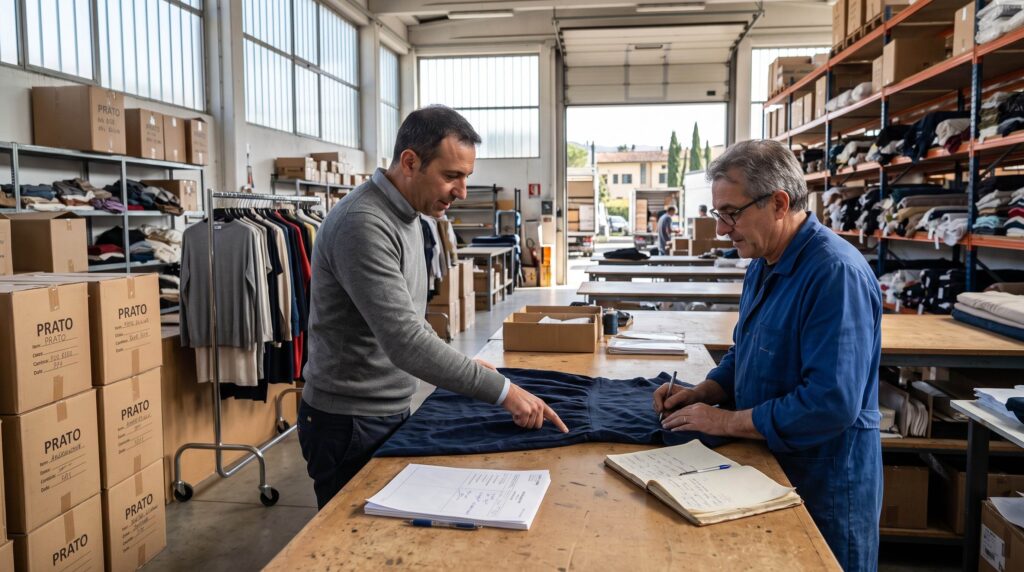
The same problems behave differently when they meet a referent inside the district. Most get intercepted before departure, at consolidation, where goods from every supplier are verified against confirmations: quantities, styles, colours, sizes and condition checked while the supplier still holds stock and the correction is a short drive. An issue caught at this stage costs a conversation. The distributor typically learns of it only as a line in an update, already resolved.
Issues that surface later still land differently. A defect or discrepancy raised in person, in Italian, by someone the supplier sees weekly and supplies continuously carries the weight of a relationship worth defending, and it gets treated accordingly: replacements pulled, credits agreed, priorities adjusted. The identical complaint arriving from abroad competes for attention with no such weight behind it. Same garment, same fault, structurally different outcome.
Resolution follows a practical ladder rather than a legal one. First choice is replacement before shipment, drawing on the supplier’s remaining stock while the consolidation window is open; failing that, a credit agreed on the spot and documented; beyond that, adjusted priority on the next order, restocks reserved or terms softened as compensation. Wholesale disputes in the district are settled through continued business far more often than through formal claims, and the referent’s job is to convert each incident into the best available version of continuing.
Issue management shades naturally into negotiation, because both run on the same standing. Conditions, quantities, delivery priorities, reserved restocks and the shape of recurring orders are all conversations that reward presence and repeat business, and the practical ground rules are set out in negotiating with Italian fashion suppliers on quantities and conditions. A referent negotiating across the district weekly knows what each showroom will actually concede, and spends that knowledge on the distributor’s behalf.
The gains are concrete rather than theatrical. District minimums, normally €300 to €500 per warehouse and 2 to 12 pieces per style, leave room for arrangement on curves and assortments; strong articles can be reserved ahead of restocks; recurring programmes can be shaped so the distributor’s orders get picked first in busy weeks. None of this appears on a price list, and none of it is reliably available to a buyer the supplier meets once a year.
A parallel class of issues never touches a garment. Export paperwork, invoices, values, compositions and shipping data must agree with each other and with the cartons, and disagreements surface at the worst possible checkpoint: customs. A managed flow closes this gap by preparing documentation centrally at consolidation, checking data at source, and presenting one coherent file per shipment, with freight itself calculated transparently on volumetric weight using the standard divisor of 5,000.
Duty questions belong to the same discipline, with one caution that experience keeps confirming: import duty rates change and must be verified as current at the time of each shipment rather than assumed from the last one. What a managed process guarantees is not a fixed tariff but a clean file, and clean files clear borders while inconsistent ones sit. For a distributor working against seasonal windows, that difference is measured in selling days.
Summed up, issue management is where a sourcing model shows its real cost structure. The service fee, 10% of purchase value with a €250 minimum commission and no minimum order value, buys interception before shipment, advocacy on the ground and documentary discipline, functions a distributor otherwise staffs internally or absorbs as silent losses. Priced against the annual write-off list most importers carry, the comparison is rarely close.
A managed process also accumulates memory that ad hoc firefighting never does. Every incident gets logged against its supplier, patterns surface across seasons, and the supply base evolves accordingly: houses with recurring problems lose categories to cleaner competitors, reliable ones earn depth. Issue management thus feeds back into sourcing itself, so the rate of problems falls structurally over time rather than being merely survived at a constant rate.
The path in is deliberately simple: an application interview to establish categories, volumes and markets, then a first contained programme where the mechanics prove themselves on real orders. Supplier issues will keep occurring, in any model, under any relationship. The choice a distributor actually has is whether they land on his desk, three borders late, or get resolved where they started, by someone whose job is standing there.
Italian fashion supply, curated and delivered to your inbox.
How can we assist?
See our services