Adding bags to a clothing assortment is one of the most frequent expansion moves a retailer makes, and it is also the point where sourcing logic changes most. Italian handbags wholesale runs on mechanics that differ from apparel: material availability, hardware supply and specialised workshops all shape what is realistic. A boutique or an online store facing this category has two practical routes in front of it. Either buying finished stock from the districts, or commissioning a dedicated production under its own label. The two carry different costs, different risks and a very different distance between the decision and the first sale.
Two Routes Into Italian Handbags Wholesale
The first route means buying what already exists. Wholesalers in the districts hold finished bags in stock, ready to ship, produced in advance at the supplier’s own risk. The second means becoming the client of a workshop rather than the customer of a warehouse, with a product built to your specification. IFS has operated across the Prato district for six years, and the accessories and leather goods workshops it works with sit in the neighbouring Tuscan districts. Choosing sensibly starts with understanding how the leather goods supply chain is organised in Italy, because the constraints are not the same at any step.
Neither route is inherently better, and they answer different questions. Stock buying tells you whether your customers will pay for bags at all, and at which price point they stop. A dedicated production run is how you build a recognisable product once that demand has already been demonstrated. Retailers who invert the sequence usually spend an entire accessory budget on inventory that carries their logo and no sales history. The commercial risk sits in committing capital to a category the store has never tested, not in the manufacturing itself, which is the part most people worry about first.
Buying Stock: Testing the Handbag Category Without Overexposure
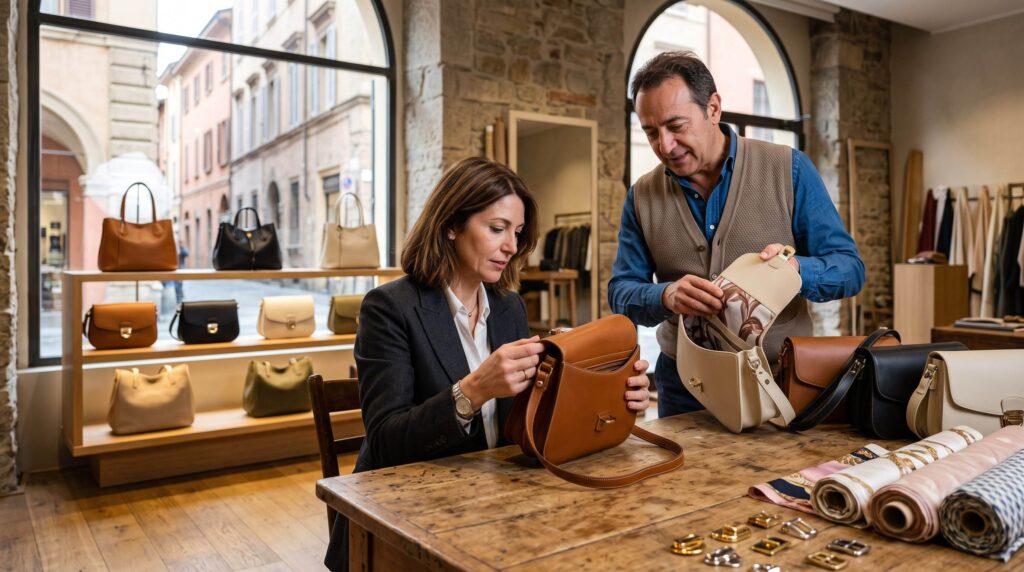
Stock purchasing has one decisive advantage: the product is finished and in front of you. Nothing is described, promised or projected from a technical sheet. Colour, weight, lining quality, zip action and stitching can all be judged before money moves. Quantities stay contained because the entry thresholds are modest by production standards, with supplier minimums normally between 300 and 500 euro per warehouse and two to twelve pieces per style. That structure lets a store buy four or five models in small depth rather than one model in commercial quantity, which is exactly what a first test requires.
The second advantage is reordering. As long as a model remains available in the warehouse, a retailer can go back and take more of what sold, without any new negotiation. Availability is finite, though, and nobody controls it: stock is produced once, and when it ends it usually ends for good. Buying from several accessory suppliers in the same session does not multiply the administrative work, since the order is closed with one invoice and one consolidated shipment. What the retailer gains here is speed and information; what it does not gain is exclusivity, because the same models circulate.
Private Label Bags Italy: Exclusivity at a Higher Entry Cost
Retailers regularly ask how much they need to commit before a workshop will run bags under their own brand. The floor is 3,000 euro of order value and 100 pieces per model, and those two conditions apply together rather than alternatively. Before production opens there is a sampling phase, since nothing goes into the line until a physical prototype has been approved in writing. Anyone weighing this route should read the terms of private label production made in Italy against their actual sell-through, not against an ambition.
Time is the other cost, and it is the one most often underestimated. A sample has to be developed, produced, shipped, examined and either approved or corrected, and each correction restarts part of that loop. Only after written approval does the workshop schedule the run. Against a stock purchase that can be selected and dispatched within a normal buying cycle, dedicated production sits on a materially longer horizon. The compensation is real: the model is yours, the labelling is yours, and no competing store two streets away will carry the identical bag.
Material Minimums Are the Real Ceiling in Leather Goods Sourcing
The number that blocks most private label bag projects is not the piece count. Specialised materials carry their own minimum quantities, set by the tannery or the mill rather than by the workshop assembling the bag. A particular leather finish, a specific coated fabric, a custom hardware colour or a woven lining may only be produced above a threshold that has nothing to do with how many bags you intend to sell. That threshold frequently exceeds what 100 pieces would consume, which is why a project sized correctly on paper can still fail on materials.
The practical consequence is that flexibility comes from working within what the workshop already sources rather than from specifying freely. Materials held in continuous stock, standard hardware finishes and established lining suppliers keep a project viable at accessible volumes. IFS does not release supplier lists and does not disclose supplier names, so these relationships remain managed on the client’s behalf rather than handed over. Retailers who arrive with a fixed material specification and no willingness to adapt it tend to discover the constraint late, after sampling costs have already been incurred.
Vegan Leather and Alternative Materials Follow a Different Chain
Materials presented as vegan leather cover a wide field, from polyurethane-coated fabrics to recycled and partly plant-based composites, and they do not come from the same supply base as hides. Different mills, different converters, different minimum runs. Some of these materials are easier to obtain in small quantities because they are woven or coated in continuous lengths; others are harder, because they are produced only on order for brands buying at scale. Treating them as a straightforward substitute for leather is where planning usually goes wrong.
Scouting this segment properly takes working days on the ground, and the service is priced accordingly: a 10% commission on confirmed purchase value, with a minimum of 250 euro per working day. Verifying that a claimed composition matches what a supplier can actually deliver, in the quantity and at the price discussed, is field work rather than correspondence. For a retailer building a mixed assortment, the reasonable approach is to test alternative materials in stock form first, then decide whether the response justifies commissioning them.
Price Positioning Sets the Limit on What Wholesale Bags Can Deliver
Expectations drawn from luxury leather goods do not survive contact with a low purchase price, and this is worth settling before any sourcing begins. A bag bought at an entry-level cost will have machine-set edges rather than hand-painted ones, lighter hardware, and linings chosen for cost rather than for feel. That does not make it a poor product for a boutique selling at accessible retail prices. It makes it a different product. IFS does not work in the luxury segment, and does not present district output as something it is not.
Quality tolerance also shifts with positioning. In low-cost pronto moda, up to 5% of pieces can show minor irregularities, and the correct commercial response is to price and plan for that rather than to treat each instance as a supplier failure. Retailers who inspect incoming goods on arrival, set aside the occasional imperfect piece and account for it in margin, run the category calmly. Those who expect a flawless rate at an entry price tend to burn the relationship on the first shipment and learn nothing about the category.
Sequencing Italian Handbags Wholesale: Stock First, Production Later
The operational recommendation is unambiguous. Test the category by buying stock, in limited depth, across several shapes and price points, and read what the till tells you over a full season. Sell-through by model, by colour and by retail price gives you the specification for a dedicated line far more reliably than taste does. The comparison between ready-made stock and private label in Italian fashion wholesale becomes straightforward once real numbers exist, because the decision stops being a preference and becomes arithmetic.
Two administrative points close the picture, since both affect cash. Payment is 100% before shipment on either route, so the capital is committed earlier than in domestic wholesale with open terms. Shipments travel DAP, which means local duties and taxes fall to the buyer and must sit in the landed cost calculation from the start. Handled in this order, italian handbags wholesale stops being a gamble on a new category and becomes a sequence of decisions, each one supported by the evidence produced by the previous step.