Custom Woven Labels for Clothing: Size, Wording and the Proof You Approve Before Production
14 October 2026
How It Works
Knitwear quality checks are the skill that separates buyers who reorder all winter from buyers who process returns all winter, and nowhere do they matter more than in a district selling finished garments at 15 to 45 euros wholesale. At those prices, Prato offers both excellent knitwear and mediocre knitwear, often hanging in showrooms a street apart, and the label alone will not tell you which is which. This article sets out the practical inspection method used during buying sessions; for what to buy once you can judge it, our guide to sourcing kid mohair, baby alpaca and cashmere blend knitwear in Prato covers the categories, prices and ordering process in full.
Gauge, the number of stitches per inch, is the first property to assess because it determines how a garment wears, drapes and survives. Fine gauges of twelve and above produce the slim, dense knits that layer under tailoring; mid gauges around seven give the standard winter sweater; chunky three and five gauge knits deliver visual volume. None is inherently better, but consistency within the garment is non-negotiable. Hold the body up to window light and look for thin patches at the sides and under the arms, where machines run fastest and cost-cutting shows first.
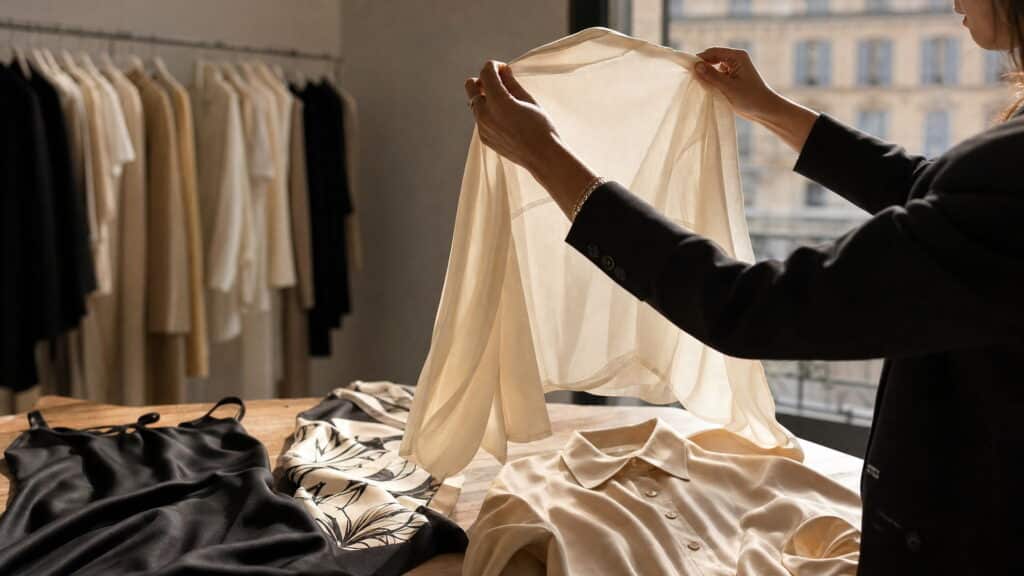
Density should also match the price being asked. A loosely knitted garment uses less yarn, and in noble fibre blends yarn is the dominant cost, so a suspiciously cheap kid mohair sweater has usually saved its money in exactly this invisible way. The light test exposes it in seconds: a quality knit reads as an even fabric against the window, while an underfed one shows a grid of daylight. Buyers running this check across three suppliers’ versions of the same silhouette will find the price differences suddenly make sense.
Two supplier questions sharpen this check further. Ask the yarn count of the piece in hand, expressed in the trade as figures like two over twenty-eight, and ask the finished garment weight; a showroom that answers both immediately is telling you it controls its production rather than merely reselling it. Weight comparisons between similar silhouettes are especially revealing on camera, where a scale on the inspection table settles in one reading what the eye cannot: two visually identical crewnecks can differ by sixty grams of yarn, and that difference is the entire quality gap expressed in a number.
Gauge also interacts with silhouette in ways worth internalising. Fine gauge flatters fitted shapes and fails in oversized ones, where the fabric collapses rather than stands; chunky gauge does the reverse, giving oversized bodies their architecture while making fitted styles bulky. When a garment looks somehow wrong on the hanger despite good yarn and clean seams, a mismatch between gauge and silhouette is usually the reason, and it is a design fault no inspection of workmanship will surface unless the buyer is looking for it deliberately.
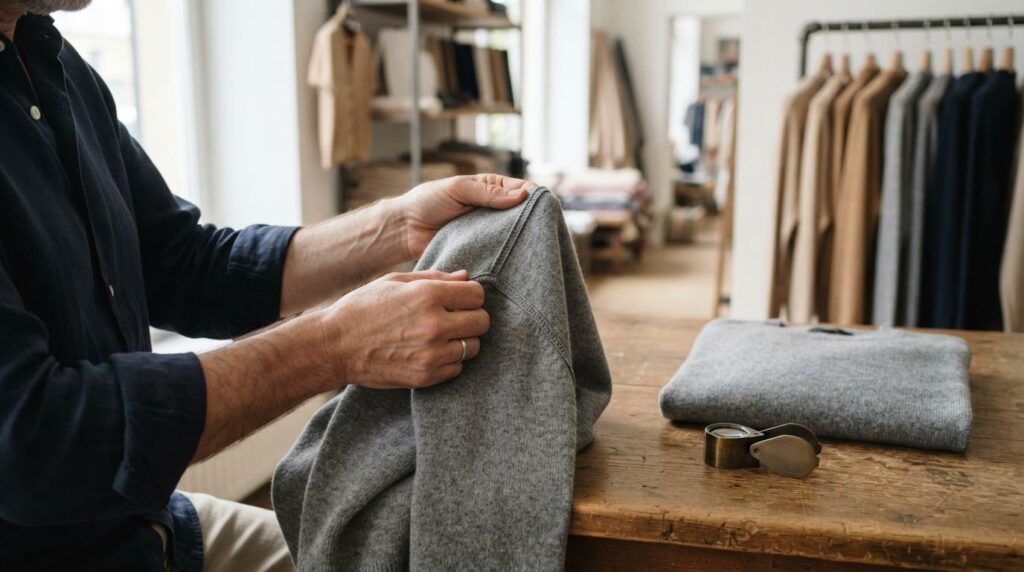
Linking is the process that joins knitted panels at shoulders, necklines and cuffs, and it is where production discipline is most visible. A properly linked seam is flat, slightly elastic and even, stitch for stitch; a cut-and-sewn shortcut seam is bulky, rigid and prone to failure at the neckline, the highest-stress point on any sweater. Run a finger along the inside of the shoulder seam: it should feel like part of the fabric, not like a ridge sewn onto it. On fully fashioned garments, look for the decorative marks along raglan lines that show panels were knitted to shape rather than cut from yardage.
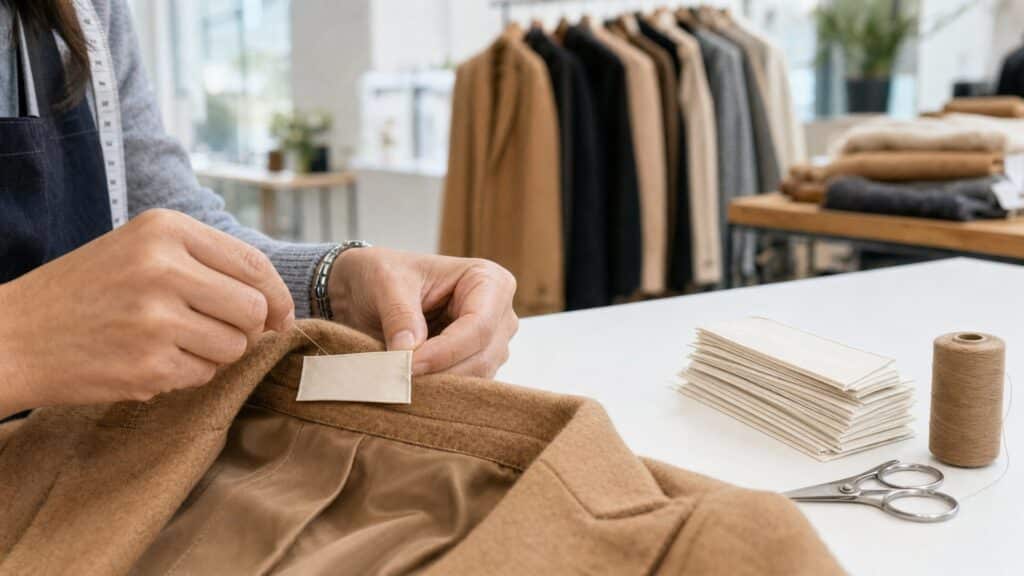
The garment’s interior finishes the story. Secured yarn ends, tidy floats behind jacquard patterns, and a brand or composition label attached without puckering all indicate a workshop that finishes what it starts. This matters beyond the single garment, because internal habits are consistent: a supplier whose 20 euro crewneck is clean inside will deliver clean coatigans at 45, while one that leaves loose ends will leave them everywhere. Inspecting one garment thoroughly therefore evaluates the entire showroom more reliably than glancing at twenty.
Elastic recovery predicts how a knit will look in week ten. Stretch a cuff firmly and release it; quality ribbing snaps back to its original dimension, while tired yarn or loose knitting returns slowly and incompletely. Repeat the test at the hem and, gently, across the body. A basic that will be worn weekly lives on this property, and it cannot be photographed, which is precisely why remote buying from lookbooks so often disappoints and why live handling, on camera or in person, remains the standard for knitwear.
Pilling resistance can also be previewed in the showroom. Rub a flat palm briskly across the fabric surface ten times and inspect: immediate fuzzing predicts a garment that will pill in the customer’s first month. In mohair, distinguish this from the fibre’s natural light shedding, which settles; in cashmere blends, pilling concentrates where gauge is loosest, connecting this check back to the first. Suppliers confident in their yarns tolerate these tests cheerfully, and their reaction to being tested is itself a useful signal about everything you cannot see.
Finishing treatments deserve a question of their own. Quality Prato knitwear is steamed and often washed at the workshop before packing, which relaxes the knit to its true dimensions and settles surface fibre; garments packed straight off the machine can shrink or distort on the customer’s first wash, arriving at the boutique in a size that will not survive ownership. Asking whether a piece is delivered washed and relaxed, and checking the care label for the workshop’s own confidence in its instructions, closes the gap between the garment you approved and the garment your customer keeps.
Composition labels are legally required in the European Union, and the great majority of Prato wholesalers declare honestly, but percentages at the boundaries deserve verification. The tools are your hands and comparison. Genuine baby alpaca has a cool, dry slip; kid mohair announces itself with halo and lightness; cashmere content becomes perceptible as a dense butteriness from roughly twelve percent upward. Handling declared references early in a session calibrates your fingers, after which a garment whose hand does not match its tag stands out immediately.
Fibre honesty is ultimately a supplier-selection question rather than a garment question, which is why it belongs inside a broader vetting habit covering consistency, delivery reliability and labelling accuracy, the discipline described in our guide on how to vet fashion suppliers before ordering. In practice, the district polices itself reasonably well, because showrooms live on repeat wholesale business, but a buyer who demonstrably checks receives a different quality of service from one who visibly does not, and that difference compounds across a multi-year relationship.
Every check above translates to a live video session: garments are held to the light, turned inside out, stretched and rubbed on camera by our team, at whatever proximity the question requires, and the buyer directs the inspection in real time. What video cannot fully transmit is hand feel itself, which is why buyers making large commitments or building private label programmes often add an in-person sourcing day in Prato, priced at 250 euros for the first day and 125 euros for each additional day, walking the same showrooms physically with the checks performed in their own hands.
A sensible progression is to begin remotely, since the sourcing service itself carries no minimum order value and the fee is 10 percent of purchase value with a 250 euro minimum commission, then invest in an in-person day once volumes justify it. Either way, the five checks, gauge, linking, recovery, pilling and fibre honesty, take under a minute per garment once practised, and they convert knitwear buying from an act of faith into a repeatable procedure. Quality in this district is abundantly available; these knitwear quality checks are simply how you make sure it is what enters your boxes.
One habit turns these checks into a system: record them. A photograph of each approved garment’s seam, label and light test, filed against the supplier and order date, makes the first reorder verifiable, because knitwear quality can drift between production runs even in good workshops. Buyers who reference their own inspection photos when a repeat delivery arrives catch drift immediately and correct it with the supplier while the relationship is still young, which is how a one-season source becomes a multi-year relationship on terms the boutique controls.
Italian fashion supply, curated and delivered to your inbox.
How can we assist?
See our services