Private label knitwear Italy is the natural second chapter for boutiques whose pronto moda knitwear already sells. After a season or two of reordering kid mohair sweaters and cashmere blend basics from Prato showrooms, the pattern in the sales data becomes impossible to ignore: certain silhouettes belong to the shop’s identity, and the only element they lack is the shop’s name inside the collar. The district’s knitwear workshops exist to close exactly that gap, producing made in Italy garments under your label through the same supply chain behind the wholesale collections described in our Prato guide to kid mohair, baby alpaca and cashmere blend knitwear wholesale.
The commercial reasoning is margin and ownership. A private label garment removes the possibility of a customer finding the identical piece elsewhere, converts the boutique from curator into brand, and typically improves gross margin per unit, since production pricing rewards the hundred-piece commitment. The trade is risk: capital is committed months before sale, and the reorder agility that makes pronto moda forgiving is exchanged for a production calendar. This article walks through how the process actually operates so that trade can be made with open eyes.
Two Routes into Production: Existing Models or Original Designs
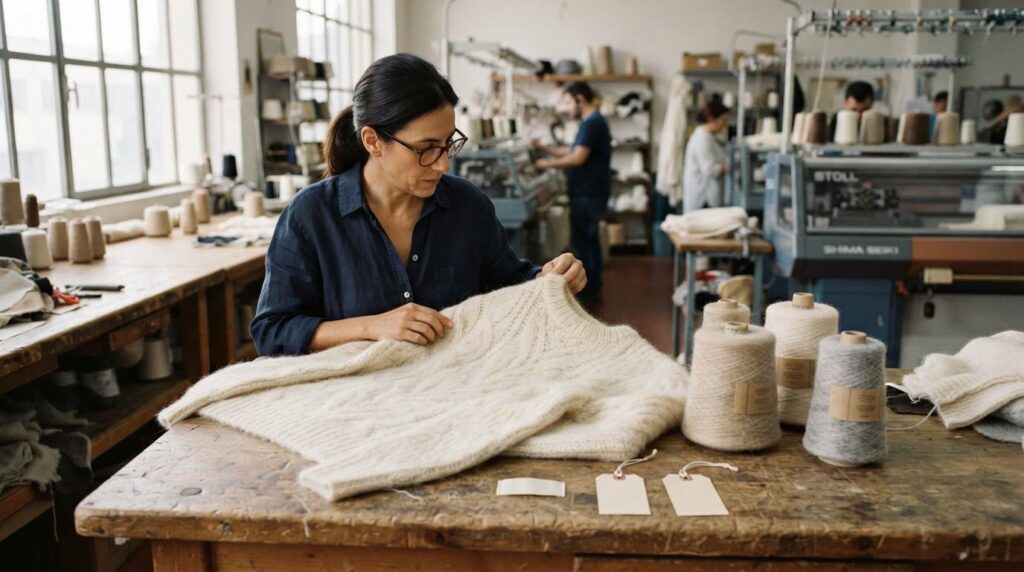
Prato workshops accept private label knitwear projects from two starting points, and the first is dramatically easier than newcomers expect. Route one adapts an existing pronto moda model: you select a sweater or cardigan already in production, and the workshop reproduces it with your labelling, your colour choices, and modest modifications, a longer body, a different button, an adjusted neckline. Because the pattern and knitting programme already exist, development cost is minimal and the prototype arrives quickly, which is why most first private label capsules sensibly take this route.
Route two develops from your own design: sketches, technical drawings or a physical reference garment. The workshop translates these into a knitting programme, produces a prototype, and iterates until the sample matches intent. This route delivers genuine exclusivity and correspondingly demands more of the buyer, clearer references, more decision points, longer development, and it rewards boutiques that arrive with a reference garment to hand rather than an idea to describe. In both routes, one rule is absolute: series production begins only after your written approval of the physical prototype, which is the single most important control in the entire process.
A hybrid worth knowing sits between the routes: taking an existing model’s body and commissioning a distinctive detail that becomes yours, a signature stitch panel, a specific collar construction, an unexpected colour blocking. The development burden stays close to route one while the finished garment stops being identifiable as anyone else’s stock, and several long-running boutique labels in the district’s client book began exactly this way, accumulating one owned detail per season until the line was unmistakably theirs.
Yarn Selection: Where the District’s Depth Becomes Your Advantage
Knitwear private label lives or dies on yarn, and this is where producing in Prato pays most visibly. The workshops hold standing relationships with Italian spinners, so specifying a 30 percent kid mohair blend, a baby alpaca and wool mixture, or a 15 percent cashmere yarn draws on the identical supply feeding the showroom collections you have already tested at retail. You are not gambling on an unknown mill’s interpretation of luxury; you are ordering from a menu whose results your customers have literally already bought.
Practical yarn decisions cover fibre composition, yarn count, which sets the gauge range available, and colour, chosen from spinners’ seasonal cards or lab-dipped for larger commitments. Composition is also a pricing lever under your control: moving a design from a 10 to a 15 percent cashmere yarn raises cost per piece by a knowable increment, letting you position the finished garment’s retail ticket deliberately. The consultancy layer of the service exists precisely here, translating a boutique’s target retail price backward into the yarn specification that supports it.
Sustainability questions increasingly belong in this conversation too. Italian spinners now offer certified and traceable versions of most noble fibre blends, recycled cashmere among them, at modest premiums, and a private label garment is the natural place to make that commitment because the label telling the story is yours. For boutiques whose customers ask origin questions at the till, specifying a certified yarn converts an abstract value into a sentence staff can say with a garment in hand, which is the only form of sustainability messaging that reliably survives the shop floor.
Minimums, Money and the Approval Gate
The operating parameters through Italian Fashion Sourcing are concrete: a minimum purchase value of 3,000 euros per production order and a minimum of 100 pieces per style, with the size and colour distribution inside those hundred pieces defined by you. One style means one knitting programme, so a first capsule of two styles commits to two hundred garments; buyers should let their pronto moda sell-through data nominate the styles, because the data already knows which silhouettes move at which sizes in your specific market.
Payment is 100 percent in advance of shipment, by bank transfer or card, which is standard for made in Italy production at this scale and is the reason the prototype approval gate matters so much. Nothing proceeds to bulk until you have held the physical sample, checked its gauge, seams, measurements and labelling, and approved it in writing. Buyers who treat that approval as a formality inherit whatever they missed; buyers who measure the prototype against a specification sheet and wash-test it convert the payment structure from a risk into a mere sequencing detail.
It helps to know what the minimums are protecting. One hundred pieces is roughly the threshold at which a knitting programme, yarn purchase and finishing run become economical for an Italian workshop; below it, per-piece costs rise steeply and quality-sensitive stages get rationed. The floor therefore is not a sales tactic but the physics of small-batch manufacturing, and boutiques that respect it, concentrating volume on fewer styles rather than negotiating it thinner across many, receive noticeably better pricing and noticeably better garments for the identical total spend.
Timelines: Why Knitwear Runs Slower and How to Plan Around It
Knitwear production is sequential in ways cut-and-sew is not: yarn must arrive, panels must be knitted, linked, washed, finished and pressed, and each stage feeds the next. A realistic window from approved prototype to shipped goods is six to ten weeks, stretching toward the upper bound in autumn when the district’s machines are fullest. Development time precedes this: near-immediate for adapted existing models, two to four weeks of prototyping for original designs. The full calendar logic, including how seasonal congestion moves the numbers, is mapped in our article on the private label production timeline in Italy.
Worked backward, the arithmetic sets your decision dates. A capsule intended for October delivery needs production launched by late July, prototype approved by mid-July, and the project opened in late spring, which conveniently is when your previous winter’s complete sell-through data is available to steer it. Boutiques that miss the window are better served waiting for the next one than compressing it, because the stages that get squeezed, washing, finishing, quality control, are precisely the ones that distinguish made in Italy production from what your customers can buy anywhere.
Labels, Packaging and What Arrives in the Boxes
The scope of a production order includes the elements that make the garment retail-ready under your name: woven brand labels to your artwork, legally compliant composition and care labelling, printed swing tags, and individual polybag packing. Quality control runs at each production stage rather than only at the end, and the finished order ships with complete export documentation, commercial invoice, packing list and certificate of origin where required, so the goods clear customs as smoothly as a wholesale order. Freight is calculated on volumetric weight exactly as with showroom purchases, and import duty in your market should be verified against current tariff schedules before final costing, as rates can change at any time.
The sensible first project, in summary, is modest and evidence-led: one or two adapted existing models in the yarns your customers already reward, a hundred pieces each, sized by your own sales curve, timed for the season your data says is strongest. The complete service framework, from concept development through quality control to delivery, is described on our private label production service page. Private label knitwear Italy is not a leap from retailing into manufacturing; done through the district that already makes your bestsellers, it is the shortest step in fashion, and the one that finally puts your name on the margin.