Hang Tags for Clothing: What Goes on the Tag When the Label Is Too Small
16 October 2026
Sourcing Strategy
Winter is the season in which an independent boutique makes or loses most of its year. Coats, knitwear and occasionwear carry the highest tickets, they take the most space on the floor, and a wrong order can stay on the rail until the sales. Italian winter clothing wholesale gives boutiques access to garments with a quality and a story that customers recognise, at prices that leave room for a healthy margin, but the Prato district works on its own calendar and its own rules. This guide explains them in the order a buyer meets them, from the timing of the season to minimums, payment, shipping and the practical ways of buying from abroad.
It is the reference page of our winter content. Each category has its own detailed guide, and the most important ones are linked in the relevant sections: knitwear, outerwear and the trends of the season. Buyers who are new to Italian wholesale can read this page alone and have a complete picture, while those preparing a specific order can move from here to the category they need. The figures quoted come from our daily work in the Prato showrooms and from the orders we consolidate for clients in Europe, North America, the Middle East and Australia.
Prato is the largest textile and clothing district in Italy, with thousands of companies working in fashion, and its pronto moda wholesalers produce womenswear in short runs that reach the showroom within days. For winter this model has a particular rhythm. The first autumn pieces appear in early summer, often while summer stock is still being sold, the offer deepens through August and September, and knitwear in particular keeps refreshing every three to four weeks until January. A buyer who visits in July, in September and in November will see three different districts, each with its own opportunities.
The range is complete. Knitwear is the strongest category, from fine-gauge basics to mohair, alpaca and cashmere blends, and it is covered in our guide to Italian knitwear wholesale. Outerwear includes structured wool blend coats, quilted and padded jackets, teddy and faux fur, explained in our guide to Italian outerwear wholesale. Around them sit jersey and woven separates, velvet and knit dresses, denim and the accessories that complete a winter rail. What a boutique buys is always the finished garment, sold by the unit and labelled with its composition.
The most useful decision a buyer can make is to split the winter budget across two or three moments. The first session, at the end of June or in July, should cover the pieces that sell out or depend on limited production: statement knitwear, structured coats and texture-led items. A second session in September completes the core with jersey separates, basic knitwear in commercial colours and the categories that wholesalers produce continuously. Our practical buying calendar for autumn works backwards from the date a boutique wants new stock on the floor, which for most stores is mid-September.
From October onwards the logic changes from collection to correction. Late buys fill the gaps that the first weeks of selling have revealed, and our article on using late-season buying to fix the winter assortment explains how to use them without overstocking. Occasionwear for the holiday period should be bought in October and early November, as described in our guide to winter dresses and occasionwear. Boutiques in the Southern Hemisphere follow an inverted calendar, set out in our guide to Italian winter wholesale for Australia and the Southern Hemisphere.
Winter garments in Prato span a wide range of prices, and the right level depends on the store’s customer rather than on an abstract idea of quality. As an indication from the mid-market showrooms, knitwear and jersey separates mostly sit between €18 and €28 at wholesale, woven trousers and blouses between €25 and €40, and coordinated sets between €35 and €55. A simple quilted jacket can leave the warehouse at €15 to €20, while a wool blend coat with a clean construction usually costs between €30 and €45, and velvet or heavier wool pieces can go higher. With a retail multiple of around 2.5, these levels cover almost every boutique positioning.
Minimums are low compared to brand wholesale. Most wholesalers ask for €300 to €500 per warehouse, with two to twelve pieces per style, so a boutique can build a varied winter assortment by buying a few pieces from many showrooms in a single day. A live session with us starts from a purchase value of €3,000. For outerwear in particular, buying shallow on new styles and keeping a reserve for reorders is the safest approach, and our article on how many coats a boutique should buy shows how to size the coat rail without carrying stock into February.
Payment terms are the same in the whole district: 100% before shipment, with no open account, no consignment and no returns on unsold goods. Each wholesaler invoices us and we invoice the client, which is the only way to combine many suppliers into one payment and one shipment. Clients can pay by bank transfer, credit card, Wise or PayPal, with card or PayPal fees charged to the buyer. Our fee is a 10% commission on the value of the goods purchased. The names of the suppliers stay confidential, since the relationships built over the years are what the service rests on.
Shipping is where winter differs most from summer. Couriers calculate cost on volumetric weight, the space a parcel occupies rather than its mass, using a divisor of 5,000, so a carton of padded jackets or lofty knitwear can cost two or three times what its scale weight suggests. As reference bands, shipping from Italy runs around €2 to €3 per volumetric kilo within Europe and around €8.50 towards North America, with Australia and South America slightly higher. We consolidate all purchases into one invoice and one shipment under DAP terms, with a maximum of five different customs codes per invoice to keep the declaration simple, and duties at destination are paid by the buyer.
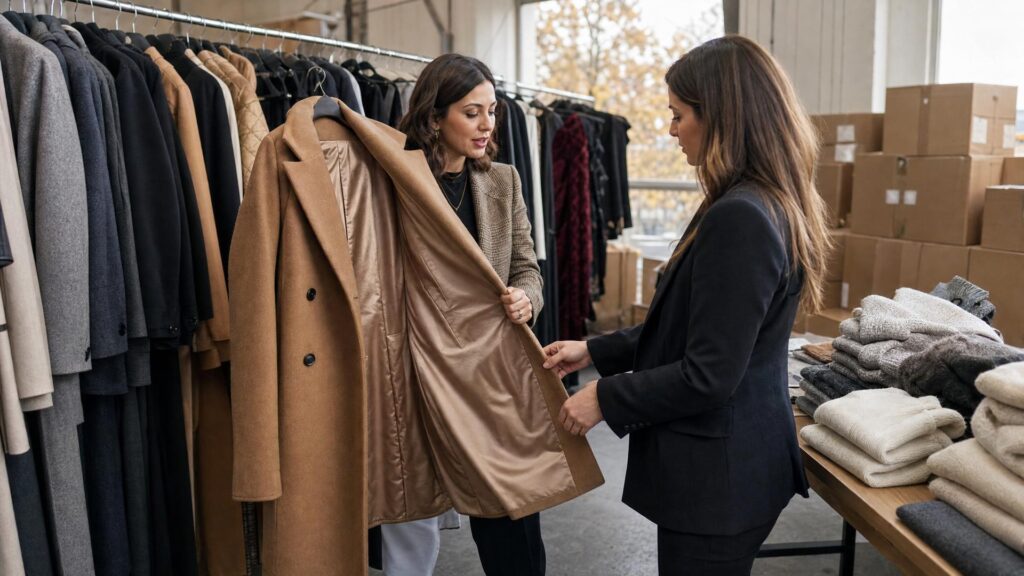
Winter garments hide more than summer ones, so checking them takes more time. On a coat the first things to look at are the composition label, because “wool coat” can mean anything from a high wool content to a blend where wool is a minority, then the lining, the finishing of the inside seams and the way buttons and pockets are attached. On knitwear the density of the knit, the linking of the seams and the behaviour of the yarn when it is rubbed between the fingers say a lot about how the garment will look after a few weeks of wear and washing.
Padded jackets need a specific check, because the label must state what the filling is. Down and feather ratios, or the type of synthetic wadding, decide warmth, weight and price, and two jackets that look identical on the rail can differ substantially. Our guide to judging knitwear quality in a Prato showroom covers gauge, linking and fibre checks in detail, and the outerwear guide does the same for coats and fills. In every case it helps to handle a sample before confirming quantities, which is exactly what a local buyer does during the session.
Expectations should match the price level. In low-cost pronto moda, up to 5% of the pieces in an order can show minor irregularities, such as a loose thread or a slightly uneven hem, and this is the accepted standard of the segment rather than a failure of the supplier. What a buyer should never accept is a defect that affects a whole style, such as a coat whose lining tears at the seams or a knit that pills badly after a first wear. When that happens we handle the claim directly with the wholesaler on behalf of the client.
A winter assortment works when it combines a stable base with a few strong statements. The base is made of coats in the season’s anchor colours, fine knits that sell under every coat, trousers and dresses that customers wear every day. The statements are the pieces that make people stop at the window, a cobalt mohair sweater or a boucle jacket, bought in small quantities. Our report on winter fashion trends for 2026 and 2027 describes the colours, textures and key pieces of the season, and it is the best starting point for deciding where the statements should come from.
Accessories and small categories add value at a modest cost. Scarves, belts and small leather goods raise the average basket and help sell coats and knitwear, as explained in our article on add-on categories that lift basket value. Boutiques that sold well in summer should look at their data before committing to winter, and our guide to analysing summer sell-through before buying autumn shows which numbers matter. For retailers who need the same garment season after season, private label production timing explains when to start a winter line under their own name.
Most of our clients buy remotely. During a live session we visit several showrooms on video, show each garment up close, read the composition labels, check the weight of a coat or the density of a knit, and ask the wholesaler about colours, sizes and reorders, while the client decides piece by piece. The service is described on our page about fashion sourcing and purchasing, and real cases show how it works in practice: one boutique sourced a complete winter collection from Prato, and a South American client combined pronto moda and production in a single autumn buy.
Buyers who prefer to see the district in person can come to Prato, and we accompany them through showrooms selected in advance for their style and price level. Winter is the best season for this, because texture and weight are easier to judge by hand. Retailers who want a quick overview of what we offer for the season, or who arrive from an advertising campaign, can also read our dedicated page on autumn and winter Italian fashion wholesale, which summarises the service in a few minutes.
A successful winter order rests on timing, on a realistic budget that includes shipping and duties, and on a clear idea of the customer the store serves. Boutiques that buy their statement pieces early, keep part of the budget for reorders and check every garment before it is packed rarely end the season with a rail of unsold coats. Italian winter clothing wholesale rewards that discipline with garments that customers notice and margins that make the season worthwhile, and the earlier the first session is planned, the wider the choice in the showrooms.
16 October 2026
14 October 2026
12 October 2026
Italian fashion supply, curated and delivered to your inbox.
How can we assist?
See our services