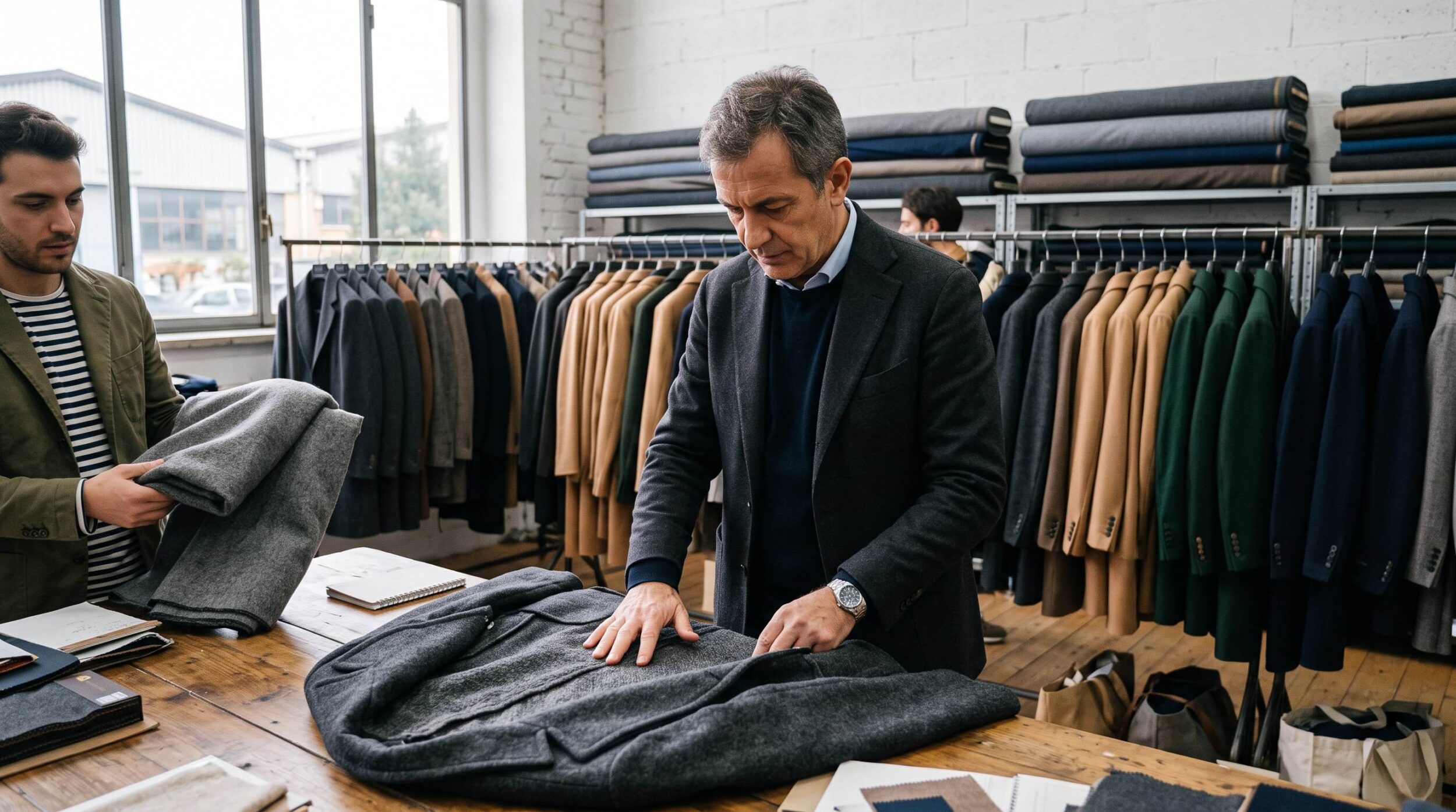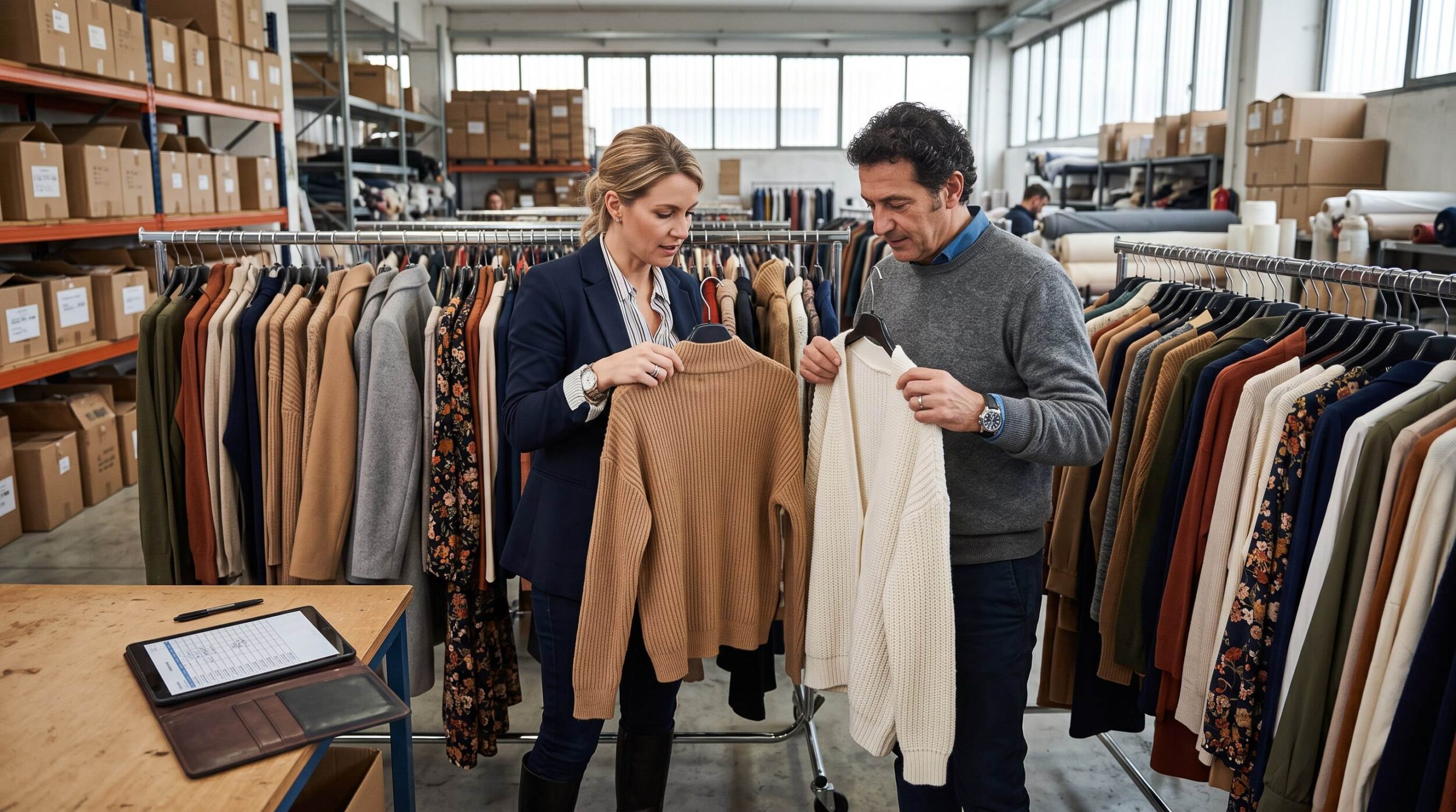

One of the most common obstacles for boutique buyers approaching Italian fashion wholesale for the first time is the absence of publicly available pricing information. Italian wholesale suppliers in the Prato district do not publish price lists online. Their catalogues, where they exist at all, are shared selectively with qualified buyers, and the prices in them are denominated in euros with no conversion context, no landed cost calculation, and no indication of how the figures compare to what buyers are used to paying in other markets. This article puts concrete numbers on the table.
How Italian Fashion Wholesale Pricing Is Structured
Italian fashion wholesale pricing in the pronto moda segment is set by the supplier as a fixed wholesale price per piece, expressed in euros. There is no standard markup formula visible to the buyer: the price reflects the supplier’s production cost, margin expectation and market positioning, and it does not vary based on the buyer’s volume at a single session. A dress that wholesale prices at EUR 34 is EUR 34 whether you buy twelve pieces or two, assuming you meet the style minimum. Volume discounts are rare in the pronto moda segment and, when they exist, apply only to buyers with established long-term relationships placing orders across multiple seasons.
The pricing also does not include logistics. The wholesale price per piece is the ex-works price, the cost of the garment at the supplier’s location in Italy. Getting that garment to a warehouse in London, Toronto or Dubai adds a further layer of cost that must be factored into the calculation before the retail price is set. Buyers who model their margin on wholesale price alone, without accounting for freight, duties and handling, consistently find that their actual margin is lower than they projected when the order was placed.
Price Ranges by Category: What Buyers Pay in Prato
Linen and linen-blend separates are the category with the broadest price range in the Prato wholesale market, because they span from simple construction basics to complex multi-panel styles with print development and finishing details. A basic linen trouser or sleeveless top in a standard construction will typically wholesale between EUR 18 and EUR 28. A mid-range linen-viscose dress with more complex shaping, tiered skirt, elastic waist, patch pockets, runs from EUR 28 to EUR 42. A fully constructed linen maxi dress with lining, cut detail and print will reach EUR 45 to EUR 65 at the upper end of the pronto moda market.
Jersey casualwear, the category that includes t-shirts, jersey dresses, wrap tops, relaxed palazzo trousers and casual coord sets in stretch fabrics, prices lower on average than linen, because the fabric cost and construction complexity are typically lower. Simple jersey pieces wholesale from EUR 14 to EUR 22. Jersey coord sets, top and trouser or skirt sold together as a unit, run from EUR 28 to EUR 48 per set, depending on fabric weight and construction. Printed viscose styles occupy a similar range to jersey, with EUR 20 to EUR 38 covering the majority of available stock in most Prato showrooms.
Occasionwear and Premium Categories: Where Pricing Moves Higher
Occasionwear is the category where Italian fashion wholesale pricing diverges most clearly from the general pronto moda baseline. Garments designed for events, weddings, formal occasions, cocktail settings, use more expensive fabrications (satin-finish polyester, metallic weaves, silk-touch jerseys), require more precise construction, and carry a higher supplier margin because the sell-through risk is lower and the buyer profile is more selective. A structured occasionwear dress in a satin or metallic fabric wholesales from EUR 48 to EUR 85 in the mid-range Prato market, with some high-positioning suppliers reaching EUR 95 to EUR 120 for gowns with significant construction complexity.
Coord sets in premium fabrications, linen-silk blends, jacquard weaves, structured cotton with print, occupy a middle tier between casualwear and occasionwear in terms of wholesale price. A well-constructed premium coord set in a quality linen or structured weave will wholesale from EUR 55 to EUR 85 per set. These are the pieces that drive the strongest retail margin for boutiques, because the retail price point, EUR 180 to EUR 280 for a quality Italian-made coord at an independent boutique, is well above the level that most buyers associate with the wholesale price they paid.
The Full Landed Cost: What Buyers Actually Pay Per Garment
The landed cost of an Italian wholesale garment, the true cost per piece by the time it arrives at the buyer’s warehouse, includes the wholesale price, the proportional share of the sourcing service fee, the freight cost divided by the number of pieces in the shipment, and the import duty applicable in the destination country. For a consolidated session covering four to five suppliers with a total wholesale spend of EUR 4,500, a typical service fee of 15 percent adds EUR 675. Freight to most European destinations for this volume runs EUR 120 to EUR 200. For a destination with 12 percent import duty, the UK rate for most womenswear, the duty on the combined invoice value adds a further EUR 540 to EUR 630.
The total landed cost for this example order, EUR 4,500 in wholesale value, comes to approximately EUR 5,900 to EUR 6,100 all-in before the buyer has set a retail price. Divided across the pieces in the order, the landed cost per piece is typically 30 to 40 percent above the wholesale price per piece. This is the number that the retail markup should be applied to, not the raw wholesale price. Understanding this calculation in detail is one of the foundations of a sound sourcing strategy, and it connects directly to the practical frameworks covered in the IFS guide to boosting boutique profit margins through smarter sourcing.
Retail Margin Multiples for Italian Fashion Wholesale
The retail multiple that boutique buyers apply to Italian fashion wholesale stock, the ratio of retail price to landed cost per piece, varies by market, by category and by the positioning of the boutique. In the UK, Northern Europe and North America, independent boutiques selling Italian-origin womenswear typically price at 2.8x to 3.5x the landed cost. This means a linen dress with a landed cost of EUR 42 retails at EUR 118 to EUR 147. A premium coord set with a landed cost of EUR 90 retails at EUR 252 to EUR 315. These are not exceptional margins, they are standard for well-positioned independent boutiques carrying Italian-origin product.
In higher-positioned markets, Gulf boutiques, premium concept stores, resort retail, the multiple extends to 4x or beyond, particularly for occasionwear and for pieces that carry a strong seasonal story. The ceiling on the retail price is set by the customer’s willingness to pay for the specific product in the specific context, not by an industry rule. Italian fashion wholesale pricing, at its mid-market Prato level, provides a cost base that accommodates these multiples with room for end-of-season markdown without eliminating margin entirely. The quality-to-price relationship at the wholesale level is what makes this possible, and it is examined in more depth in the IFS guide to quality and pricing in the pronto moda market.
What Moves Prices Within a Category, and What Buyers Can Influence
Within any given category in the Prato wholesale market, prices vary based on fabric quality, construction complexity, supplier positioning and seasonality. Fabric quality is the single biggest variable: a linen-viscose blend with a clean handle and consistent colour costs more to produce than a rougher single-weave linen, and that difference is visible in the wholesale price. Construction complexity, number of panels, type of closure, finish on seams and hems, adds cost in a relatively linear way as garments become more structured.
Supplier positioning also matters. Some Prato showrooms operate in the accessible tier of the pronto moda market, with lower prices and higher volume expectations. Others are positioned as quality specialists, with higher wholesale prices, smaller collections and more selective buyer criteria. Buyers who understand this spectrum can select the supplier mix that best fits their retail positioning and margin targets, rather than defaulting to whoever happens to be easiest to access. For buyers who want a pre-screened selection matched to their price band and style direction, a managed buying session through the Italian Fashion Sourcing purchasing service eliminates the trial-and-error cost of finding the right showrooms independently.