Among all the categories available in Italian wholesale womenswear, dresses are the segment that consistently generates the strongest performance for independent boutiques. They are visually compelling on the floor, easy to merchandise, and in the Italian pronto moda tradition they carry a quality-to-price relationship that supports comfortable retail margins. Wholesale dresses from Italy, particularly those sourced from the Prato district, range from relaxed linen maxis to structured occasionwear, and the depth of selection available in a single sourcing session is difficult to match in any other wholesale market.
The Main Dress Categories Available in Italian Wholesale
The dress category in Italian wholesale is not uniform. Suppliers in the Prato district offer a wide range of styles that serve different customer profiles and retail occasions, and experienced buyers typically select across two or three sub-categories rather than focusing on a single style direction. The most commercially active categories in spring-summer are linen and linen-blend dresses, viscose and eco-viscose printed styles, jersey-based casual dresses, and structured occasionwear in silk-touch fabrics or metallic finishes.
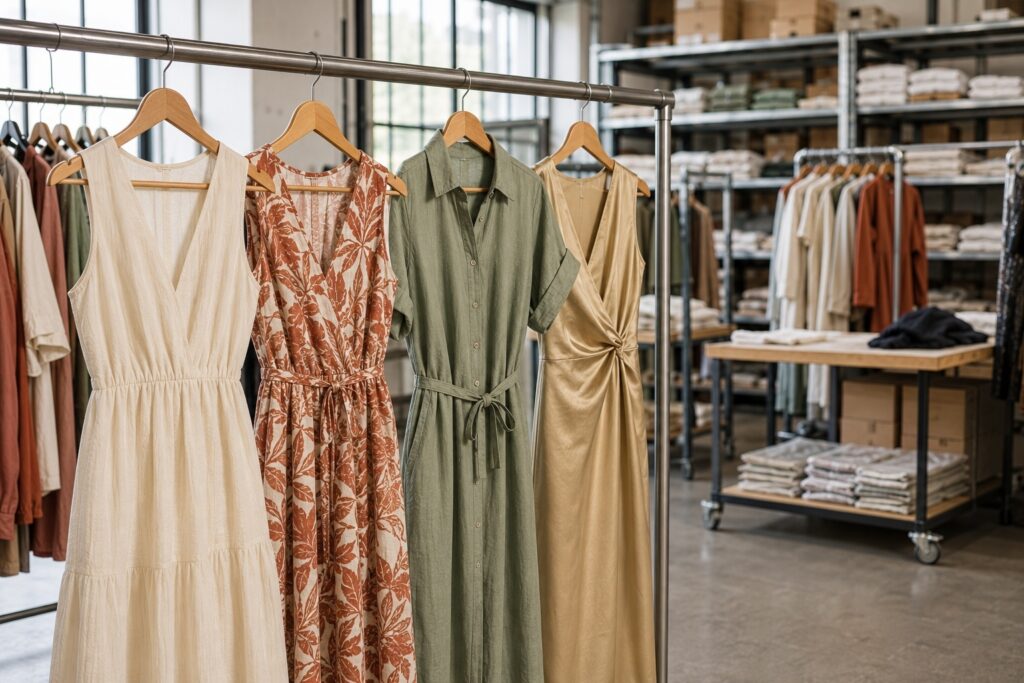
Linen and linen-blend dresses are the strongest category by volume in the Prato market. They range from simple A-line shapes and relaxed shirtdresses to more complex maxi constructions with tier detailing, drawstring waists or embroidered trim. The quality of linen sourced through Italian wholesale is generally superior to what is available from Turkish or Eastern European wholesale markets at comparable price points, and the handle and drape of Italian-finished linen is a perceptible quality indicator that end customers respond to. Linen-viscose blends are particularly popular because they soften the texture and reduce creasing without compromising breathability.
Wholesale Dress Price Points in the Prato Market
Wholesale dresses from Italy are priced across a relatively wide range depending on fabric, construction complexity and supplier positioning. At the accessible end of the pronto moda market, simple jersey or viscose dresses in basic constructions, sleeveless shift shapes, relaxed wrap styles, short printed tiers, typically wholesale between EUR 18 and EUR 28 per piece. Mid-range styles in linen-viscose blends, printed poplin or structured cotton weaves run from EUR 28 to EUR 45. More constructed styles, maxi dresses with lining, occasionwear in satin-finish fabrics, or styles with significant embellishment, regularly reach EUR 55 to EUR 80 at wholesale.
The retail multiple that boutiques apply to Italian wholesale dresses varies by market and positioning, but a standard markup of 2.8x to 3.5x is common for mid-market independent boutiques in Northern Europe, North America and the Gulf. A linen-blend maxi dress bought at EUR 38 wholesale retails comfortably at EUR 110 to EUR 135 in a well-positioned boutique. An occasionwear dress in satin-touch fabric bought at EUR 65 wholesale can retail at EUR 175 to EUR 220, depending on the market and the strength of the brand narrative supporting the buying decision.
How to Select Wholesale Dresses from Italy for Your Boutique
Selecting wholesale dresses for a boutique requires balancing editorial coherence with commercial breadth. The most common mistake buyers make in their first Italian wholesale session is gravitating entirely toward statement pieces, the dresses that photograph well and excite the buyer, while neglecting the volume drivers that actually generate the turnover. A well-structured dress selection for a boutique of average size typically includes two to three anchor styles in proven silhouettes and commercially safe colours, two or three directional styles that create visual interest and editorial pull, and at least one occasionwear or smart casual option for the customer who needs something versatile for events.
Colour is a critical selection variable in Italian wholesale dresses. Suppliers in the Prato district respond quickly to seasonal colour direction, and buyers who select for the right palette will find that their stock moves significantly faster than buyers who default to their personal colour preferences. For spring-summer, the productive colours in the pronto moda market are typically warm neutrals, ecru, sand, terracotta, alongside specific seasonal colours that shift year to year. Reading these signals correctly is part of what a sourcing agent with active market knowledge can provide, and it is one of the reasons why understanding what drives versatility and elegance in an Italian linen dress for the current season matters before placing orders.
Fabric Quality and Construction Details to Check When Buying Wholesale Dresses
Not all wholesale dresses from Italy are equal in construction quality, and buyers who shop by price alone without checking the garment details often find that their margins erode faster than expected through returns and alterations. When reviewing dresses in a wholesale session, the most important construction details to check are seam finishing, which should be clean and even, with no exposed raw edges, zip quality on any concealed or exposed zips, and the consistency of print registration on printed styles. A misaligned print that is acceptable on a EUR 20 dress becomes a problem at a EUR 100 retail price point.
Fabric weight is another variable that buyers frequently overlook in a wholesale session. A linen dress that photographs well but uses a very lightweight fabric, below 120 gsm for a single-layer construction, will often disappoint customers in terms of drape and opacity, leading to returns or negative feedback. Well-made Italian linen dresses for summer typically work in the 130 to 180 gsm range for single-layer constructions, and heavier for lined or structured styles. Suppliers who can tell you the fabric weight and composition without hesitation are generally the more reliable partners.
Sourcing Wholesale Dresses from Italy: Logistics and Timing
The timing of a wholesale dress sourcing session has a significant impact on the breadth of selection available. For spring-summer dresses, the best sourcing window in Prato is January through March, when suppliers are at full stock depth across all spring categories. By April, the most commercial styles have already moved through the market, and buyers sourcing in May or June will find a noticeably thinner selection. Buyers who consistently source early in the window have access to the full range; buyers who source late are working with what is left.
Consolidated shipping of wholesale dresses from Italy to most international destinations takes two to four weeks by air freight, depending on the destination country and the volume of the shipment. A consolidated order covering multiple suppliers, dresses alongside tops, coordinates and outerwear, is typically more cost-efficient per garment than shipping a dress-only order, because the fixed logistics costs are spread across a larger number of pieces. Buyers who want to understand how the full margin mechanics of an Italian wholesale order work, including the dress category specifically, will find practical context in the IFS guide to boosting boutique profit margins through smarter sourcing.
What Makes Italian Wholesale Dresses Worth the Investment
The case for sourcing wholesale dresses from Italy is ultimately a margin and differentiation argument. Italian-made womenswear, and particularly dresses in natural and natural-blend fabrics, commands a retail price premium in virtually every market where independent boutiques compete. Customers who shop in independent boutiques are, by definition, buyers who have chosen not to buy from fast fashion or mass-market retailers. They are willing to pay more for the right product, and Italian origin is one of the most credible markers of product value that a boutique can offer.
The practical consequence is that Italian wholesale dresses, sourced correctly and priced appropriately, generate better margin per unit and better full-price sell-through than comparable garments from lower-cost sourcing markets. The investment in a structured sourcing operation, whether through a direct trip to Prato or through a buying session managed by a specialist agent, pays back across the season. Buyers who want to explore whether an Italian fashion sourcing process is right for their boutique can start with an introductory consultation via the Italian Fashion Sourcing purchasing service to discuss fit, budget and timing.