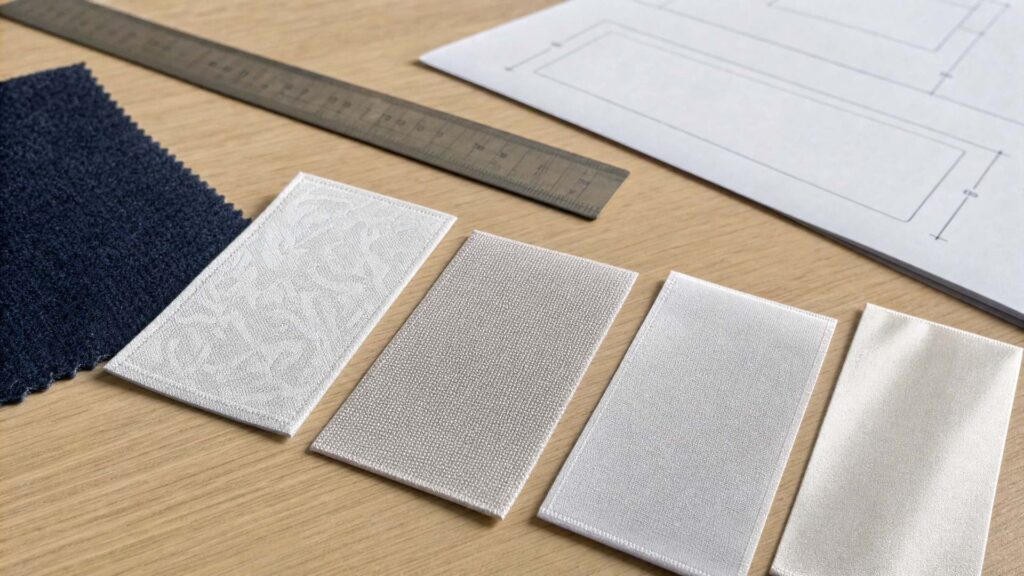
Custom Woven Labels for Clothing: Size, Wording and the Proof You Approve Before Production
14 October 2026

How It Works
Buying clothing from Italy is one of the most commercially effective decisions an independent boutique or multi-brand retailer can make. Italian womenswear consistently commands a higher retail price point than comparable garments sourced from commodity markets, and the origin itself carries a credibility that translates directly into sell-through rate. The challenge is that the Italian wholesale system operates on its own logic, different timelines, different minimums, different supplier expectations, and buyers who approach it without preparation often leave disappointed or overspent. This guide walks through the process from the beginning.
The Italian wholesale market is not a single channel. It includes open wholesale fairs like Milano Unica or Pitti Uomo, independent showrooms scattered across Florence and Milan, and concentrated pronto moda districts where suppliers hold ready-to-ship stock year-round. For international buyers sourcing womenswear at mid-market price points, the Prato district near Florence is the most relevant entry point. It concentrates approximately 7,000 fashion businesses within a compact geographic area, many of them wholesalers carrying finished ready-to-wear across multiple categories, dresses, coord sets, linen separates, occasionwear, knitwear and outerwear.
The key distinction for buyers new to Italian sourcing is between pronto moda and seasonal production. Pronto moda suppliers in Prato produce continuously throughout the year, updating their stock on a rolling basis rather than delivering twice-yearly collections. This means a buyer visiting in February and another visiting in July will see largely different assortments. It also means that when you identify something you want to order, the window to secure it is often shorter than in traditional wholesale, stock moves fast, and popular styles are not always reordered.
The landed cost of Italian wholesale clothing covers more than the supplier invoice. Buyers sourcing from Italy for the first time frequently underestimate the full cost structure, which includes the wholesale price per piece, the supplier minimum (typically between EUR 300 and EUR 500 per showroom), any sourcing service fees, freight consolidation, export documentation, import duties in the destination country, and last-mile delivery. For a session covering four to six suppliers with a total spend of EUR 3,000 to EUR 5,000, the all-in landed cost per garment typically increases the ex-factory price by 25 to 40 percent depending on destination and shipment volume.
The retail margin equation, however, remains highly favourable. A linen dress bought wholesale at EUR 28 to EUR 35 in Prato can be retailed at EUR 95 to EUR 140 in a well-positioned independent boutique in Northern Europe, North America or the Gulf. The margin multiple of 3x to 4x is standard for Italian mid-premium womenswear, and is significantly higher than what most buyers achieve sourcing similar garments from Turkish or Asian wholesale markets. This is the core commercial case for sourcing Italian clothing directly.
Finding reliable suppliers is the most time-consuming part of buying clothing from Italy, particularly for buyers who cannot make multiple trips to the country. The Prato district alone contains thousands of businesses at varying quality and reliability levels, and there is no public directory that separates the well-run operations from the unreliable ones. The traditional approach, walking the district, visiting showrooms, building relationships over successive seasons, takes years and requires Italian language capability to navigate effectively. Most international buyers working at boutique scale simply do not have that time or those resources.
The alternative is to work through a local sourcing agent who has already built and verified a supplier network in the district. A good agent operates as a personal buyer on behalf of the client: pre-selecting suppliers that match the client’s style profile and budget, running a live purchasing session in which the buyer selects pieces directly via video call, and then managing order consolidation and export logistics. This model makes importing Italian fashion operationally manageable for buyers based outside Europe, without requiring any prior knowledge of the district or its suppliers.
The practical sequence for buying Italian wholesale clothing starts with a brief, a clear picture of the budget available, the categories needed, the price range per piece, and the style direction. Providing this upfront allows a sourcing agent or supplier to pre-select stock rather than presenting the buyer with everything in the showroom. A focused selection session of five to eight hours can cover more ground and produce better results than an open-ended visit without a plan.
After the selection is made, orders are placed directly with each supplier, typically with payment upfront or on short credit terms. In a consolidated sourcing operation, all individual supplier invoices are merged into a single shipment, which reduces freight cost and simplifies customs documentation at the destination. The Italian fashion sourcing process in Prato typically runs from initial contact to goods-in-warehouse in four to six weeks for in-stock items, with the exact timeline depending on shipment size and destination country.
Buyers should also plan for the customs clearance stage at their end. Import duties on clothing vary by country, in the EU, standard clothing tariffs run at 12 percent; in the UK, most womenswear attracts 12 percent import duty; in the US, the rate is typically between 12 and 27 percent depending on garment type and fabric composition. These rates need to be factored into the landed cost calculation before placing the order, not after.
Italian wholesale suppliers in the pronto moda segment operate with per-showroom minimums rather than per-style minimums. A typical supplier in Prato will require a minimum spend of EUR 300 to EUR 500 per visit, with a minimum of two to twelve pieces per style depending on the category. These figures vary by supplier, some work with lower thresholds for new buyers, others are stricter, but the general principle is that a meaningful order, not a sampling exercise, is expected. Buyers who approach Italian wholesale with the intent of placing very small test orders of one or two pieces often find that suppliers are not equipped or willing to process them.
For boutique buyers working with limited budgets, the practical implication is that it is better to focus depth on fewer suppliers than to spread thin across many. A selection session covering three to five suppliers with EUR 600 to EUR 1,000 per showroom produces a coherent, commercially viable order. This approach also builds supplier relationships faster, which matters in a market where continuity of access is directly linked to trust. For buyers looking for private label production italy opportunities, the same principle applies, meaningful volumes and clear commercial intent are required to engage with quality suppliers. Buyers who want to understand what a structured selection session looks like in practice can review how the full sourcing process works before committing to a session.
The most common mistake made by first-time buyers sourcing clothing from Italy is treating the process as an online shopping exercise. Italian wholesale, particularly in the pronto moda segment, is a relationship-based, in-person industry. Suppliers in Prato are not typically equipped to respond to cold email inquiries from international buyers, and many do not operate e-commerce platforms or publish their catalogues online. Access requires either a physical presence in the district or a trusted intermediary with existing relationships. Professional italian fashion services can bridge this gap by providing established supplier relationships and local market knowledge.
A second frequent error is underestimating the importance of seasonal timing. While pronto moda stock is available year-round, the composition of supplier assortments changes significantly with the season. Buyers looking for lightweight linen and summer coordinates will find the best selection between January and March, when suppliers are showing their spring-summer stock. Buyers looking for knitwear and outerwear should plan visits or sessions between July and September. Arriving outside the relevant sourcing window often means finding depleted or transitional stock rather than the full seasonal range.
Italian fashion supply, curated and delivered to your inbox.
How can we assist?
See our services