Custom Woven Labels for Clothing: Size, Wording and the Proof You Approve Before Production
14 October 2026
Case Study
A Northern European boutique buyer working with Italian Fashion Sourcing this June offers a useful real-world picture of how an AW26/27 italian fashion wholesale order actually comes together, from initial budget planning through to a consolidated shipment ready for the winter selling season. The retailer, a multi-brand boutique serving a customer base in a genuinely cold climate, had previously sourced two SS26 seasons through guided buying sessions and approached this AW26/27 order with a clearer sense of priorities than a first-time buyer typically brings to the process.
This case walks through the specific decisions made at each stage of the sourcing process, illustrating how the broader category and timing principles already covered throughout this season’s sourcing series play out in an actual order rather than as general guidance alone.
The buyer entered the initial interview with a defined total budget and a clear sense that structured outerwear and knitwear would anchor the order, given the genuinely cold winters in their market. Heavyweight coats and padded jackets were flagged early as a priority category rather than an afterthought, reflecting the practical climate need driving much of their customer base’s winter purchasing behaviour.
This early clarity on category weighting made the pre-scouting phase considerably more efficient than it might have been with a more open-ended brief, since the agency could focus supplier research specifically on manufacturers strong in heavyweight outerwear and structured knitwear rather than surveying the full breadth of AW26/27 categories equally.
Pre-scouting identified several Prato suppliers with strong heavyweight outerwear production, distinct from the broader structured tailoring specialists covered in earlier sourcing conversations this season, since the buyer’s priority was genuine cold-weather performance rather than primarily fashion-forward silhouette. This distinction mattered directly, since a generalist outerwear showroom would not have had the same depth of padded jacket and heavyweight wool coat options as the specialists identified during scouting.
Knitwear suppliers were also pre-selected based on gauge weight and yarn quality suited to the buyer’s climate, prioritising heavier rib knits and cable constructions over the lighter knitwear options that might suit a milder market, which meant the live session itself could move efficiently through relevant options rather than spending time on styles unsuited to the buyer’s actual customer base.
This level of targeted matching is generally not possible for a buyer working without local guidance, since identifying which Prato showrooms genuinely specialise in heavyweight technical outerwear, as opposed to those producing primarily fashion-driven tailored pieces, requires direct, ongoing familiarity with the district’s supplier base rather than information easily gathered from a general search or a single introductory visit.
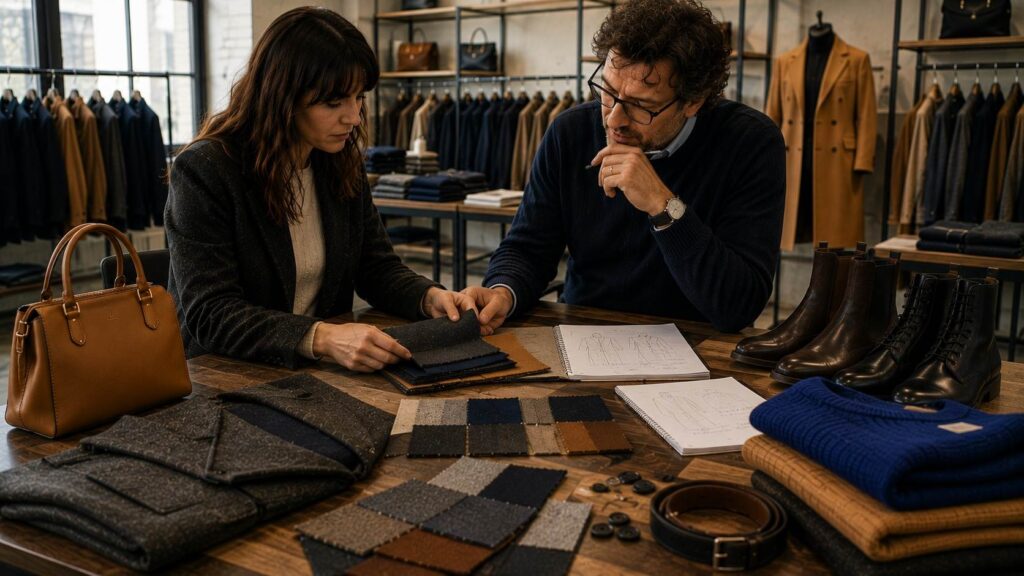
During the live video session, the buyer was able to compare heavyweight coats from three different suppliers side by side, examining lining quality, shoulder structure and fill type on padded jackets directly with showroom representatives rather than relying on photographs. This comparison surfaced a meaningful quality difference between two similarly priced padded jacket suppliers, with one offering noticeably higher fill power down at a comparable price point once the full specification was discussed.
The buyer ultimately split their outerwear order across two suppliers rather than consolidating with a single source, a decision made directly during the session once it became clear that one supplier’s strength was heavyweight wool coats while the other’s was padded jackets, and combining both gave a more balanced assortment than concentrating the full budget with either supplier alone.
This kind of side-by-side specification comparison, where two suppliers initially appeared comparable on price alone, is difficult to replicate through separate email exchanges with each showroom individually, since it relies on having both suppliers’ detailed answers available for direct comparison within the same conversation rather than spread across asynchronous correspondence over several days.
Consistent with the broader cobalt, camel and charcoal direction shaping this season’s collections, the buyer weighted their order toward camel and charcoal as the dominant colours for heavyweight outerwear, reserving cobalt for a smaller number of statement knitwear pieces rather than extending it into the technical outerwear category. This reflected guidance the buyer had already absorbed from earlier sourcing conversations about how differently cobalt performs across functional versus fashion-forward categories this season.
The final order also included a modest denim allocation and a small accessories selection, both added during the same session once the core outerwear and knitwear budget was confirmed, illustrating how a single consolidated session allows a buyer to build a complete assortment rather than treating each category as a separate sourcing exercise.
With purchases spread across three separate Prato suppliers, order consolidation into a single shipment was a meaningful practical benefit for this buyer, avoiding three separate deliveries with three separate customs processes. The heavier volumetric weight of the finished order, dominated by padded jackets and wool coats, was factored into the buyer’s budget as an estimated range rather than a fixed figure until the shipment was actually packed and weighed.
Given the buyer’s Northern European location, the consolidated shipment benefited from a comparatively favourable regional shipping rate, though the buyer still saw a noticeably higher shipping line item than their previous SS26 orders, consistent with the volumetric weight differences already typical of bulkier winter garments compared with lighter summer pieces.
The buyer had been advised during the initial interview to expect this shipping increase relative to previous SS26 orders, which meant the higher line item, once confirmed after packing, did not disrupt the overall budget the way an unanticipated cost increase might have for a buyer who had not been prepared for the volumetric weight difference in advance.
This buyer’s experience illustrates several of the season’s broader sourcing patterns covered in earlier articles in this series, particularly the value of matching supplier specialisation to actual category needs rather than assuming any outerwear showroom can deliver genuine heavyweight performance, a distinction covered directly in the discussion of wool, velvet and jersey pieces moving through Italian wholesale.
The case also demonstrates how early category clarity, established during the initial interview rather than discovered mid-session, allows pre-scouting to do more of the matching work in advance, which in turn makes the live session itself more efficient and decision-focused rather than exploratory.
This buyer began their sourcing process in June, consistent with the early-commitment pattern recommended throughout this season’s coverage in the AW26 sourcing session in Prato guide, which gave them access to the full range of heavyweight outerwear options before specialist supplier capacity tightened further into late summer. Several of the padded jacket and wool coat suppliers identified during pre-scouting were already reporting strong early demand at the time of this buyer’s session.
Had this buyer delayed their sourcing process into September, several specialists identified during pre-scouting may not have had comparable capacity remaining, which would likely have forced a compromise on either supplier quality or delivery timing relative to the buyer’s desired in-store date ahead of peak winter selling.
The buyer’s finalised AW26/27 order combined heavyweight outerwear from two specialist suppliers, climate-appropriate knitwear, a modest denim allocation, and a small coordinated accessories selection, consolidated into a single shipment with an agreed delivery window ahead of the core winter selling season. This category mix reflects a buyer who entered the process with clear priorities and used the live session to refine specific supplier and colour decisions rather than starting from scratch on category strategy during the session itself.
For boutiques approaching their own AW26/27 sourcing with similarly cold-climate customer needs, this case suggests that early category clarity, paired with supplier specialisation matched to genuine performance requirements rather than general outerwear capability, produces a more efficient and better-targeted sourcing session than a more open-ended approach.
This AW26/27 case illustrates how the category, timing and pricing principles covered throughout this season’s sourcing series translate into an actual boutique order, from the value of matching supplier specialisation to real climate needs through to the practical benefits of order consolidation for a multi-supplier purchase. Boutiques planning their own AW26/27 italian fashion wholesale order this summer can draw directly on this buyer’s approach: define category priorities early, lean on pre-scouting to identify genuine specialists rather than generalists, and commit to a sourcing session before specialist supplier capacity tightens further into the autumn buying rush.
If you recognise your own boutique’s priorities in this case, a guided sourcing session starts the same way this buyer’s did: with an interview to define your category priorities before pre-scouting begins. Start at italianfashionsourcing.com/interview/ and we will match you with the Prato specialists best suited to your market and customer base for AW26/27.
Italian fashion supply, curated and delivered to your inbox.
How can we assist?
See our services