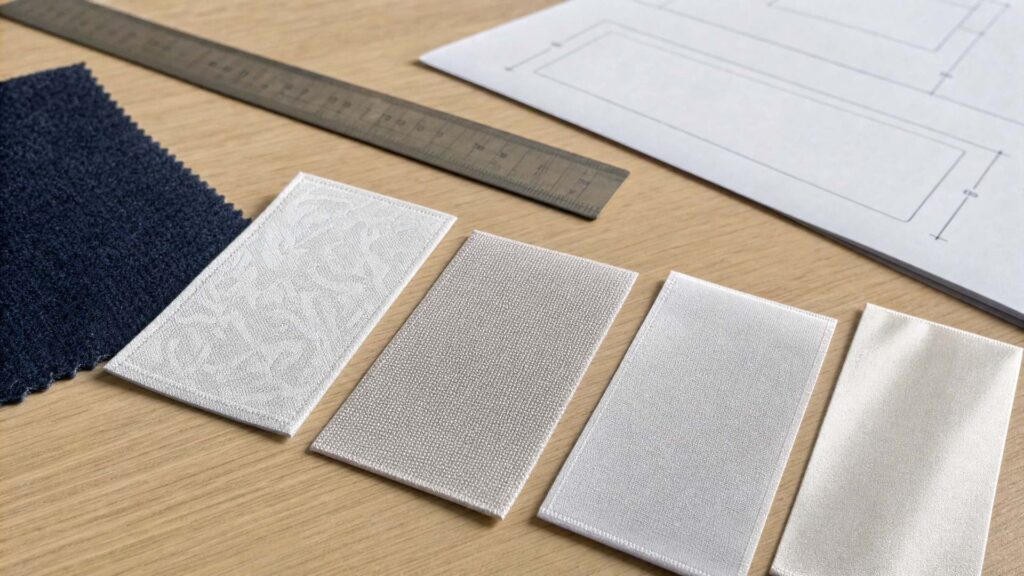
Custom Woven Labels for Clothing: Size, Wording and the Proof You Approve Before Production
14 October 2026

Sourcing Strategy
Linen has a reputation for being a straightforward fabric. It’s natural, it breathes, it creases. But for boutique buyers sourcing Italian pronto moda remotely, that apparent simplicity hides a wide performance gap between one piece and the next. Two garments photographed side by side in a Prato showroom can look identical and sell at very different retail price points — not because of the design, but because of the yarn weight, weave density, and how the fabric was finished after production.
The gap matters commercially. A linen dress made from loosely woven 150-gram fabric will lose its shape after three washes. A dress made from a tighter 220-gram weave with a softening treatment will hold its structure through a full season and resell well in end-of-season edits. Buyers who understand the difference can negotiate better, build more defensible price points, and avoid the customer service problems that come with garments that underperform. These checks are one part of a wider process, and our complete guide to Italian linen wholesale covers minimums, payment, timing and shipping as well.
Prato spans the full range. Some manufacturers are working with premium European flax; others are using blended yarns and finishing treatments to approximate the look. On a screen, the difference between these two categories is often invisible — which is exactly why the price gap between them can be so hard to explain to a customer who feels she got a worse product than the showroom suggested.
When evaluating linen in person or through a close-up video session, four factors carry the most weight. The first is yarn regularity. High-quality linen yarn, spun from longer flax fibres, shows consistent thickness along the thread length. Cheaper blends made from shorter fibres tend to have visible irregularities — small thickened sections that catch the light unevenly. These are not the natural slubs you find in artisanal linen; they are inconsistencies that suggest lower raw material grade.
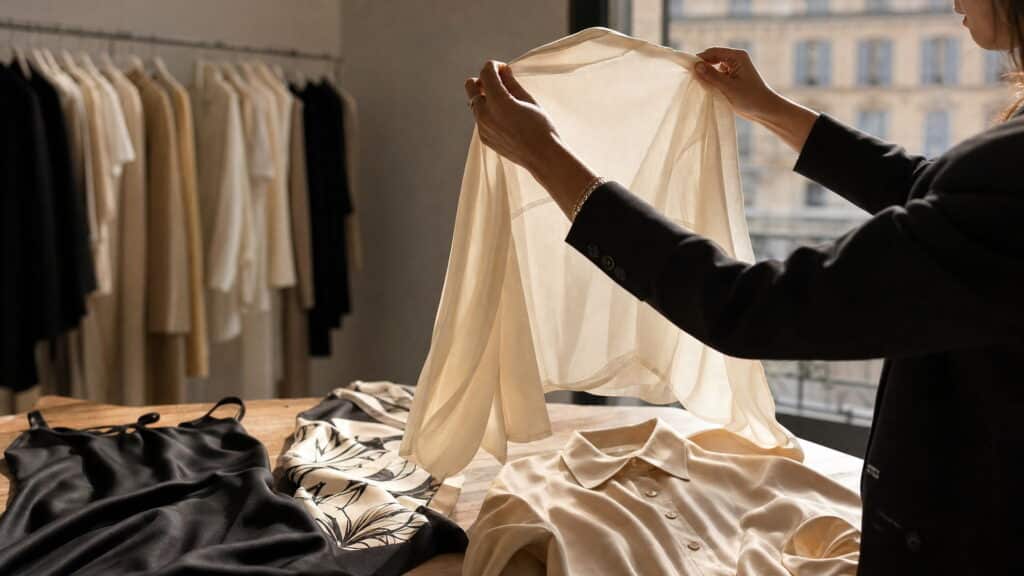
The second indicator is weave density. Hold a piece of linen fabric up to the light — or ask a supplier to do this during a video sourcing session. A tightly woven piece should show minimal light transmission and a clearly defined grid pattern. Loosely woven fabric will appear almost translucent, which affects both opaqueness at retail and durability in wear. For shirting and wide-leg trousers, which are the two SS26 silhouettes where linen is currently doing the most commercial work, weave density is directly linked to how the garment holds its shape through the day.
Third is hand feel, which you can partially read through video by watching how a fabric drapes when held between two fingers and released. Stiff recovery suggests heavy sizing — a finishing treatment sometimes used to simulate body in a lighter fabric. Fluid recovery with some residual crease indicates natural body without chemical assistance. The fourth indicator is surface finish: look for consistent colour saturation, absence of surface pills, and whether the selvedge edges are clean.
Pure linen is only one part of what Italian pronto moda suppliers work with. Linen-cotton, linen-viscose, and linen-modal blends have been growing steadily in SS26 collections, and each blend changes the commercial profile of the garment in ways buyers should account for when building an order. The evolution of linen blends in SS26 womenswear reflects a deliberate supplier response to buyers asking for fabrics that travel better and crease less.
Linen-viscose blends, which now account for a significant share of the lightweight dress and blouse category in Prato, trade some of linen’s natural structure for a softer drape and reduced creasing. For boutiques selling to customers who wear these pieces on holiday or in warm climates, the trade-off makes commercial sense. For boutiques whose customers value the crisp, textured aesthetic of pure linen, the blend can read as a downgrade — even if the price point is similar.
Linen-cotton blends sit in a different position: they tend to hold their shape better than pure linen in lighter weights, which makes them useful for shirt-style garments where structure matters. The key question for buyers is not whether a blend is better or worse than pure linen in abstract terms, but whether it serves the specific end-use the customer has in mind. The fabric composition label tells you the blend ratio; the fabric behaviour under light and handling tells you whether the composition is being used honestly.
Most international buyers working through a sourcing agent in Prato will never touch the fabric before the shipment arrives. That makes the pre-order conversation with a supplier — or with the agent managing it on your behalf — the primary quality checkpoint. The questions that give you the most useful information are specific rather than open-ended.
Ask for the fabric weight in grams per square metre rather than accepting descriptions like ‘medium weight’ or ‘quality linen.’ A summer blouse in the 120–150 g/m2 range will be light and somewhat delicate; a coord set in the 180–210 g/m2 range will have the structure needed for a trouser or straight-cut jacket. Ask whether the fabric has been pre-washed or whether it will shrink after the customer’s first wash. Ask about the yarn origin — European flax, primarily from France and Belgium, produces a finer, longer-staple fibre than most Asian-sourced equivalents, and the difference shows in the finished garment’s lifespan.
During a live sourcing session with Italian Fashion Sourcing, these questions are built into the showroom visit workflow. The agent handles the technical conversation with the supplier so the buyer can focus on the selection. But having this framework in mind before the session helps buyers make faster, more confident decisions when they see the range.
The finishing stage is where a lot of the quality variation in pronto moda linen gets introduced — and where buyers who don’t know what to look for can be misled. Stone washing creates a lived-in surface that photographs well and hides minor imperfections in the base fabric. It also weakens the seams slightly compared to untreated linen of the same weight, which matters for garments like wide-leg trousers that see repeated stress at the side seams.
Enzyme washing produces a softer handle without roughening the surface texture, and it tends to be used on higher-grade base fabrics because the cost of the treatment isn’t worth applying to cheaper yarns. Silicone finishing creates a smooth, almost synthetic feel that some buyers mistake for quality but which tends to wash out after a few cycles, leaving a coarser handle than the customer experienced in store. When evaluating linen garments through video or photos, look for how the surface responds to folding — genuine softness from enzyme treatment holds its character under compression; silicone-finished fabric often has a slightly glassy surface sheen that disappears when the fold is released.
Understanding finishing treatments also helps buyers interpret price variation in SS26 linen collections. Two coord sets at very different price points from different Prato suppliers may use the same base fabric weight, with the price difference explained entirely by the finishing quality. The relationship between quality and price in pronto moda is not always linear, and finishing is one of the main reasons why.
If you’re building your next linen buy and want to evaluate fabrics live with a Prato-based expert on your side, the first step is a short introduction call. You can book it at italianfashionsourcing.com/interview/ — we’ll cover your target price points, the styles you’re looking for, and how to set up a sourcing session that saves you time and reduces order risk.
Italian fashion supply, curated and delivered to your inbox.
How can we assist?
See our services