Kid mohair sweaters wholesale is the category international boutiques ask about most once cold weather buying begins, and the reason is visible from across a shop floor. No other knit communicates luxury as immediately as mohair’s soft, light-catching halo, and no other district produces it as finished ready-to-wear at Prato’s price points. This article looks specifically at the sweater formats, compositions and colours performing in showrooms right now; for the full category picture across all three noble fibres, our complete guide to kid mohair, baby alpaca and cashmere blend knitwear in Prato covers pricing, private label production and worldwide shipping in one place.
Why the Kid Mohair Halo Works So Hard at Retail
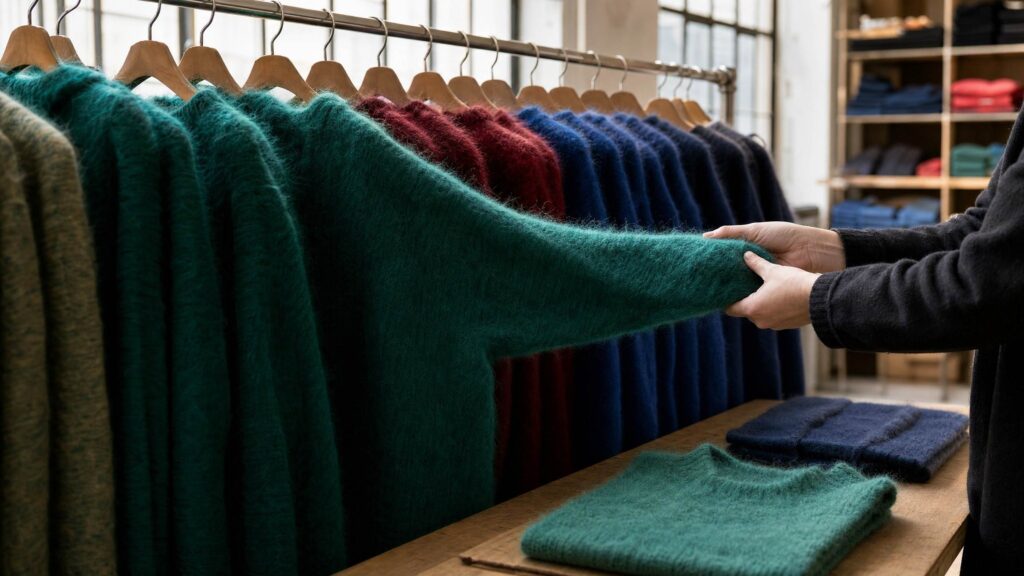
Kid mohair is the fibre from the Angora goat’s first shearing, finer and softer than adult mohair, and its defining trait is lustre. The fibre’s surface scales lie almost flat, so light reflects off a kid mohair sweater in a way wool physically cannot reproduce. On the shop floor this behaves like built-in visual merchandising: the garment glows slightly under retail lighting, the surface halo gives it three-dimensional depth on a hanger, and customers reach out to touch it without being prompted. Touch, in knitwear retail, is most of the sale.
The commercial consequence is that kid mohair sweaters carry a boutique’s window and social content through the winter months. A single emerald oversized crewneck photographs with more presence than an entire shelf of flat merino, which is why buyers increasingly plan mohair as their content category as much as their sales category. Wholesale prices for these finished garments in Prato run from roughly 20 to 45 euros depending on fibre percentage and weight, a band that supports retail tickets between 59 and 119 euros while preserving a full markup.
Blend Composition: Why 25 to 40 Percent Beats Higher Concentrations
Buyers new to mohair often assume a higher percentage means a better garment, and the showroom reality is more interesting. Prato’s kid mohair sweaters typically contain 25 to 40 percent kid mohair, blended with polyamide and wool. The polyamide is not a cost-saving filler; it is the structural core that gives the knit elastic memory. A sweater built on that core returns to shape after wearing, keeps its cuffs firm across a season of retail try-ons and survives customer washing mistakes far better than delicate high-percentage knits.
Very high mohair concentrations also shed more, weigh less than customers expect and demand hand-washing discipline most end consumers will not maintain. The 25 to 40 percent band is where sensory impact and real-world durability meet, and it is where the district concentrates its production for exactly that reason. When comparing two similar sweaters in a showroom, the fibre percentage on the composition tag matters less than how the specific yarn was spun and knitted, which is why physically handling garments during a session remains irreplaceable.
The Sweater Silhouettes Selling in Prato Showrooms
Three formats dominate current wholesale orders. The oversized crewneck is the anchor: dropped shoulders, ribbed hem and cuffs, a body length that works over both denim and tailored trousers. It is the piece boutiques reorder most because it fits the widest range of customers and styling contexts. The second format is the cropped cardigan, usually with statement buttons in horn or gold tone, which sells to a younger customer and layers over dresses. The third is the sleeveless vest, an entry-price route into the fibre that layers over shirting and extends the selling season into early spring.
Within these formats, details separate strong sellers from shelf-sitters. Balloon sleeves photograph well but size unpredictably, so they suit boutiques that can offer fitting guidance. Mock necks outsell true turtlenecks in mohair because the fibre near the chin divides customers. Longline cardigans in mohair exist but compete with alpaca coatigans, which handle that silhouette better. A focused mohair order of one crewneck in three colours, one cardigan and one vest gives a boutique a coherent story without duplicating what its other fibres already do.
Unit depth is the other silhouette decision. Because pronto moda restocks quickly, the district rewards shallow initial buys: two or three pieces per size in the hero crewneck, single-size runs in the cardigan and vest, and a reorder placed the week the first colour proves itself. Sizing in oversized formats is forgiving, which lets a boutique cover its customer base with two sizes where fitted knitwear would demand four. That compression of the size curve is a quiet margin advantage of the oversized silhouette that rarely appears in trend commentary but shows up clearly in the buying arithmetic, since every size dropped from an order is capital released for an additional colour.
Colour Strategy: Jewel Tones Are the Point
Mohair takes dye with a saturation and luminosity flat fibres cannot achieve, and the current season rewards buyers who exploit it. Emerald, ruby, sapphire, amethyst and deep teal are the tones moving through Prato showrooms, alongside a softer secondary story of powder pink and butter yellow for markets that resist dark winters. Buying mohair in beige or grey wastes the fibre’s principal advantage; those neutrals belong to the cashmere blend basics wall, where they anchor outfits rather than lead them.
A workable colour plan for a boutique is one hero colour bought in depth, two supporting tones bought shallow, and a willingness to reorder whichever proves right within the season, since pronto moda collections refresh every three to four weeks. This chromatic role for mohair sits inside a broader tactile direction in Italian collections this winter, where surface interest is consistently outperforming flat fabric across categories, a pattern documented in our report on winter texture trends across Italian pronto moda.
Showroom Checks Before You Commit
Kid mohair has one honest behaviour buyers should verify rather than fear: light shedding in a garment’s first weeks. Well-produced sweaters are steam-finished before packing, which settles loose surface fibre. The showroom test is simple: press a flat palm against the knit and draw it across the surface once. A properly spun and finished garment releases almost nothing; a poorly made one deposits visible fibre immediately, and that garment will do the same on your customer’s black coat.
Beyond shedding, check the ribbing recovery by stretching a cuff and watching it return, inspect the linking at shoulder seams for flat, even joins, and hold the body up to window light to confirm knit density is consistent rather than thin at the sides. These checks take under a minute per style and are performed on camera during live sessions, where our team handles each garment while you watch. Care labelling matters too: garments carrying clear hand-wash or gentle-cycle instructions reduce returns, and it is worth briefing shop staff to pass that guidance on at the till.
Weight class is worth checking too. Prato produces kid mohair sweaters in distinctly different knit weights, from gossamer seven-gauge layers to dense winter pieces, and the difference is not always obvious in photographs. A lighter knit suits boutiques in milder markets and layers over shirting; the heavier weights read as principal winter garments and justify the top of the retail band. Asking the showroom to hold two weights side by side on camera settles the question in seconds, and mixing one of each into the order lets the shop floor serve both the October customer and the January one from the same rail.
Ordering Kid Mohair Sweaters Wholesale Through a Live Session
Prato’s mohair specialists are wholesale showrooms rather than public shops, restocked on short cycles and operating in Italian, which is the access problem a guided session solves. After an initial interview establishing your market and budget, suppliers are pre-scouted to your profile and visited live on video, so you evaluate halo, colour and construction in real time and build one consolidated order across several specialists. Supplier minimums are modest, generally a few pieces per style, and there is no minimum order value on the sourcing side; the service fee is 10 percent of purchase value with a 250 euro minimum commission. The mechanics from interview to delivery are laid out on our fashion sourcing and purchasing service page.
For boutiques building a winter around statement knitwear, kid mohair sweaters wholesale from Prato offer the rare combination of visual drama, honest pricing and restock agility. Buy the halo in colours only this fibre can carry, verify construction with your own eyes on camera, and keep budget in reserve for the reorder, because the first jewel tone that sells out will tell you exactly what your customers want more of.