Custom Woven Labels for Clothing: Size, Wording and the Proof You Approve Before Production
14 October 2026
Sourcing Strategy
Luxury knitwear retail pricing is where the Prato advantage either compounds or evaporates. A boutique that sources kid mohair, baby alpaca and cashmere blend garments at 15 to 45 euros wholesale has bought itself the raw material of an excellent winter; whether that winter delivers depends on disciplines that happen after the boxes arrive, on tickets, tables, sentences and steam. This article collects those retail disciplines in one place; the buying side that precedes them, categories, showroom prices and ordering, lives in our guide to kid mohair, baby alpaca and cashmere blend knitwear wholesale in Prato.
The foundational number is landed cost per garment: wholesale price plus the 10 percent sourcing fee plus allocated freight and destination duty, a sum that typically adds 12 to 20 percent over wholesale for non-European boutiques and less within Europe. Retail tickets are then set at roughly 2.5 times that landed figure, which places the Prato ladder at approximately 49, 79 and 129 euro price points across its entry, middle and statement bands. The full mechanics of that calculation, and how it compares across sourcing channels, are worked through in our analysis of boutique gross margin against Italian sourcing costs.
Two refinements make the arithmetic retail-ready. Round into clean psychological price points, since 79 outsells 82.37 for reasons no spreadsheet captures, and let the rounding absorb small landed cost differences within a band so the wall shows three prices rather than eleven. And build no markdown provision into knitwear basics at all: garments in permanent colours that reorder within days do not need the discount insurance that fashion categories quietly carry in their tickets, and removing it is worth two to three margin points on the highest-volume pieces in the shop.
Noble fibre garments arrive with their justification built in; the retail task is making it sayable. Kid mohair from the Angora goat’s first shearing, baby alpaca graded at 22 microns, misto cashmere at a declared percentage, knitted in the Prato district: each is a sentence a customer can repeat to someone else, which is the actual test of a price justification at this level. Staff who can deliver the right sentence with the garment in hand convert hesitation at 129 euros far more reliably than any general vocabulary of luxury and quality, words that customers have learned to hear as noise.
The story should also be visible without staff. A small printed card on the knitwear table naming the three fibres and one fact about each does silent work all day, and the composition swing tag, which Prato garments carry as a legal matter, becomes an asset when the display teaches customers to look for it. Boutiques report that once regulars learn to read percentages, they trade themselves up the ladder unprompted, because the tags convert the price differences from arbitrary into explicable, and explicable differences are the ones people pay.
Fibre stories also segment naturally by customer. The provenance narrative, first shearing, micron counts, the Prato district, lands with the quality-literate customer; the practical narrative, warmth without weight, machine-forgiving blends, a garment that keeps its shape, converts the sceptic who distrusts luxury language altogether. Staff who can read which customer is in front of them and choose the register accordingly are performing the highest-value selling in the shop, and the reading skill is teachable in a single team meeting with the garments on the table.
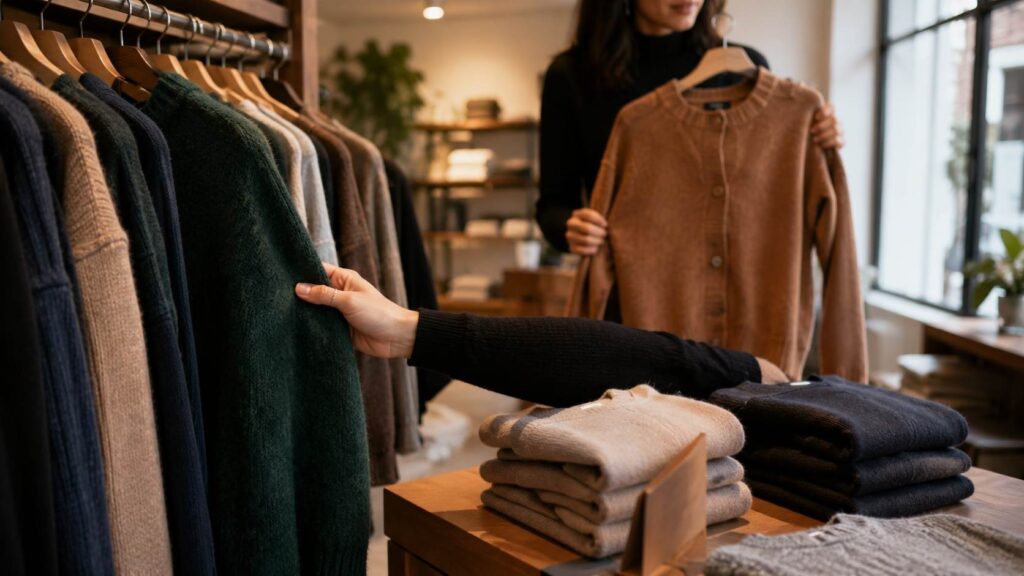
Knitwear is bought by touch, so the display’s single job is getting fibre under fingertips. Folded stacks at counter height invite the hand in a way hanging rails only partially match; the highest-converting arrangement most boutiques find is a touchable table of folded basics forward, statement pieces on adjacent rails at eye line, and one hero garment dressed on a form near the entrance where its silhouette does the advertising. Glass, height and over-tidiness are the enemies: a stack too perfect to disturb is a stack that will not sell, and staff should restyle rather than police it.
Lighting completes the physics. Mohair’s halo and alpaca’s surface glow are light effects, and they reward warm directional lighting angled across the garments rather than flat overhead wash; the difference is visible from the street and costs a repositioned spotlight. Colour blocking, the jewel zone and natural zone bought deliberately in Prato, should survive intact onto the floor, because customers navigate by colour before category and a wall arranged by the buyer’s logic sells that logic.
Rotation keeps the physics working. Knitwear flattens and dulls under a fortnight of handling, so a weekly quarter-hour of steaming the display pieces and rotating stack orders restores the loft and halo that justify the tickets; the steam that finishes garments in Prato workshops has a retail counterpart, and boutiques that treat it as routine floor discipline report displays that photograph as well in January as they did in October. The habit costs nothing and protects the shop’s most expensive visual asset, which is the fibre itself behaving as promised.
Returns are where knitwear margins leak, and most knitwear returns are preventable care failures: the mohair sweater machine-washed, the alpaca cardigan hung until it grew, the cashmere blend shaved by a hot dryer. The protection is a fifteen-second script at the till, hand wash or gentle cycle cold, dry flat, store folded, delivered as insider advice rather than warning, plus the care label pointed out physically. Boutiques that institutionalise this script report return rates on knitwear dropping measurably within a season, which at a 79 euro average ticket is not a rounding error.
The conversation doubles as relationship building. Care advice is one of the few till-point exchanges customers experience as generosity rather than selling, it positions staff as knowledgeable rather than transactional, and it seeds the return visit, since the customer who was taught to care for her mohair comes back to the shop that taught her. A one-line care card in the bag, costing cents, extends the same service home and carries the boutique’s name onto the shelf where the sweater lives.
Pilling deserves one honest sentence in the same conversation. All noble fibre knits pill lightly where friction concentrates, a fact better volunteered at purchase, with the remedy, a simple cashmere comb, sold or gifted alongside, than discovered at home and interpreted as a defect. Boutiques that stock combs beside the knitwear wall convert a potential return conversation into a small accessory sale and a demonstration of expertise, which is the pattern all good care retailing follows: anticipate the fibre’s honest behaviour and monetise the anticipation.
Statement pieces earn part of their keep without selling. A 149 euro coatigan on the floor re-frames every ticket beneath it: the 89 euro alpaca cardigan becomes the sensible choice rather than the expensive one, and the 79 euro middle band, where the assortment’s volume lives, sells in the statement’s shadow at full price. This anchoring effect is why the top band is bought shallow but must be bought, and why marking statements down mid-season is doubly expensive, costing both the piece’s margin and the ceiling it was holding up for everything else.
Anchors work best when they are visibly exceptional rather than merely priced high: richest fibre content, deepest colour, the garment staff would choose for themselves. One per zone is enough, rotated as the season’s waves bring new arrivals, and the rotation itself is merchandising, giving regulars a reason to re-walk a wall they think they know. The economics of the entire knitwear floor, in this sense, are architectural, with each band doing structural work for its neighbours, exactly as the wholesale ladder in Prato was designed to allow.
Every discipline above assumes garments that can support it, honest compositions, clean construction, landed costs that leave room in the ticket, which is to say the retail half of the knitwear margin is enabled or crippled at the buying stage. The entry point to buying that way is a conversation about your market, your customers and your price points, which is precisely what the initial interview exists to establish before any session is planned. Luxury knitwear retail pricing, done on that foundation, stops being a season of guesses and becomes what it is for the strongest independent boutiques: a repeatable system where Prato supplies the garments and the shop floor, deliberately run, supplies the margin.
Italian fashion supply, curated and delivered to your inbox.
How can we assist?
See our services