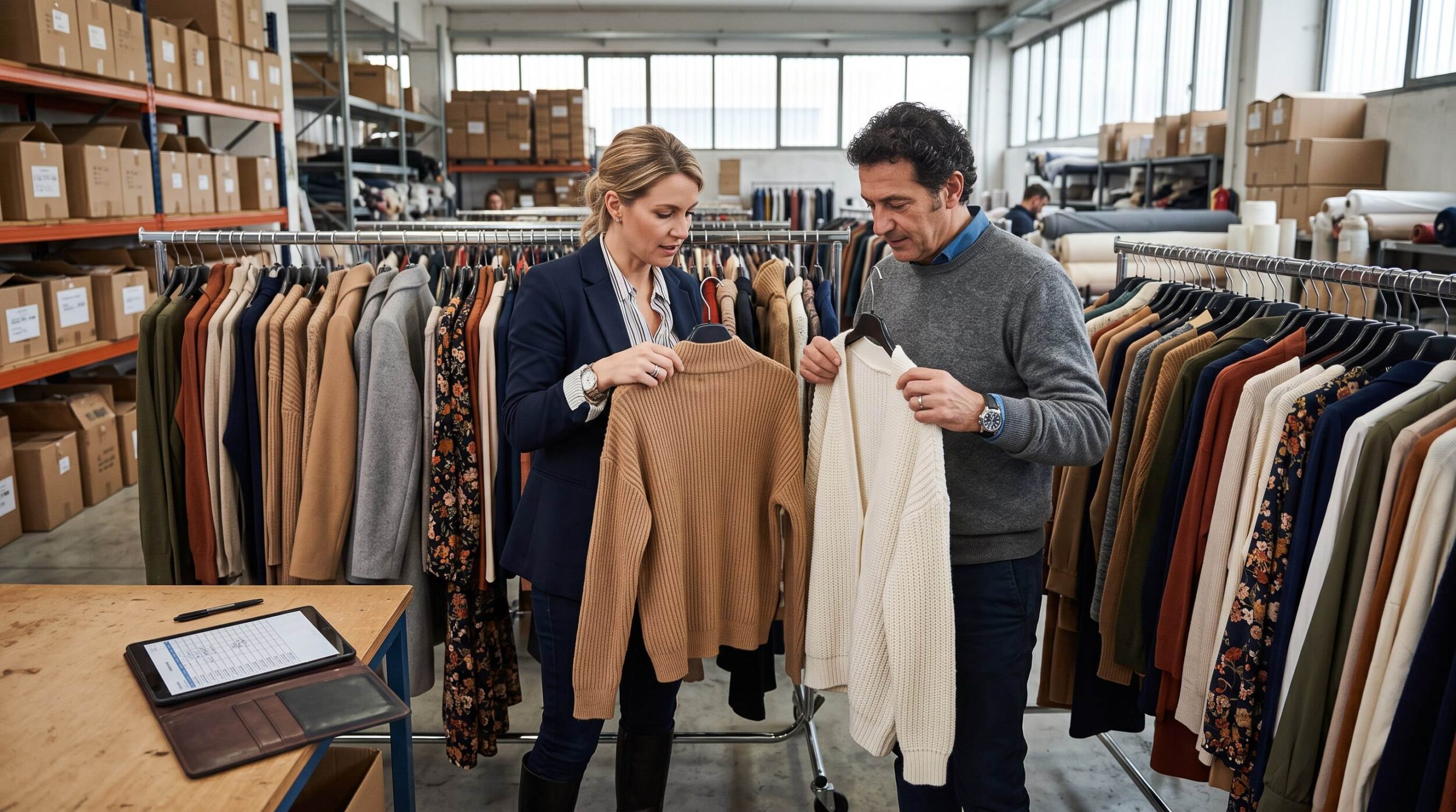

Knitwear availability in September is the question that comes up most often once the autumn season is already running. Showrooms are full, rails look complete, and a buyer walking through a Prato warehouse in the middle of the month sees what appears to be an untouched range. The picture is less generous than it looks. Knitwear is planned earlier than any other category, so by mid-September most of what will exist for the season already exists, and a meaningful share of it has already been allocated to someone else. The distance between a good September purchase and a frustrating one is almost entirely a matter of timing.
This piece deals only with that timing. Not with yarns, gauges, price architecture or quality control, all of which have been covered separately on this blog over the summer. The question here is narrower and more urgent for anyone buying right now: which references are still obtainable in mid-September, which have effectively closed, and how a boutique or an online retailer should structure whatever budget is left. Six years of buying inside the Prato district produce a fairly stable pattern, and that pattern repeats with only small variations from one autumn to the next.
Why Knitwear Availability in September Is a Timing Problem
Knitwear moves through the supply chain ahead of almost everything else. Yarn is committed and machine time is booked long before the selling window opens, because a knit programme cannot be improvised the way a woven top can be improvised. By the middle of September those decisions are closed and nothing substantial gets added to the district. What circulates is what was planned, minus whatever the earliest buyers have already carried away. The catalogue on paper stays wide for weeks. The range you can actually ship narrows every working day, quietly, without any announcement from the supplier.
The consequence for a retailer is that the September calendar behaves differently from the one they are used to. In categories where fabric is bought and cut close to the selling season, a late order is inconvenient. In knitwear it is frequently impossible, because the constraint sits upstream at the yarn stage and no amount of commercial pressure moves it. Suppliers are not withholding product to create urgency; they genuinely do not have more of it. Understanding that distinction changes the way a buyer negotiates, and it removes a good deal of frustration from a mid-September session.
What Has Already Closed: Italian Knitwear Wholesale Timing in Practice
What disappears first is almost never an entire model. It is the centre of the size curve. M and L on the strongest references go before anything else, followed by the colour that worked in photographs, and what stays on the rail is a complete model in sizes no boutique can sell in the same proportion. Typical supplier minimums sit around two to twelve pieces per style, which means a single order from another buyer can remove one size from a short production run. A model listed as available is not the same thing as a model available in a usable size range.
The second casualty is the upper part of the range. Noble yarns and heavier constructions are produced in deliberately limited quantities, because the raw material cost makes overproduction dangerous for the manufacturer. Those construction differences have been examined elsewhere; the point that matters this month is that the sweaters and cardigans that give an autumn winter range its character exist in the smallest numbers and close first. Basic references survive longer. Identity pieces do not. A buyer who postpones the distinctive part of the order until October is usually choosing among what other people rejected.
Why a Pronto Moda Knitwear Reorder Often Does Not Happen
A model that sells well is not automatically remade. This is the single most useful thing to understand about buying knitwear in a pronto moda district, and it contradicts the instinct most retailers bring from working with brands on a fixed seasonal order cycle. Warehouses in Prato work on rotation rather than repetition: the capacity that produced one reference in July is producing something else by late September, and the yarn lot behind it may no longer be obtainable at the same cost. Asking for a repeat is legitimate. Receiving one is a possibility, never a commitment, and no serious agent should present it differently.
There is a partial remedy, and its limits are worth stating plainly. When a specific reference is gone, a comparable one often exists in another warehouse, and fast replenishment handled by a buying agent already inside the district tends to be quicker than waiting for a manufacturer to schedule a second run. Private label is not a September answer either: with a minimum of 3,000 euro in order value and 100 pieces per model, it belongs to a planning horizon that opens months before the season starts, not in the weeks when it is already selling.
What Is Still Available in Mid-September for Autumn Knitwear Buying
Base references remain the safest part of the market well into the month. Plain crew necks and simple cardigans in neutral colours, together with fine-gauge pieces, are produced in depth because every retailer needs them, and warehouses restock them more readily than anything else in the range. Minimums here are the ordinary ones, generally three hundred to five hundred euro per warehouse, which makes it realistic to cover several suppliers within one session without inflating the total order. These are also the references that carry the season commercially, since they sell through slowly and continuously rather than in a single concentrated peak.
Beyond the base, what is left is residual, and it has to be treated as such. Single models are still on the rail, but with size curves already broken and colours reduced to whatever earlier buyers did not take, so the selection works only for a buyer willing to choose among what is physically present instead of arriving with a fixed list of references. Quality expectations should stay realistic too. In low-cost pronto moda up to 5% of pieces can show minor irregularities, and that tolerance is built into the price structure rather than being a failure on the supplier’s part. Checking goods on arrival matters far more than negotiating afterwards.
How to Structure a Budget for Autumn Knitwear Buying Now
Cover the base immediately and without hesitation. Those are the references that hold the season together, and they are also the ones most exposed to the size erosion described above. Then take the identity pieces in the same session rather than in a second one, because postponing a distinctive cardigan or a heavier yarn to a later visit amounts, in practical terms, to deciding not to buy it at all. The order in which a buyer commits weighs more heavily in knitwear than in any other category, since the recovery options available for a woven blouse simply do not exist here.
Keep a share of the budget aside for replenishment on whatever sells in the first weeks, and treat that share as an option rather than a plan. If the reference turns out to be repeatable, it gets repeated; if it does not, the same money moves to an equivalent piece found in another warehouse. Payment terms belong in the calculation as well, since the full amount is settled before shipment and goods travel DAP, with local duties and taxes falling to the buyer. One invoice and one consolidated shipment keep that arithmetic manageable even when several suppliers are involved.
September Knitwear Buying Runs Against a Saturated Calendar
September concentrates more buying activity than any other month on the Prato district, and that affects availability in a second, less visible way. The same references are being examined by many buyers within the same few weeks, while the warehouses themselves are working at capacity and sessions saturate quickly. Booking early is not a formality. A sourcing and purchasing session run on your behalf inside the warehouses is priced at ten per cent of the confirmed purchase value, with a minimum of 250 euro per working day, and on-site assistance is charged at the same daily rate plus commission.
The practical conclusion is unglamorous. What a buyer can still obtain this month is real but shrinking, weighted towards base product and against the pieces that differentiate a range, and it does not improve by waiting for better conditions. A retailer who commits before the month closes still has a workable market in front of them, with incomplete but usable choice. A retailer who waits for October will be buying what other people left behind, in size curves that were never chosen for their store.