
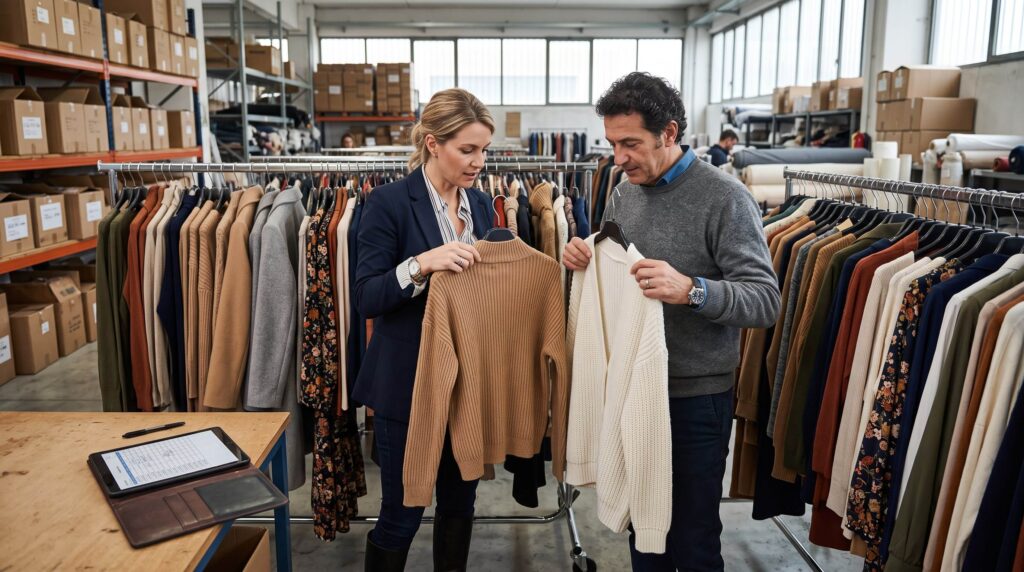
Peak season wholesale buying in the Italian pronto moda districts runs on a shorter clock than the rest of the year. September and October compress two flows into one short window of weeks: new stock reaching the warehouses, and buyers arriving from abroad or joining by video. A rail that looks well supplied on Tuesday morning can be visibly thinner by Thursday, and nobody announces the change. Boutiques and online stores new to the Italian market often read this as seller pressure. It is closer to arithmetic.
Why Peak Season Wholesale Buying Runs on a Shorter Clock
The mechanism is structural. A pronto moda warehouse buys or produces a limited run of a style, puts it on the floor and moves to the next one. Reorders happen when fabric and factory capacity allow, which means sometimes, and never on demand. Typical supplier minimums sit at 300 to 500 euro per warehouse and two to twelve pieces per style, so assortments are built to split across many small buyers rather than serve one. What sells first disappears first.
In high season the effect is amplified, because one warehouse serves many buyers inside a single narrow window. Six years across the Prato and Bologna districts have made the pattern predictable in shape, if never in detail. The strongest styles in a room tend to go early. What remains comfortably available late in the season is usually what nobody competed for. Waiting a week to confirm rarely produces a better version of that decision.
How a Live Buying Session in Italy Is Built to Produce Decisions
A productive day starts before anyone opens a door. The buyer arrives with a budget already split by category rather than a single global figure, because a global figure lets the first showroom absorb what the third one needed. Splitting means fixing in advance the share going to knitwear, outerwear and dresses, and accepting that those envelopes bend without breaking. The habits that make a first sourcing session in Prato work are the ones that carry a September day.
The second element is a selection criterion, clear enough to say out loud. It might be commercial, a target margin or a price ceiling for the shop floor or the product page, or assortment-driven, filling a gap in a colour story instead of adding another version of something already in store. What matters is that the criterion exists before the first rail is touched, because a rule applied on the spot produces a decision, while a rule invented afterwards produces a justification.
The rest is scheduling. A session covers several warehouses in sequence, on site or through a live video call, so the last supplier of the day is not visited with whatever is left of the day and no budget. The way we handle sourcing and purchasing for a client is built around that sequence, and the fee of 10% on confirmed purchase value, with a minimum of 250 euro per working day, applies to what actually gets confirmed.
Pronto Moda Stock Rotation and the Real Cost of the Maybe List
The most expensive habit in a busy session is the maybe list. A buyer walks through several warehouses, likes far more styles than the budget can cover, confirms the obvious ones and sets the rest aside for a calmer review that evening. The review usually does happen. What has changed by then is availability, and often conviction, since a garment recalled from a photograph is never as persuasive as that garment handled earlier in the day. The list shrinks by attrition, not by judgement.
Set against that, an ordering mistake on a handful of units is a small and bounded loss. A few pieces of a slow style can be discounted in January and forgotten. A style that sold out across the district while it sat on a maybe list cannot be recovered at any price, and a second trip to close the gap costs a further 250 euro per day of on-site assistance plus commission.
Buyers ask how much of a session should be decided on the spot and how much can wait. The workable proportion in September and October is that everything shown inside the agreed categories and inside budget receives a yes or a no before leaving the warehouse, and only items outside those boundaries are carried over. That keeps the deferral list short enough to close in one follow-up, instead of a document spreading across several suppliers.
Booked Stock in Peak Season Waits for Payment, Not for a Decision
Booking is not reservation in the sense most retailers assume. When a style is confirmed the warehouse pulls the pieces and sets them aside physically, on a rail or in a bay marked with the order number. That space is finite and the goods sit there pending payment, since the terms are 100% settlement before shipment. Nothing is invoiced and nothing moves until the transfer lands. The hold is a courtesy with an expectation of speed, not an open-ended contract.
If payment slips, the warehouse does what any warehouse does in high season and releases the pieces to the next buyer asking for them. Rebuilding an order after a release is possible only where the same style is still in stock, which by definition is the part that was least in demand. The practical consequence is that payment belongs to the week of the session, not to a later administrative cycle.
Consolidation works in the buyer’s favour here. Even when an order is spread across several suppliers, it closes as one invoice and one consolidated shipment, so there is a single payment to organise in place of several and a single set of export documents. Terms are DAP, meaning duties and local taxes are settled by the buyer on arrival and belong in the landed cost calculation before the session. That structure removes friction, and concentrates everything on one transfer.
What Can Be Added After a Live Buying Session, and What Cannot
Suppliers pack quickly once a session closes. Within a short window the confirmed pieces are boxed, labelled and staged for collection, and reopening a carton to slip in a few extra items is disruptive enough that most warehouses decline unless the request arrives almost immediately. In the busiest weeks it closes faster still. Anything added after packing becomes a second order, with its own minimums.
Some additions are genuinely straightforward. A repeat order on something already confirmed, where the warehouse still holds stock, is the simplest case, and that logic supports fast replenishment of a style that sells out at home between one session and the next. Size top-ups on an existing order behave much the same way. What these cases share is that supplier, style and price are already fixed, so nothing has to be scouted or negotiated twice.
What does not work as an afterthought is anything requiring development or fresh supplier selection. Private label sits firmly in that group, since it starts from a minimum order value of 3,000 euro and 100 pieces per model and belongs to a separate track that is planned well ahead of the season. Requests for supplier names or lists also fall outside what the service does, because the direct relationship with each warehouse is what makes the sessions possible.
Buying Decisions in the District Depend on Criteria, Not Speed
There is an honest counterweight to all of this. Deciding during the session does not mean saying yes to everything in front of you, and the atmosphere of a busy warehouse in October can push an unprepared buyer into exactly that. The discipline described here is narrower. It means knowing what you are looking for and what you will pay for it, then being willing to leave a warehouse having confirmed nothing when nothing fits.
Buyers without a criterion do not buy less under time pressure. They buy worse. The budget gets spread thinly across every supplier visited, to avoid missing anything, and the result is a thin scatter of styles where there should be a coherent block of stock with a point of view. Speed is only useful on top of preparation. Applied to someone who has not prepared, speed only produces a shipment full of choices nobody can defend by November.
The last piece is expectation management. In low-cost pronto moda up to 5% of pieces can show minor irregularities, which belongs to the price positioning and not to a failure in sourcing, and a buyer who plans for that margin spends less time arguing and more time selling. Buying in the peak weeks rewards preparation far more than reflexes. Luxury, childrenswear, jewellery and dropshipping stay outside the scope, which keeps the autumn calendar on districts whose rotation is genuinely understood.