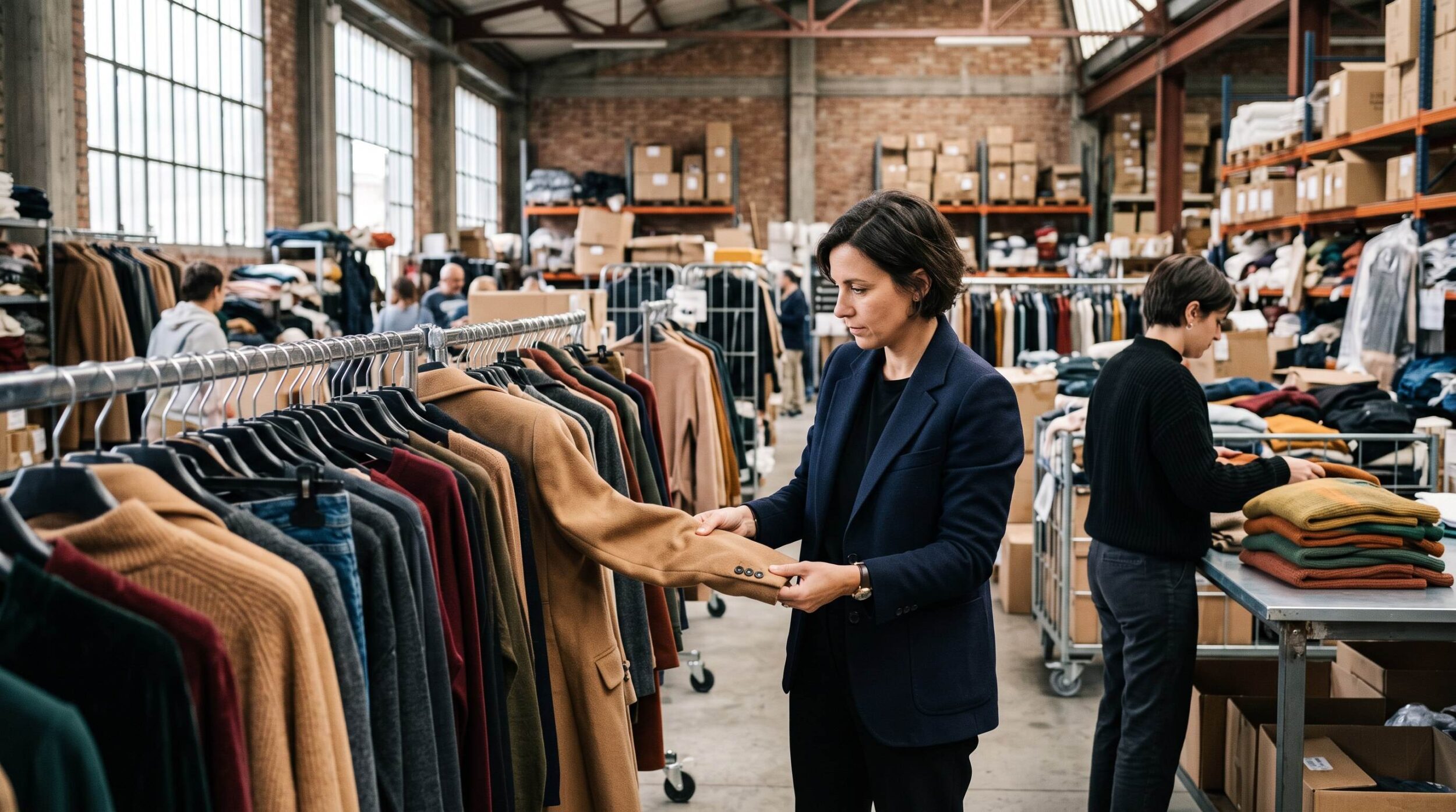
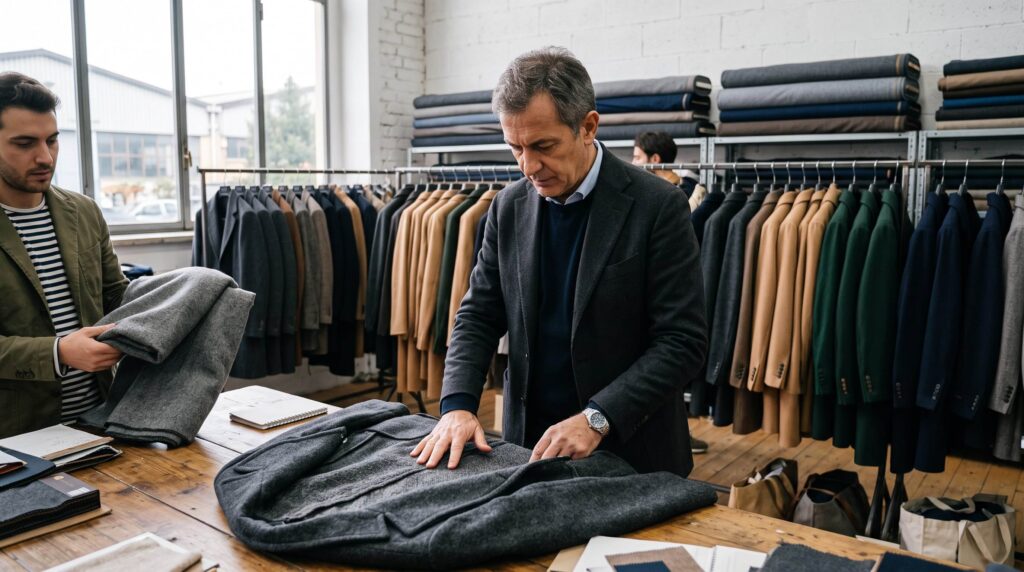
Wool quality wholesale Italy is a search that returns product listings and very little explanation. The gap between two coats on the same rail, at buying prices far apart, is rarely visible in a photograph. It comes from fibre, weight, finish and construction, and from how those elements behave after a season of wear. Six years of buying across the Prato and Bologna districts point to a simple conclusion: retailers who read a garment physically negotiate better and defend their retail price.
What Really Separates Two Wool Garments at Wholesale Level
The first idea to abandon is that price differences inside a district are arbitrary. In pronto moda, quality tracks the price band with reasonable precision, because the same supplier structure, yarn purchasing and production runs sit behind every article in a given range. A wholesaler working at entry level buys cheaper yarn and finishes it faster. Typical supplier minimums of €300 to €500 per warehouse and two to twelve pieces per style mean several bands can be tested before volume is committed.
Expectations must match the band being bought. A garment bought at the lower end of the wool offer will not carry the hand, the weight or the internal construction of structured tailoring, and merchandising does not compensate. It is also why IFS stays out of luxury, a category running on a different cost structure. The useful judgement is not whether a piece is good in absolute terms, but whether it is good for its price and for the customer who will wear it.
Composition First: Virgin Wool, Wool Blends and Regenerated Fibre
Composition is the first line of the label and the fastest filter available. Virgin wool is spun from fibre used for the first time and gives better elasticity, loft and recovery. Regenerated wool, a long-standing speciality of the Prato area, reuses fibre from earlier textile cycles and can produce excellent compact cloths, though the fibres are shorter. Blends with polyester, acrylic or viscose lower the cost and add stability, while cashmere, alpaca or mohair change the surface and the softness more than the warmth.
Buyers ask whether a blend can be presented to a customer as wool. The label settles it: the printed percentages are what can be claimed, and a small share of a noble fibre in a synthetic cloth is a texture choice, not a quality claim. When composition is central to positioning, private label is the route: specifying yarn and cloth requires a minimum order of €3,000 with 100 pieces per model. In a season where wool, velvet and jersey circulate together across Italian wholesale, percentages keep a range coherent.
Fabric Weight and Winter Fabric Quality Buying
Weight, measured in grams per square metre, sets the real season more reliably than the category name on the hanger. A light wool coat sold as winterwear works as an autumn piece in a northern market and a full winter piece in a mild one. Weight drives perceived quality: a cloth with body falls straight, holds a lapel and feels substantial when lifted, while a thin one telegraphs every crease. Ask for the weight before ordering; suppliers know it even when it is printed nowhere.
Comparing across weight bands is where most buying errors happen. A structured overcoat and a padded piece answer different needs, and the spread of heavyweight coats and padded jackets available in Prato wholesale is easy to misjudge from a screen. Lift each sample and watch how it hangs from the shoulder rather than how it looks flat on a table. For markets built around heated indoor retail, a mid-weight cloth with a convincing finish often outperforms the heaviest article in the room.
Finish and Surface Treatment in Italian Wool Wholesale
Finishing is where two identical cloths stop resembling each other. Milling compacts the fabric and closes the surface. Brushing raises a soft nap, pressing gives a flat formal face, while boiled treatments produce a dense cloth with no visible weave. A good finish makes a modest blend feel convincing for the first weeks of wear, which is why the hand alone is not a reliable verdict. Look at the reverse side and the cut edges, where the honest structure of the cloth shows.
A practical check takes seconds. Rub the surface firmly with the pad of the thumb and see whether fibres lift immediately; hold the fabric against a window and read how even the weave is; then release a crushed section and watch how quickly it recovers. Cloth that stays creased after that treatment will crease in a fitting room as well. On a live video call the same checks can be requested from the person handling the garment.
Construction, Lining and Shape Retention Behind a Wool Blend Garment Price
Two coats cut in the same cloth can differ in price mainly because of what sits inside them. Interfacing at the front edge, a shaped shoulder, a lining cut with enough ease and seams with adequate stitch density keep a garment in shape after a few months. Cheaper construction announces itself through a collar that rolls oddly, pockets that pull and hems that ripple. None of that is visible in a catalogue photograph, and all of it reaches the customer within weeks.
With the garment in front of you, turn it inside out before deciding anything. Check whether the lining is stitched or glued at the hem, whether the shoulder seam is reinforced, whether the pocket bags will survive daily use. Photograph the interior of each sample so details can be compared later against other suppliers, because memory blurs after a full day of showrooms. Construction is the element most worth paying for, since it protects the experience that produces the second purchase.
Pilling, Wear and How Wool Quality Behaves After the Season
Pilling depends mainly on fibre length and on friction, so it appears first under the arms, along the sides and wherever a bag rubs. Short-fibre blends pill sooner, compact finishes resist longer, and brushed surfaces show it visibly but often shed it with use. A garment that pills is not automatically defective, and the honest approach in store is to say so before the sale. Most wool problems originate in washing rather than in wearing.
Expectations at the low end of pronto moda also need a realistic frame. In that band up to 5% of pieces can show minor irregularities, a loose thread or a small mark that a steamer removes, and that share belongs in the margin calculation rather than being treated as an incident. Payment is made in full before shipment, so checking happens while goods are still being selected. Buyers who plan for this treat quality as a distribution, not as a binary.
A Practical Method for Assessing Wool Quality During a Buying Session
A repeatable sequence beats intuition. Take the weight of the piece by holding it from the shoulder, then crush a section of cloth and release it, then rub the surface, then look at the reverse, then read the label and confirm the percentages. The routine is quick, and it separates a cloth that will hold from one that will not. Running it in the same order makes samples comparable across suppliers and across days.
What is asked of the supplier should be equally structured: exact composition, cloth weight, finishing process, care instructions and whether the article can be repeated next season. IFS never releases supplier lists or supplier names, so those answers are gathered and reported by whoever runs the visit, which is the core of a sourcing and purchasing service built around live buying sessions. On-site assistance is charged at €250 per day plus commission when a buyer prefers physical presence in the showroom.
Turning Wool Quality Into a Sales Argument for Your Customer
Everything above has a commercial purpose. A boutique able to explain why one coat costs more than the one beside it sells the more expensive piece more often, because the customer is buying an explanation as much as a garment. Staff who know the composition, the weight and the finish handle objections without reaching for a discount. On an e-commerce page the same information becomes product copy that reduces returns.
Landed cost completes the picture. Purchases are consolidated into one invoice and one shipment even with several suppliers involved, goods travel on DAP terms with duties and local taxes payable at destination, and the service fee is 10% of confirmed purchase value, minimum €250 per working day. Add those figures to the cloth cost and the retail price becomes defensible. That is the practical value of understanding wool quality wholesale Italy: it turns a purchase into an argument that can be repeated at the counter.