Custom Neck Labels on Wholesale Clothing: Putting Your Boutique’s Name on Italian Ready-to-Wear
12 October 2026

How It Works
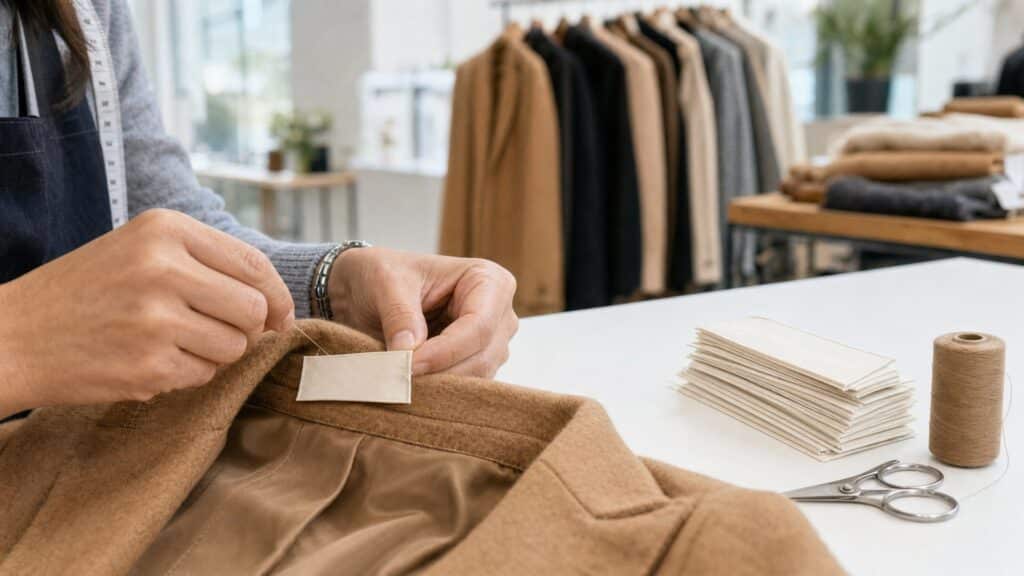
Custom woven labels for clothing are made on a loom, with the design built into the fabric of the tape rather than printed on its surface. The threads that form the letters are the same threads that hold the label together, which is why a good woven label survives washing, ironing and years of wear without fading. Boutiques that buy finished garments in Italy and sell them under their own name use these labels at the back of the collar, where the customer looks first, and they expect them to feel as finished as the garment itself. A label that scratches, curls or looks cheap undermines everything else on the rail.
The term is often used loosely in the trade. Many buyers say woven when they mean any fabric label, including embroidered and printed ones, and suppliers tend to follow the buyer’s wording rather than correct it. Knowing the difference helps before asking for quotations, because the three techniques give different results on the same artwork, and we can produce all of them for a boutique’s own label. The label approved by a multi-brand boutique from Kuwait City for its autumn-winter order, for example, was woven in two colours on polyester taffeta, a choice that suited a short name in bold letters and kept the label light and flat against the collar, which the owners checked by holding a sample against their own garments.
Damask weaving produces the finest detail, with dense threads that can render small letters and thin lines cleanly, and it is the usual choice when a brand name has delicate serifs or a fine logo. Taffeta is coarser and lighter, more economical and perfectly adequate for bold names with few details. Satin weaves give a soft, shiny surface that feels gentle on the skin, which is useful on lingerie, knitwear and summer pieces worn directly on the neck. Each of these is a true woven label, and the choice depends on how much detail the design needs and on how the label should feel.
Embroidered labels add thread on top of a base tape, with a raised effect that reads well from a distance but limits how small the text can be. Printed labels transfer ink onto satin or cotton tape, which allows photographic detail and tiny text but can wear with repeated washing. For Italian ready-to-wear sold in a boutique, the decision usually comes down to two things: how small the smallest element of the design is, and whether the label sits against the skin. Our overview of custom fashion packaging in Italy shows how the label fits with boxes, tissue and bags in a coherent brand presentation.
Neck labels in the women’s ready-to-wear sold in Prato are usually between 50 and 70 millimetres wide and between 15 and 30 millimetres high, plus a few millimetres folded under on each side for stitching. The proposal for the Kuwait order started at 60 by 20 millimetres. When the owners compared the drawing with a real blouse, the label looked too thin for their name, so the height was increased to 25 millimetres. The change kept the same production setup, and the result was a label that reads clearly on a coat collar as well as on a light top, which mattered because the order mixed both.
Height is the measure buyers underestimate most. Every millimetre of height gives the letters more room, and letters that are too short close up during weaving, especially on taffeta. Width is limited by the garment: a label that runs too close to the shoulder seams on a narrow neckline will show through or pull the fabric. The fold also matters. End-fold labels are stitched along both short sides and lie flat, while centre-fold labels are sewn into the seam as a loop and stand up slightly. For relabeling finished garments, end-fold labels are easier for the supplier to place in the same position as the original.
The most common mistake is asking a small label to say too much. The Kuwait boutique initially wanted its name, the words “Distributed by”, the full street address and the phrase “Made in Italy” on the same tape. At 60 millimetres wide, a woven address would have been illegible, so the address moved to a hang tag and the label kept only what a customer needs to recognise the store. A label is a signature, not a document, and the information that importers or customers need in writing belongs on paper attached to the garment, where it can be read without squinting.
Origin wording needs particular care. In the Kuwait order some styles were Italian-made and others came from Chinese production, so a label claiming one origin for everything would simply have been wrong on part of the stock. The phrase was removed and each garment kept its own composition and origin label from the supplier, which is also where regulations expect that information to be. Our article on launching a Made in Italy clothing brand covers the cases in which an origin claim on your own label is fully justified.
Before production the buyer receives a PDF proof showing the label at its real dimensions, with tolerances, colour references, thread colours and the exact position of every letter. Approving it means accepting everything on the page, so it deserves a careful reading. On the Kuwait order the proof went through two revisions: the origin line was removed and the height was enlarged. Both changes took minutes at proof stage, while the same changes after production would have required a new run of the full quantity, because labels are made in a single batch and cannot be altered once woven.
A proof is best checked on paper rather than on screen. Print it at 100 per cent scale, cut it out and hold it against a garment from the order, ideally one in a dark fabric and one in a light one, because the contrast between label colours and garment colours changes the reading. Check the spelling of the name letter by letter, the spacing between words, and whether any element sits too close to the edge, where the fold will hide it. When these checks are done, approval can go back the same day and production starts immediately.
Labels are produced in full runs on computerised machines, so the quantity ordered is delivered all together. The unit cost falls significantly as the quantity rises, which is why the Kuwait boutique chose a run large enough to cover both the autumn-winter season and the following spring-summer. Standard production took about three weeks from approval, while an urgent option shortened it to around ten working days. Ordering the larger quantity once meant that later orders would not have to wait for labels at all, because the stock was already in Italy.
Reordering is simpler when the artwork file and the approved proof are archived. The supplier usually keeps the machine programme, so a second run with the same design normally needs only a confirmation of the quantity. If the design changes even slightly, a new proof is issued. For boutiques that plan to sell under their own name for several seasons, our labels and packaging team keeps the label files and the stock, and schedules relabeling together with each new order.
A good label starts with a short, clear design and a realistic size, and it is confirmed by a proof checked against real garments. The technique follows from the design: damask for fine detail, taffeta for bold names, satin or printed tape for softness and small text. Information that does not fit legibly on the collar moves to a hang tag, and origin claims appear only where they are true for every garment that will carry the label. These choices take an afternoon to settle and then serve the boutique for every later order.
Custom woven labels for clothing are the most visible part of a boutique’s own label, and also the part that customers touch every time they try something on. Getting them right the first time means fewer revisions, a single efficient production run and garments that arrive in the store already speaking with the store’s name. For buyers sourcing ready-to-wear in Italy, the label is the point where a selection from many suppliers becomes a collection.
Italian fashion supply, curated and delivered to your inbox.
How can we assist?
See our services