The first article in this pair dealt with what goes on the garment: neck labels, swing tags, individual bagging, barcodes. This one deals with everything around it. Custom fashion packaging in Italy is a production line of its own, with its own suppliers, artwork files and quote, and it usually gets decided late, once the order is confirmed and shipping is close. That timing is a mistake. The materials carrying a garment out of a shop or through a courier network are what the customer keeps.
What Custom Fashion Packaging in Italy Actually Includes
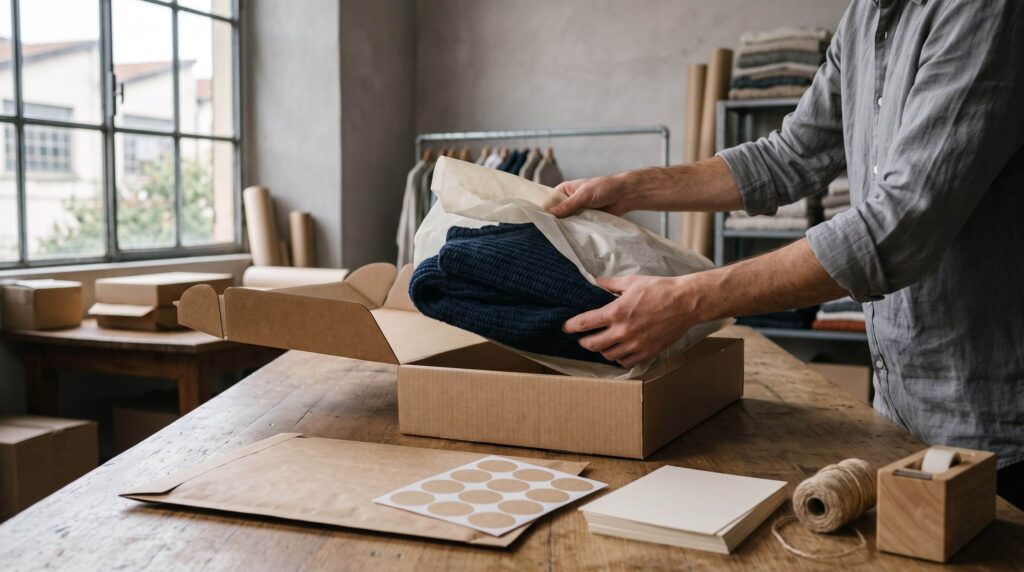
The range is wider than most buyers expect. Boxes and the counter-boxes that sit under them, tissue paper and internal wrapping sheets, printed shipping mailers for online orders, adhesive closure labels carrying a logo, loyalty cards, printed cards in assorted formats, letters slipped inside the parcel, promotional codes. All of it is produced to order against artwork, and none of it sits on a fixed price list. Format, material, print process and run size move the cost too much for that, which is why packaging travels on a separate quote.
Two families of items behave differently once production starts. Boxes, cards, tissue and mailers are goods: printed to order and shipped, able to travel with the garments or arrive separately. Anything added to the garment during manufacturing — a printed polybag for individual bagging, a branded seal closing that bag — sits inside the supplier’s run instead. The consequence for planning is concrete: the first family depends on the print supplier’s calendar, the second on the clothing production calendar, and only the second can hold a shipment back.
Branded Unboxing Wholesale Orders Can Support Without a Rebrand
Branded unboxing on a wholesale order does not require a full identity project. A retailer already trading under a shop name can start from the cheapest recognisable set: a printed mailer, a closure sticker and tissue in a single ink. That set changes what the customer sees when the parcel opens, and it can be reordered without touching the garment supply chain. The surcharge for any operation applied to the goods is communicated at order stage, item by item, so the buyer knows the impact before confirming.
Heavier items follow when volumes justify them. A rigid box with an inner tray, a printed loyalty card, a folded letter, a promotional code on a card that pulls the second purchase — these belong to the stage where the same customer comes back and the packaging has a measurable job. IFS does not push the full set onto a first order. The honest sequence is to begin with what protects and identifies the goods, then extend once the reorder rate shows the investment is worth carrying.
Ecommerce Packaging a Boutique Uses in Both Channels
Individual bagging deserves its own passage, because the material choice has turned into a commercial argument. The polybag exists in clear polythene, in recycled or recyclable versions, in biodegradable or compostable versions, and in an opaque or paper form. Each option prints, folds and presents the garment differently when the parcel opens. For an ecommerce packaging decision a boutique takes once and repeats on every order, the material is not a detail: it is the line the customer reads before deciding whether the brand means what it claims.
The printed mailer works the same way from the outside. A shipping bag carrying the shop name travels through a courier network, sits in a hallway, gets photographed and posted. Boutiques selling in a physical store and online usually align the two channels, putting the same closure sticker on the shop bag and on the mailer and the same tissue inside both. That coherence costs almost nothing to specify at artwork stage and a great deal to retrofit later, once materials have been ordered in quantity.
The Design Work Behind Custom Packaging, Starting From a Logo
The part that matters most for a young label is the design work sitting behind these materials. IFS runs an internal graphic department, so the client is not obliged to arrive with print-ready files. Work can start from a file the client already owns, adapted to each format and process, or from nothing more than a name and a rough direction. Through the sister companies in the group the scope extends to complete brand identity development: logo, palette, typography, applications, the whole system a label needs before printing anything.
That capability changes the conversation for a retailer building a private label brand from a logo and little else, because the packaging and the garment labelling can be designed as one system instead of being commissioned from two unrelated studios. Files are prepared per format and per process, since a paper mailer, a rigid box and an adhesive seal do not accept the same artwork or the same colour build. Proofs are approved before anything goes to print, and that approval is the client’s to sign.
Who Executes Private Label Packaging Production, and When
Buyers regularly ask whether custom packaging pushes the delivery date back. Normally it does not. Operations applied to the goods are carried out by the supplier during production, inside the same run, with a surcharge charged for each operation. No extra days are added to the agreed lead time in the standard case. The exception is material availability: if the printed polybags, the seals or the boxes are not physically ready when the garments are, the shipment waits for them, and that is the variable worth locking down early.
Materials are therefore quoted and ordered alongside the collection itself, which is standard practice inside private label production managed end to end in Italy, where prototypes, labels and packaging move through a single approval chain. Everything then leaves on one consolidated shipment against one invoice, even when several suppliers contributed to the order. Duties and local taxes on arrival stay with the client under DAP terms, and printed materials are customs goods like any other, so they belong in the declaration from the outset.
Where Custom Packaging Is Available and Where It Stops Paying
Availability is not uniform across the two services. On private label production, custom packaging is always possible, because the garments are already manufactured to specification and printed materials extend a process that is running anyway. On pronto moda the answer comes supplier by supplier and volume by volume. Some wholesalers accept branded bagging on stock garments, others do not handle it at all, and the deciding factor is how much of their output an order represents. IFS verifies this case by case rather than promising it in advance.
There is no formal minimum on packaging, but there is an economic one, and it is worth stating plainly. Print runs behave the way print runs always behave: unit cost is high on small quantities and falls as the run grows, so a handful of boxes costs disproportionately more per piece than a proper batch. Below a certain threshold the exercise stops making commercial sense, and the honest advice is to wait rather than to spend badly. The separate quote makes that visible before any commitment exists.
What Branded Packaging Does for an Ecommerce and for a Shop Floor
For an online retailer the parcel is the only physical contact in the whole relationship. Everything else happens on a screen. The box, the tissue, the sealed bag and the card inside them carry the entire tactile impression of the business, and they arrive at the one moment when the customer’s attention is undivided. That window is narrow and it is measurable through returns, reviews and repeat orders, which is why ecommerce operators tend to fund packaging before anything else on the physical side.
A shop works on a different mechanic. The bag leaves the counter and walks down the street, sits on a restaurant floor, gets reused for months by someone who chose to keep it. It is advertising the customer carries voluntarily, and it performs best when it matches what is inside. A retailer trading on what Made in Italy means to a boutique’s customers gives away part of that argument when an Italian garment travels home in wrapping that could have come from anywhere.
Planning Custom Fashion Packaging Italy Before the Order Closes
Custom fashion packaging in Italy works best treated as part of the order rather than as something bolted on at the end. Materials, artwork, the surcharge on each operation and the production calendar are all connected, and every decision is cheap while the order is still open and expensive once it has closed. Raising the packaging question in the first conversation about the collection, alongside quantities and delivery dates, produces a coherent set of materials instead of separate repairs made under time pressure.