
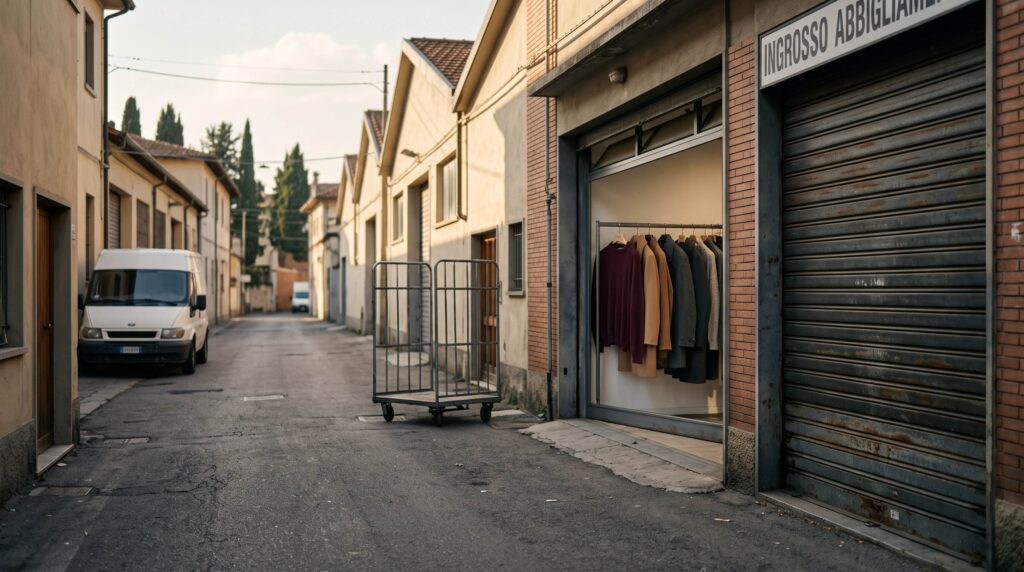
Italian wholesale runs on a calendar that most foreign buyers discover the hard way. The Prato August closure shapes wholesale buying more decisively than any trade fair date, and it arrives every year at roughly the same point: the district begins to empty out around the second week of August and comes back to life in the final days of the month. For a boutique in Copenhagen or an online store in Toronto that fortnight is not a detail. It sits exactly where the AW26/27 order calendar needs to be moving, and a plan built without it tends to lose three weeks that nobody budgeted for.
What the Prato August Closure Looks Like on the Ground
Prato is the largest textile district in Europe, with something close to 7,000 fashion companies packed into a small area of Tuscany, and the majority of them are family-run. That ownership structure explains the calendar. From around the tenth of August the warehouses start closing, and by the fifteenth the district is effectively shut: shutters down, phones unanswered, couriers running a skeleton service. The reopening is staggered rather than simultaneous. A few wholesalers are back on the 25th, most return in the last two or three days of the month, and a minority waits until the first working days of September.
The closure is not uniform, and that irregularity is what catches people out. A larger operator may leave one person in the office answering email while the warehouse itself stays locked, which means an order can be confirmed but nothing can be picked, packed or shipped. The accessories and leather goods workshops follow a comparable rhythm. Showrooms have been displaying AW26/27 samples since early July, so the collections exist and are visible, but the physical capacity to move stock disappears for roughly two weeks. Reading the mid-month break as a slowdown rather than a full stop is the most common planning error.
Wholesale Buying That Still Gets Done in July and Early August
July is the most productive month of the entire autumn cycle, and it is routinely underused by foreign buyers who assume Italy is already on holiday. AW26/27 ranges are in the showrooms from the first week, restocking is still running, and supplier minimums stay at their normal level: usually 300 to 500 euro per warehouse, with two to twelve pieces per style. A session across four or five wholesalers therefore produces a coherent first delivery without forcing anyone to overcommit on a single supplier. Sessions run live by video, so a buyer sees the rails in real time from their own shop.
Buyers regularly want to know whether an order confirmed in the first week of August can still leave Italy before the shutdown. It can, and it happens every year, but the conditions are narrow. Payment is 100% in advance of shipment, so the funds have to be visible on the account before the warehouse packs anything, and a cross-border transfer sent on the 8th rarely clears in time. Working backwards from a realistic dispatch date around the 12th, the order needs confirming by the 4th and paying by the 6th. Goods then leave as one consolidated shipment with a single invoice.
What the Pronto Moda District Pushes to September
Anything that requires a production step moves to September without negotiation. Private label sits firmly in that category: the entry threshold is 3,000 euro of order value and 100 pieces per model, and before production starts there is a prototype to develop, dispatch, review and approve in writing. A sample sent for approval on the 10th of August will not be looked at again until the district reopens, so the practical effect of opening that conversation mid-month is a three-week pause built into the schedule before a single metre of fabric has been cut.
Reassortments and quality discussions belong to the same group. In low-cost pronto moda, up to 5% of the pieces can show minor irregularities — a loose thread, a print registration slightly off — and at that price level it is the accepted standard of the segment rather than a failure in the supply chain. Handling it requires someone physically present in the warehouse to check and replace, which is impossible while the shutters are down. On-site assistance, billed at 250 euro per day plus commission, stops for exactly the same reason: there is nothing left to visit.
Late Payments During the Italian Wholesale Summer Shutdown
The most expensive mistake of the whole period is a late transfer. Because the goods only move once the balance has cleared, money initiated on the 12th sits unreconciled for two weeks, and the reservation on the stock is not guaranteed to survive that gap. Fast-selling styles get released back into general availability, and the buyer returns in September to find part of the selection gone. Bank holidays compound the problem: mid-August is a national holiday in Italy, and correspondent banks in other markets add their own delays to an already stretched cycle.
The workable rule is blunt. Funds should move before the 6th of August or after the reopening, with nothing attempted in between. The same logic applies to the service side, where the fee is 10% of confirmed purchase value with a minimum of 250 euro per session day, invoiced alongside the order rather than months later. Buyers who treat the first days of August as an ordinary week and send payment on a normal seven-day cycle end up losing more time than they would have lost by simply waiting and booking a proper September session.
Rebuilding the AW26/27 Buying Calendar Around Prato’s Closure
Rebuilding the AW26/27 buying calendar around the closure means splitting the season into two tranches instead of one. The first goes out in July and covers the core of the offer: outerwear, knitwear, the pieces that have to be on the floor the week temperatures drop. The second is placed in September and reacts to early sell-through. Deciding when to start buying autumn stock for a boutique is a matter of counting backwards from the delivery date rather than forwards from the fair calendar, and mid-August has to be marked on that count as dead time.
Announcing the closure to international customers early is part of the job, and it costs nothing. A short note in July telling a wholesale account or an e-commerce audience that Italian dispatch stops between roughly the 10th and the 28th of August removes most of the friction later. Retailers who publish realistic shipping windows on their product pages for that period see fewer cancellations than those who discover the gap once an order has already been taken. The information is not commercially sensitive, since every operator in the district works to the same rhythm.
September is the peak of AW buying across the district, and the appointment book fills quickly. Showrooms that were calm in July handle continuous traffic from the first week, and a buyer arriving unprepared finds the useful slots already taken. Sessions are scheduled, never improvised, and a serious first visit needs its groundwork finished in advance, which is the whole argument for treating a first AW26/27 sourcing session in Prato as something to organise weeks ahead rather than a trip to be arranged once the flights are cheap.
August Briefing, September Buying: Preparing Before Prato Reopens
August is the right month to write the brief, precisely because nothing else can be done with it. A usable brief states the budget, the categories, the retail price bands the shop already works with, the size curve and the date the goods have to be on the shelf. It also states what falls outside the scope: no luxury, no childrenswear, no dropshipping. Turning that document into a shortlist of warehouses is what the sourcing and purchasing work carried out before a session consists of, and it takes days rather than hours when it is done properly.
Supplier names are never shared and no supplier list is issued at any stage, so the value of the preparation sits in the matching rather than in the contacts. Planning around the Prato August closure is ordinary wholesale buying discipline, not a special manoeuvre: the dates repeat every year and the only real variable is whether July and the quiet fortnight were used. Shipments continue to move DAP, with duties and local taxes payable by the buyer on arrival, so the landed cost calculation belongs in the same August work.