

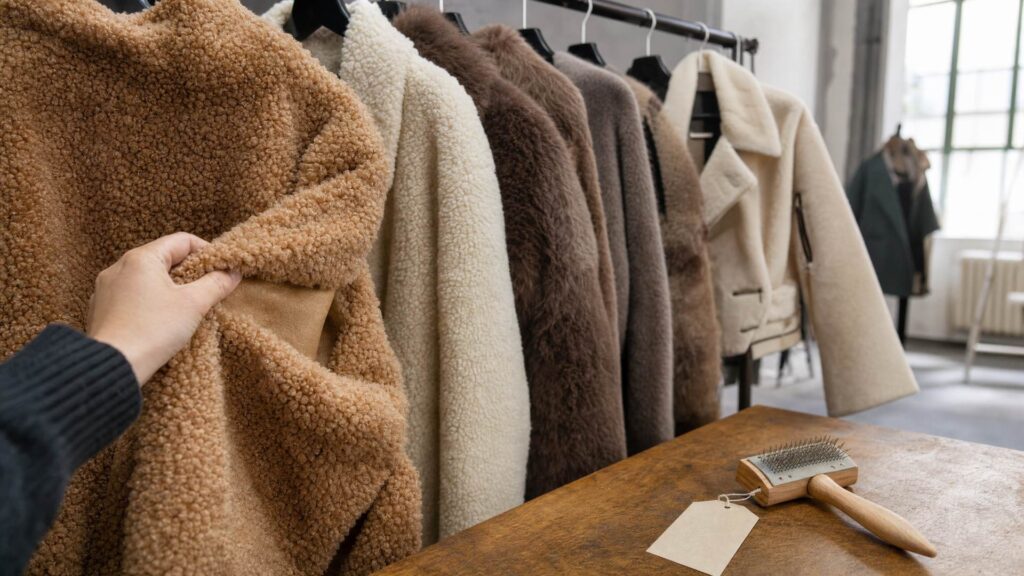
A faux fur coat looks simple from the outside, a soft surface that imitates an animal pelt, but the way it is built decides almost everything about how it feels after one winter. The same is true of the teddy coat and of faux shearling, which belong to the same family of pile fabrics. Some keep their softness for years, while others flatten under the arms within weeks. The difference comes from the density of the pile and from the backing that holds it. This guide explains those materials, then covers warmth, wear, cleaning and storage, and closes with advice for boutique buyers.
What a Faux Fur Coat Is Made Of
Faux fur is a pile fabric. Thousands of cut fibres stand upright from a knitted or woven backing, held in place by the yarns of that base layer, and the length and finish of those fibres create the look of a particular pelt. The fibres used are almost always synthetic. Acrylic and modacrylic are the traditional choices, valued because they closely resemble animal hair, and modacrylic is also inherently flame resistant. Polyester has become the most common fibre in fashion faux fur, since it is cheaper and very durable. Many fabrics blend these fibres to combine softness with strength.
The labels reflect this construction. Composition is often stated for the whole fabric, but European rules also allow the pile and the backing to be listed separately, so a label may give one percentage for the surface and another for the base. Faux shearling is a close relative, with a short dense pile on one side imitating the woolly inside of a sheepskin and often a suede effect fabric bonded to the other. Real fur trims are a different matter, because in the European Union a garment containing them must carry the phrase stating that it contains non textile parts of animal origin.
How Warm a Teddy Coat Really Is
A teddy coat is a faux fur coat with a short, curly or looped pile, usually in polyester, that imitates the bouclé texture of alpaca and wool teddy fabrics. Its warmth comes from the air trapped between the fibres of the pile, and two factors matter more than anything else. The first is pile density, meaning how many fibres stand on each square centimetre. The second is the backing. When the base yarns are close together and firm, wind cannot pass through, whereas a loosely knitted backing lets cold air reach the body even under a thick looking surface.
In practice, a dense faux fur or teddy coat with a good lining is comfortable through an ordinary city winter, especially when worn over a knit. It is less windproof than a wool coat with a tight weave and less warm than a padded jacket of similar weight, so it suits dry cold better than wet wind. Moisture is the other limit. Synthetic pile does not absorb much water, but when it gets soaked it clumps and flattens, and if the wearer sits down in a wet coat the fibres can set in that crushed position. A quick shake and drying on a hanger usually restores the surface.
Shedding, Matting and How Pile Wears Over Time
Some shedding is normal in the first weeks. Because the pile is made of cut fibres, loose ends left over from production come away on clothes and car seats until they are exhausted, and a gentle shake or brushing speeds up the process. Shedding that continues after several wears is a different signal, usually pointing to a backing that does not grip the fibres firmly. Matting is the more common long term problem. It appears where the coat rubs against itself or against something else, especially under the arms and along the side where a bag strap sits.
Heat is the main enemy of synthetic pile. Acrylic and polyester soften at high temperatures, and modacrylic is particularly sensitive, so a hot radiator or an iron can leave the fibres permanently flattened or even melted. Teddy fabrics have their own weakness, since the looped pile tends to tangle and form small balls with friction, which gives an old teddy coat a felted look. Regular brushing slows both processes considerably. Quality matters here too, because a dense pile on a firm backing resists matting far longer than a sparse one on a soft base.
Faux Fur Coat Care and How to Clean a Teddy Coat
The care label decides the method. Some faux fur and teddy coats can go in the washing machine, while others need professional dry cleaning, often because the lining or the trims cannot take water. When machine washing is allowed, the coat should go inside out into a large mesh bag, on a delicate cold cycle with a gentle detergent and a low spin. Hand washing in cool water is even safer. The coat should never be wrung out, because twisting tangles the pile and can distort the backing. Gently pressing out the water with a towel works far better.
Drying is where most damage happens. A tumble dryer can melt or flatten synthetic pile, so faux fur should dry on a wide padded hanger or flat on a rack, at room temperature and away from radiators or direct sun. Once it is completely dry, a wide tooth comb or a wire pet brush restores the surface, working gently in the direction of the pile and then lightly against it to lift the fibres. Small stains can often be treated without washing the whole coat, by stroking a damp cloth along the nap rather than rubbing in circles, which mats the fibres.
Storing a Faux Fur Coat Between Seasons
A faux fur coat should be stored clean, since stains left over the summer set and become harder to remove. A wide padded hanger supports the shoulders without leaving marks, and the coat needs space in the wardrobe, because pressing it between other garments crushes the pile in a way that is slow to recover. Breathable cotton or canvas covers are better than plastic, which traps moisture and can encourage mildew. Clean synthetic fur does not attract moths the way wool and real fur do, although a coat with wool blend lining or trims still needs some protection.
How to Tell Quality Pile Before Buying
Quality can be judged by hand in a few seconds. Parting the pile with the fingers shows how much of the backing is visible, and the less base can be seen, the denser and warmer the fabric. The backing itself should feel firm and should not stretch easily when pulled. A gentle tug on a small tuft reveals how well the fibres are anchored, since a few loose strands are acceptable while a clump coming away is not. The seams deserve a look as well, because good makers brush the pile out of the stitching, so the joins disappear instead of showing as flat lines.
Teddy and Faux Fur Coats in Prato: What Buyers Should Check
For boutique owners, Prato is one of the most active sources of faux fur and teddy outerwear in Europe, and most pieces in the pronto moda showrooms are made of polyester pile, with acrylic blends appearing in some styles. Our overview of teddy coats, faux shearling and eco-fur in Prato describes the styles currently moving. Because payment is 100% before shipment and there are no returns, the checks described above have to be done before ordering, together with the quality of the lining. In low cost pronto moda, up to 5% of pieces may show minor irregularities.
Most of our clients do not travel to Italy for these checks. During a live buying session we walk through the showrooms on video, part the pile in front of the camera and read the composition label aloud, so the client can decide piece by piece. Wholesalers usually ask for a minimum of €300 to €500 per warehouse, with two to twelve pieces per style, and we consolidate purchases from several of them into a single invoice and shipment. The wider picture of winter buying is covered in our guide to Italian outerwear wholesale.
Getting the Most from a Faux Fur Coat
The useful lesson is that softness in the showroom says little about how a coat will age. Density and backing determine warmth and durability, while gentle washing and regular brushing decide how long the surface stays beautiful. For shoppers, that means reading the label and touching the pile before buying, then keeping heat away from the fibres. Retailers gain from choosing fabrics that will not disappoint customers after a month of wear, and from explaining care at the till. Treated with that attention, a well made faux fur coat can look good for many winters.



