

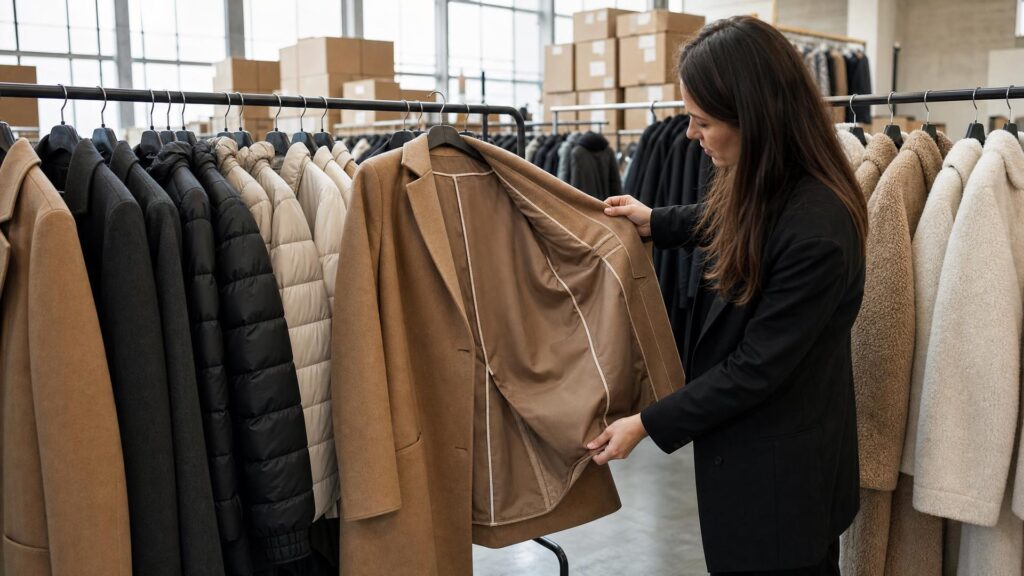
Outerwear is the most visible and the most expensive part of a winter assortment. A coat rail is the first thing customers see from the door between October and February, it carries the highest tickets of the season, and a single wrong style bought in depth can stay on the floor until the sales. Italian outerwear wholesale gives independent boutiques access to coats and jackets with good construction and a recognisable style at prices that leave room for a margin, provided the buyer knows what to look for in fabric, fill and finishing. This guide covers the categories, the prices, the checks and the quantities, based on our daily work buying outerwear in the Prato district.
It is the reference page of our outerwear content, linked to more detailed articles on each topic. Readers who want the broader view of the winter season, including knitwear, dresses and the buying calendar, will find it in our complete guide to Italian winter clothing wholesale. Those who want to understand the trends that shape this year’s coats can start from our report on winter fashion trends, which describes the colours and textures of the season. The figures in this guide come from the orders we consolidate for clients in Europe, North America, the Middle East and Australia, and they are updated as the season moves.
The Main Categories in Italian Outerwear Wholesale
The structured coat is the backbone of the rail. In Prato it comes mostly in wool blends, with a clean shoulder, in camel, charcoal, black and cream, in lengths from mid-thigh to ankle. Tailored blazers and short jackets in wool, velvet or boucle complete the same family and sell from the first cool days of September, often worn over knitwear. Customers who buy a coat usually expect it to last several seasons, so this is the category where construction matters most and where a boutique builds its reputation for quality.
Padded and quilted jackets cover the practical side of winter. They range from light quilted pieces that work as a layer to heavier puffer jackets with down or synthetic fill, in short and long versions. Teddy coats, faux shearling and faux fur make up the third family, chosen for warmth, comfort and the tactile appeal that has made them a strong trend in recent seasons, as described in our article on teddy coats, faux shearling and eco-fur in Prato. A boutique rail usually needs a balance of all three families, weighted according to its customers and its climate.
Prices in Italian Outerwear Wholesale
Outerwear prices in Prato span a wide but readable range. A simple quilted jacket can leave a warehouse at €15 to €20, a wool blend coat with a clean construction usually sits between €30 and €45, and heavier pieces with a defined shoulder, a higher wool content or a mixed material body can go higher. With a retail multiple of around 2.5, this range produces shelf prices from under €50 to well over €100, which is the spread a mixed clientele needs to find something at its own level. Minimums usually sit between €300 and €500 per warehouse, with two to twelve pieces per style.
Price differences between coats that look similar are almost always explained by the label. Wool content, the weight of the fabric, the quality of the lining and, for padded jackets, the type and quantity of the fill account for most of the gap. A buyer comparing two camel coats at €28 and €42 should look inside before deciding, because the cheaper one may be the better buy for a fast-turnover store and the more expensive one the right choice for a boutique whose customers keep a coat for years. Our guide to reading wool fibre, weight and finish explains these differences in detail.
Reading Fabric and Fill Before You Order
On a wool coat the composition label is the starting point. “Wool coat” can describe anything from a high wool content to a blend in which polyester or polyamide is the main fibre, and both can be legitimate products at their own price. What matters is that the price matches the composition. The fabric should then be checked by hand for weight and density, the lining for its finish at the seams, and the details such as buttons, pockets and collar for how firmly they are attached, since these are the points where a coat fails first.
Padded jackets require a specific reading. The label must state the filling, and the ratio between down and feather, or the type of synthetic wadding, decides warmth, weight and price. Our article on reading a padded jacket before you order explains what the labels mean in wholesale terms, while our consumer guide to down versus synthetic jackets helps staff answer the questions customers ask in the store. Faux fur and teddy have their own checks, from pile density to shedding, covered in our guide to faux fur coats and their care.
Styles and Colours for a Winter Coat Rail
The season’s coats follow a quieter, more tailored line than in recent years. Shoulders are defined but not exaggerated, lengths are generous, and the most requested shapes are the straight single-breasted coat and the belted wrap coat, with the double-breasted version close behind. Camel and charcoal dominate the core, with cream and black as safe alternatives and cobalt or burgundy for the pieces that need to stand out. Customers buy these coats to wear for years, so a classic shape in a good colour is usually a better investment for the boutique than an extreme trend.
Short jackets carry the more playful side of the season. Cropped boucle jackets, quilted pieces with a soft collar, teddy jackets and faux shearling bombers bring texture and colour to the rail and sell well to younger customers and to those who already own a classic coat. In padded jackets the trend favours matt fabrics and sober colours over shiny finishes, with a mix of short and long versions. A rail that combines one or two long classics in each anchor colour with a selection of short textured pieces covers most of the demand a boutique will meet.
Climate decides the proportions. Boutiques in northern Europe, Canada and the northern United States need real warmth, so padded jackets and heavier wool coats take a larger share. Stores in milder markets, from the southern United States to the Mediterranean and the Middle East, sell more blazers, lighter coats and teddy pieces that are warm without weight. Knowing the local winter, and how long it lasts, is the starting point for deciding how deep to buy in each category.
How Many Coats a Boutique Should Buy
Coats absorb a large share of the winter budget and carry the highest risk per unit, so quantities need discipline. The safest approach is to buy shallow on new styles, a few pieces per reference spread across sizes, and to keep a reserve for a second purchase once the first weeks of selling show which shapes and colours customers actually want. Ten pieces of an untested coat usually means a markdown in January, while three pieces that sell out can be reordered or replaced by a similar style from another wholesaler.
Most boutiques put slightly more than half of their outerwear budget into core coats in the season’s anchor colours and spread the rest across padded jackets, teddy and a few statement pieces. The reserve funds a second buy in late October or November, based on what is genuinely moving on the floor rather than on a reorder of something already gone. Our article on building a winter outerwear rail shows the numbers behind this approach and how to adapt them to stores of different sizes.
When to Buy Coats and Jackets in Prato
Timing changes the choice available. Structured coats and blazers ordered in late June or July are bought from a supplier’s full size range and fabric options, while a September order is more likely to involve compromises on sizes or substitutions of fabric. Padded jackets and teddy follow a slightly later rhythm, with the widest offer between August and October. From November the outerwear offer becomes a market of remaining stock and quick reorders, useful for filling gaps but not for building a rail from scratch.
Boutiques in mild climates can follow a lighter calendar, since blazers, long cardigans and short boucle jackets replace the heavy coat for most of their season, as explained in our article on boucle fabric and how it wears. Boutiques in the Southern Hemisphere, whose winter starts in June, have to buy outerwear on the Italian calendar and hold it for months, and our guide to Italian winter wholesale for Australia and the Southern Hemisphere explains how to plan it. For knitwear to style under these coats, see our guide to Italian knitwear wholesale.
Shipping Bulky Outerwear Orders
Outerwear is the category where shipping cost surprises buyers most. Couriers calculate cost on volumetric weight, the space a parcel occupies, using a divisor of 5,000, which pushes a carton of padded jackets well above its scale weight. As reference bands, shipping from Italy runs around €2 to €3 per volumetric kilo within Europe and around €8.50 towards North America, with Australia and South America slightly higher. Landed cost per coat should therefore include freight, our 10 percent commission and the import duty of the destination country before the retail price is set.
We consolidate purchases from all the wholesalers visited into one invoice and one shipment under DAP terms, with a maximum of five different customs codes per invoice so that the declaration stays simple and does not trigger extra courier charges. Payment is 100 percent before shipment, with no consignment and no returns on unsold goods. Packing bulky items carefully matters too, because a crushed padded jacket or a creased wool coat arrives in a condition that costs the boutique time and steaming before it can go on the rail.
Buying Italian Outerwear Wholesale with a Local Buyer
Outerwear is hard to judge from photographs, because weight, fabric density and the quality of the lining only show in the hand. During a live session we visit several showrooms on video, open each coat to show the lining and seams, read the labels and ask about sizes and reorders while the client decides piece by piece, as described on our page about fashion sourcing and purchasing. Buyers who prefer to travel can come to Prato, and winter is the best season to do it. Italian outerwear wholesale rewards buyers who check before they buy, keep quantities shallow on new styles and plan the second buy from the start.



