

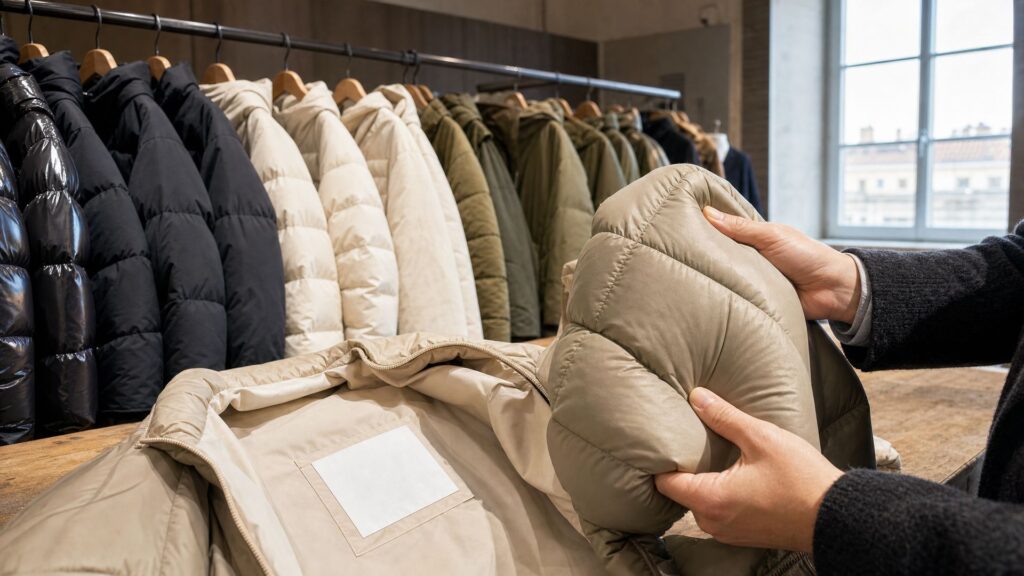
Choosing between a down vs synthetic jacket looks like a simple question of warmth, but warmth is only where the comparison starts. The two fillings behave very differently once they get wet or are packed into a bag, and they age in different ways after a few winters of washing. A shopper who understands these differences ends up with a jacket that suits the way they actually live. This guide compares the two insulations point by point and closes with a section for boutique buyers ordering padded jackets in Italy.
Both fillings work on the same principle. Insulation does not produce heat. It traps the warm air given off by the body and slows its escape, so the more still air a filling holds, the warmer the garment feels. Down does this with clusters, the soft plumes that grow beneath the outer feathers of ducks and geese, which have no quill and open into a ball of fine filaments. Synthetic insulation imitates that structure with polyester fibres, supplied either as sheets of wadding or as loose clusters blown into the quilted channels.
Down vs Synthetic Insulation on Warmth and Packability
Gram for gram, good down is the warmer material. A synthetic jacket needs more filling to reach the same warmth, so it is heavier and usually bulkier on the body. The gap has narrowed, because the best blown synthetic fibres now come close to mid grade down in loft. Construction matters as much as the filling. When the quilting is stitched straight through shell and lining, every seam becomes a thin line with almost no insulation, while internal walls between the layers keep the filling at full height and remove those cold spots.
Down also compresses further and springs back more completely, which is why a light down jacket can be rolled into its own pocket and recover its shape hours later. Synthetic fibres pack less tightly, and repeated compression slowly breaks them down, so a synthetic jacket stuffed into a bag every day loses loft faster than a down one. Neither filling likes being stored compressed for months, and down in particular should spend the summer hanging loosely or folded in a breathable bag.
Fill Power and the Down Feather Ratio on the Label
Fill power measures the quality of down, not its quantity. It expresses how many cubic inches one ounce of down occupies under a standard test, so a higher number means fluffier clusters that trap more air for the same weight. Everyday down jackets usually sit between 550 and 650, while 700 and above indicates very good down, found mostly in technical outerwear. A high number alone does not guarantee warmth, because a jacket with a little 800 fill down can feel cooler than one generously filled with 600. European and American test methods differ, so figures are not always directly comparable.
The down feather ratio tells a different story. A label reading 90/10 or 80/20 states the share by weight of down clusters and feathers. The difference is significant, since feathers have a quill, loft much less and tend to work their way through the fabric over time. Under the European standard EN 12934, a filling can be called down only when it contains at least 60% down, while the American labelling standard expects at least 75%. On Italian labels, piumino indicates down and piuma indicates feathers.
Down vs Synthetic Jacket in Wet Weather
Moisture is where the comparison turns around. When down gets wet, the clusters collapse and stick together, and the jacket loses most of its insulating power until it has dried completely, which can take a long time. Polyester fibres absorb very little water, so a synthetic filling keeps insulating when damp and dries noticeably faster. The shell plays its part as well, since a water repellent finish makes light rain bead and roll off, although it will not hold back a sustained downpour.
In practice the climate usually decides. Where winters are cold and dry, down gives the most warmth for the least weight and rarely gets wet enough to matter. In rainy climates, or for anyone who sweats heavily during activity, a synthetic jacket is the safer choice because it forgives moisture from outside and from inside. Many outdoor brands now combine the two, placing synthetic insulation in the shoulders and hood, where rain concentrates, and keeping down in the body where it does its best work.
Durability and Washing Care for Each Puffer Jacket
Treated well, down can keep its loft for many years, which partly offsets its higher price. Its weak points are the seams, through which small feathers may slowly escape, and the risk of damage if the jacket is stored damp. Synthetic fillings lose loft gradually with compression and washing, so a synthetic puffer jacket often gives its best warmth in the first seasons and then flattens, although its shell is frequently tougher. The difference in lifespan depends far more on how the jacket is used and cleaned than on the filling alone.
Down needs some care in the laundry. It should be washed only when necessary, on a gentle cycle at around 30°C, with a detergent made for down and no fabric softener, then rinsed thoroughly. Drying is the critical step, best done in a tumble dryer on a low setting with a few dryer or tennis balls to break up the clusters, and it may take several cycles. A synthetic jacket is easier to look after, since a mild detergent works and it dries far more quickly, but high heat can damage polyester fibres. The care label always has the final word.
Animal Welfare Certifications and Price
Most down is a by-product of the poultry meat industry, yet plucking from live birds and force feeding have drawn criticism for years. The Responsible Down Standard, managed by Textile Exchange, and the Global Traceable Down Standard both prohibit these practices and audit the supply chain from farm to finished product, so a certified label offers real assurance about origin. Synthetic insulation contains no animal material at all, although it is derived from petroleum, and recycled polyester fillings now appear in a growing share of jackets.
Price follows the filling. Down costs more because supply is limited and demand from outerwear and bedding is high, and the premium grows steeply with fill power and certification. Synthetic insulation is cheaper to produce, which is why most fashion puffer jackets at accessible prices use polyester wadding. A higher price does not automatically mean a warmer jacket, because a well built synthetic piece with generous filling can outperform a cheap down jacket with low down content and stitched through quilting. Reading the label is the only reliable way to know what the money is paying for.
What Padded Jackets in Italian Pronto Moda Contain
For boutique owners buying in Italy, the label matters even more. In the pronto moda showrooms of Prato, most padded jackets in the entry and middle price bands are filled with polyester wadding inside a polyester or polyamide shell, while down appears in the higher band, typically as 80/20 or 90/10 fillings. In everyday Italian the word piumino means any puffer, so a style sold as a piumino may contain no down at all. The composition label lists each layer on its own line, and the imbottitura line reveals what the filling actually is.
Payment in the district is 100% before shipment and unsold goods cannot be returned, so this reading has to happen before the order is confirmed. During a showroom visit we ask for close ups of the label, press the quilting to check that the filling is evenly distributed and look for feathers coming through the seams. Our guide to reading a padded jacket before ordering covers fill types and price bands in more depth. Through our fashion sourcing and purchasing service, purchases from several wholesalers are consolidated into one invoice and one shipment.
Choosing Between a Down vs Synthetic Jacket
Neither filling wins outright. Down is the better choice in cold and dry conditions, especially for shoppers who want a light coat that packs small and are ready to care for it properly over many winters. Synthetic insulation suits wet climates and active use, washes easily and costs less, without any animal welfare questions. For retailers, the most useful step is to stock both with clear labels, a balance explained in our broader guide to Italian outerwear wholesale. Once the label and the local climate are understood, the down vs synthetic jacket decision becomes a matter of fit rather than guesswork.



