

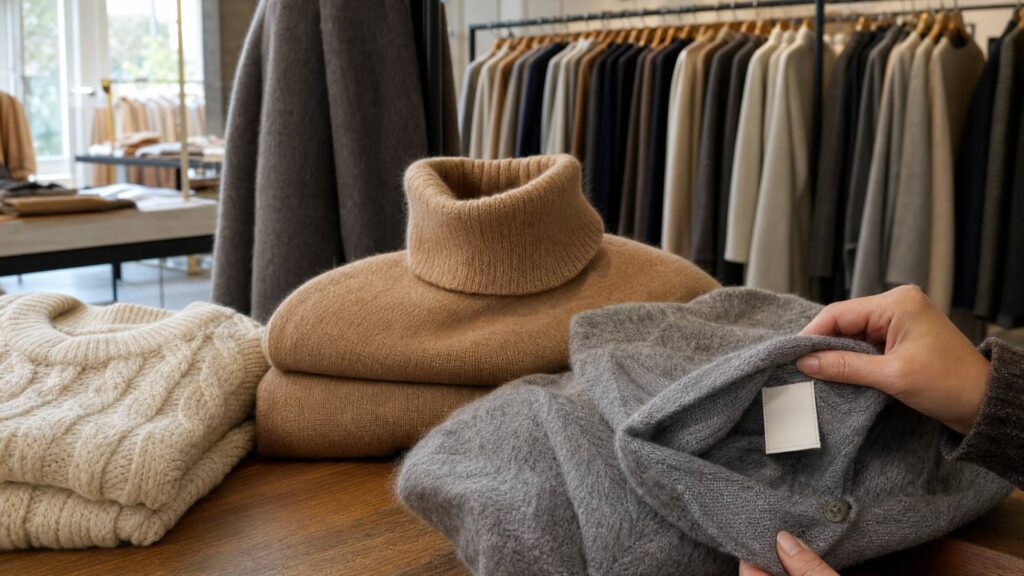
Anyone comparing wool vs cashmere on a shop rail is usually trying to settle which sweater will keep them warm without irritating the skin, and whether the higher price of cashmere is justified. Alpaca has entered the same conversation over the last few years, often sold as baby alpaca, and the labels rarely explain how these fibres behave once they are worn and washed. This guide compares sheep’s wool, including merino, with cashmere and alpaca on warmth, softness, weight, durability and care. It then explains how they appear in Italian pronto moda knitwear, where blends are far more common than pure yarns.
Wool vs Cashmere vs Alpaca: Where Each Fibre Comes From
Wool, in everyday usage, means the fleece of the domestic sheep, and it covers a huge range of qualities. Merino sheep produce the finest grades, often between about 15 and 24 microns in diameter, while many traditional breeds grow fibre of 30 microns and above, better suited to coats than to anything worn against the neck. Cashmere comes from the soft undercoat of the cashmere goat, combed or shorn and then separated from the coarse outer hair in a process called dehairing. Most of the world’s supply is grown in China and Mongolia, and each goat yields only a small quantity of usable down per year, which is the root of its price.
Alpaca is the fleece of a South American camelid raised mainly in the Peruvian Andes. Unlike sheep’s wool it contains no lanolin, the natural grease that has to be scoured out of raw wool, and many of its fibres have a partly hollow core. The term baby alpaca does not refer to young animals. It is a fineness grade, normally applied to fibre of roughly 20 to 23 microns depending on the standard used, and it can come from adult alpacas with particularly fine fleece. Cashmere, for its part, has a legal definition in the United States, with an average diameter of no more than 19 microns and strict limits on coarser fibres.
Which Is the Warmest Knitwear Fibre
Weight for weight, cashmere and alpaca are generally warmer than ordinary sheep’s wool. Cashmere owes this to its extreme fineness, since very thin, crimped fibres hold a large volume of still air, and still air is what actually insulates. Alpaca gets there through its partly hollow fibres, which add insulation without adding weight. In practice the construction of the garment matters at least as much as the fibre. A chunky lambswool sweater knitted on a coarse gauge will feel warmer than a fine gauge cashmere roll neck, simply because it is thicker and traps more air.
Moisture is the other half of warmth. All of these animal fibres are hygroscopic, which means they absorb water vapour from the body and release it slowly, so the wearer stays drier and the garment does not turn cold and clammy the way many synthetics do. Wool can take up a considerable amount of moisture before it feels damp to the touch, and it keeps insulating when slightly wet. This is why a wool or alpaca sweater stays comfortable when moving from a cold street into a heated room. For anyone asking which knit is warmest, the honest answer is alpaca or cashmere at equal weight, with merino close behind.
Comparing Softness and Itch
Itch has very little to do with allergy and almost everything to do with fibre diameter. Dermatological research shows that prickle comes from the ends of coarse fibres, roughly above 30 microns, pressing against the skin, while knits with an average diameter below about 19 to 21 microns are rarely perceived as prickly. That explains the soft hand of cashmere on bare skin and the acceptance of fine merino as a layer worn next to the body, while a cheap jumper spun from coarser fibre can feel scratchy within minutes. Alpaca sits between the two in fineness, but its smoother fibre surface makes it comfortable for many people who find ordinary wool irritating.
Weight and drape separate the fibres just as clearly. Cashmere is light, with a soft, slightly fuzzy surface that becomes more pleasant with gentle wear. Alpaca drapes more heavily and carries a subtle sheen, which suits long cardigans, but it has less natural elasticity than wool and can lengthen over time if hung on a hanger. Merino and lambswool have the most spring, thanks to their crimp, so cuffs and ribs recover their shape after stretching. A customer who wants a structured sweater that holds its silhouette is usually better served by wool, while one who looks for softness and fluid movement will lean towards cashmere or alpaca.
Wool vs Cashmere on Durability and Care
Durability follows fibre length and strength. Wool fibres are long and elastic, and a good lambswool or merino sweater can last many winters with little visible wear. Cashmere fibres are shorter and finer, so their ends work loose more easily and form small balls on the surface, especially under the arms. Pilling on cashmere is normal in the first weeks of wear and is not a sign of fake fibre. The pills come away with a cashmere comb, and a well spun yarn pills less once the loose fibres have been cleared. Alpaca pills relatively little, because its fibres are long and smooth, although it can shed slightly at first.
Care is where the differences become most practical. All three dislike heat combined with agitation, which causes the scales on the fibre surface to lock together so that the garment felts and shrinks. Hand washing in cool water with a wool detergent and drying the piece flat, away from radiators, protects every one of them. Merino treated to be machine washable, often labelled superwash, tolerates a gentle wool cycle. Cashmere and alpaca should be folded rather than hung, and stored clean in a closed bag or box, because clothes moths are attracted to animal fibres, particularly when traces of skin oils remain in the knit.
The Price Logic Behind Each Fibre
The price gap between wool and cashmere is mostly a matter of supply. A sheep can produce several kilos of fleece a year, while a cashmere goat gives only a few hundred grams of raw undercoat, and noticeably less once the coarse hair has been removed. Within each fibre, price then rises with fineness and fibre length, since finer and longer fibres spin into softer, stronger yarn that pills less. That is why two cashmere sweaters of identical weight can differ widely in price, and why a good merino can outperform an entry level cashmere in both hand feel and lifespan. Baby alpaca usually sits between fine merino and cashmere, depending on grade and origin.
Noble Fibres in Italian Pronto Moda Knitwear
For boutique owners the comparison changes once it reaches the showrooms of Prato. Pure cashmere is rare in pronto moda, where most knitwear is built on blends designed to hit a precise wholesale price. A sweater sold as misto cashmere usually contains a small share of cashmere combined with wool and polyamide, sometimes with viscose, and the label may show cashmere at only a few percent. Alpaca appears in the same way, often blended with wool and polyamide to add strength and limit stretching. These blends are not a trick, but the composition determines how the garment wears and what it should cost, so the label deserves attention before the colour does.
EU labelling law requires every garment to list the percentage by weight of each fibre in descending order, so a buyer sees at once whether cashmere is the main fibre or an accent. On Italian labels, lana means wool and poliammide means polyamide. Payment is made in full before shipment and unsold goods cannot be returned, which makes this check part of protecting the margin. Our guide to reading wool quality behind the price of a winter garment goes deeper, while the overview of Italian knitwear wholesale covers styles and timing. Through our fashion sourcing and purchasing service we read every label on camera before you buy.
Wool vs Cashmere: Choosing the Right Knit
For the end customer, the choice comes down to priorities. Cashmere offers the softest hand and the most warmth for its weight, at the cost of more careful handling and some early pilling. Alpaca gives similar warmth with a heavier drape and good resistance to pilling, and it suits people who find wool scratchy. Merino and lambswool remain the most durable and the easiest to look after, and fine merino is now soft enough to wear next to the skin. For a boutique, the wool vs cashmere question becomes a question of assortment, where well chosen blends and carefully read labels let each customer find a knit that fits the way they live.



