

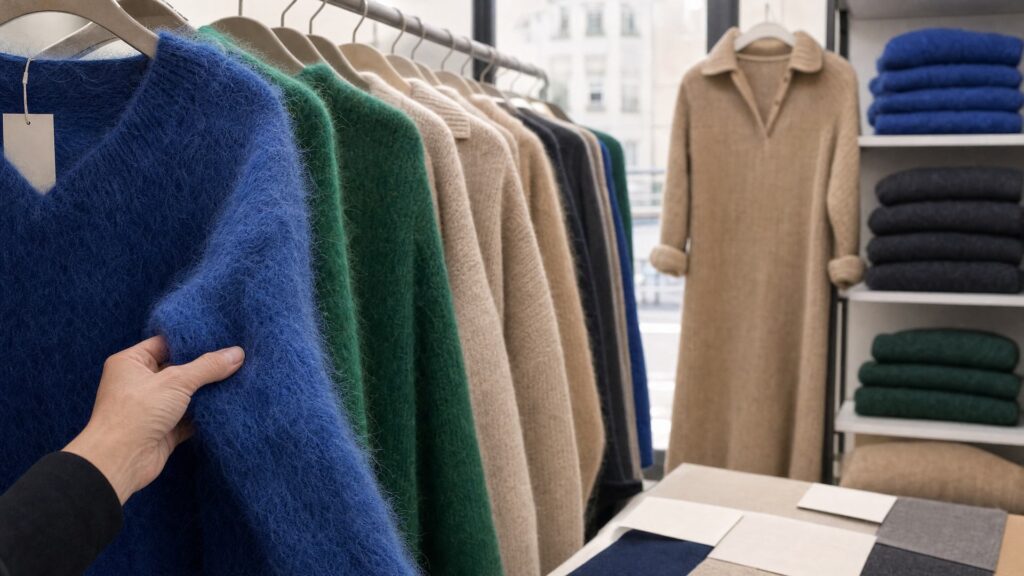
Knitwear is the category that defines a boutique’s winter. It is the first thing customers touch, it sells from September to January, and it is where a store shows the difference between its own selection and the high street. Italian knitwear wholesale in the Prato district offers sweaters, cardigans, knit dresses and coordinated sets in noble fibre blends at wholesale prices that leave room for a good margin, provided the buyer knows how to read compositions, prices and timing. This guide brings together what we have learned buying knitwear for boutiques in Europe, North America, the Middle East and Australia.
It is also the reference page of our knitwear content. Each topic touched here has a more detailed article, linked where it is relevant, so buyers can move from the overview to the detail they need. Readers who want to understand the fibres from a customer’s point of view, rather than a buyer’s, will find our comparison of wool, cashmere and alpaca useful, because the questions customers ask in the store are often the same ones a buyer should ask in the showroom.
The Fibres Behind Italian Knitwear Wholesale
Prato knitwear is built on blends. Pure cashmere exists, but most of what a boutique buys combines a noble fibre with wool, viscose or polyamide, which gives softness and visual richness at an accessible price. Kid mohair usually appears at 25 to 40 percent, mixed with polyamide or wool, and it produces the airy, slightly fuzzy sweaters that photograph so well. Baby alpaca, typically at 30 to 50 percent, gives a heavier and silkier hand and is the fibre of long cardigans and coatigans. Cashmere blends, sold in Italy as misto cashmere, range from about 5 percent in entry basics to 20 percent in the better pieces.
Customers ask about these fibres more than about any other aspect of a sweater, and two questions come up constantly. The first is whether mohair itches, which depends on the quality of the fibre and on what it is blended with, as our article on why mohair can itch explains. The second concerns synthetic fibres, especially acrylic, which appears in many commercial blends: our guide to how warm acrylic really is helps buyers and staff read a composition label honestly. A boutique that can answer these questions sells more knitwear at full price.
Wholesale Price Bands for Knitwear in Prato
Knitwear prices in Prato follow a readable ladder. Around €15 to €18 a buyer finds fine-gauge crewnecks, V-necks and slim roll necks in entry compositions, typically with a small share of cashmere. Between €22 and €30 sits the working middle, with cashmere blends at 12 to 20 percent, entry baby alpaca and lighter mohair formats. From €35 to €45 come the statement pieces: high-percentage kid mohair sweaters in strong colours, heavy baby alpaca coatigans and knit dresses. With a retail multiple of about 2.5, these bands land at around €49, €79 and €129 on the shop floor, which gives customers an immediate sense of the logic of the wall.
Composition moves price more than shape. Raising a crewneck from 5 to 15 percent cashmere adds roughly €5 to €8 at wholesale, and lifting the mohair content produces a similar step, while a more complex silhouette changes the price surprisingly little. Our detailed article on what 15, 25 and 45 euros buy in Prato knitwear shows how to use this ladder to build a wall where every band supports the others. The top band should be bought shallow, two or three pieces per style, because its job is to give the middle band room to breathe.
The Knitwear Formats That Sell Best
Fine-gauge knits are the foundation. Roll necks, crewnecks and slim cardigans in neutral colours sell under every coat and blazer, they reorder reliably, and customers often buy them in several colours. Our article on roll necks and fine-gauge knits explains why this layer deserves a large share of the budget. Above it sit the statement sweaters, oversized and textured, in mohair or chunky wool, which are the pieces that make customers stop at the window and that justify the higher price points of the wall.
Long cardigans and coatigans in baby alpaca occupy the space between a sweater and a coat, and in mild climates they replace the coat for most of the season, which makes them one of the most profitable formats for boutiques in the southern United States, the Mediterranean or the Middle East. Knit dresses and knitted coordinated sets have become a category of their own, combining the comfort of a sweater with the polish of a dress, as described in our guide to knit dresses and knitted co-ord sets. Colour completes the picture, and our analysis of colour directions for luxury knitwear explains the balance between jewel tones and undyed naturals.
Judging Knitwear Quality in the Showroom
Two sweaters with the same composition label can perform very differently after a month of wear. The details that make the difference are the gauge and density of the knit, the way the seams are linked rather than simply sewn, the finishing of cuffs and necklines, and the behaviour of the yarn when it is rubbed between the fingers. A knit that pills or loses its shape quickly damages the store’s reputation far more than its price suggests. Our guide to judging knitwear quality in a Prato showroom lists the checks we carry out on every style before a client confirms an order.
Composition labels deserve the same attention. EU rules require fibres to be listed by percentage, which means a buyer can always see how much mohair, alpaca or cashmere a garment really contains, and what supports it. Blends with polyamide or wool add strength and shape, which is not a weakness, while a very low share of a noble fibre sold at a premium price is. In low-cost pronto moda, up to 5 percent of the pieces in an order can show minor irregularities, an accepted standard of the segment, but a defect that affects the whole style is grounds for a claim, which we handle directly with the wholesaler.
Timing Knitwear Orders and Reorders
Prato knitwear collections begin showing in early summer, deepen through August and September and keep refreshing every three to four weeks into January. This rhythm suggests a simple strategy: commit roughly half of the knitwear budget early, in July or September, and hold the rest for reorders based on what actually sells in the store. It is the most effective protection against the end-of-season markdown, because the second half of the budget is spent on evidence rather than on forecasts made in summer. Statement pieces and coatigans are better bought early, while fine-gauge basics can be reordered almost all season.
The whole calendar of the winter season, with its sessions and its correction window from October onwards, is explained in our complete guide to Italian winter clothing wholesale. For knitwear specifically, the most important habit is to review sell-through every few weeks and to treat the showroom as a source of continuous supply rather than a single annual order. Buyers who work this way usually enter November with fresh knitwear arriving regularly, while competitors are already marking down what they bought in July.
Shipping, Landed Cost and Private Label Knitwear
Knitwear is light but bulky, and couriers calculate cost on volumetric weight, the space a parcel occupies, so a carton of lofty mohair sweaters can have a volumetric weight two or three times its real weight. As reference bands, shipping from Italy runs around €2 to €3 per volumetric kilo within Europe and around €8.50 towards North America. Our article on shipping knitwear worldwide explains how to calculate landed cost per garment, including our 10 percent commission and the import duty of the destination country, so that retail prices are set on real numbers.
Retailers who want a knitwear line under their own name can work with private label production, which starts from 100 pieces per style with sizes and colours distributed within that quantity. Yarn selection, sampling and approval add weeks to the timeline, so a winter private label line has to be planned well before the pronto moda season begins, as described in our guide to private label knitwear made in Italy. For most boutiques, however, the flexibility of pronto moda remains the better choice, because it allows reorders within the season.
Building a Balanced Order in Italian Knitwear Wholesale
A balanced knitwear order starts from the role each piece plays rather than from what looks best in the showroom. The largest share of the budget usually goes to basics, the fine knits in neutral colours that sell steadily and support everything else on the floor. A smaller share goes to statement pieces, chosen for colour and texture and bought shallow. The remainder is the reorder reserve, money that is deliberately not spent in the first session and that funds the styles customers actually respond to once the season has started.
Sizes and colours need the same discipline. Pronto moda knitwear is often cut in one size or in a short run of sizes, which suits oversized shapes but can leave gaps in fitted pieces, so fitted basics should be checked size by size before confirming. Colour depth works best when a boutique takes a basic in four or five colours rather than ten, and a statement sweater in one or two. A wall built this way looks full and coherent while still leaving room for the new arrivals that Prato releases every few weeks, and it avoids the dead colours that usually end up on sale.
How Boutiques Sell Italian Knitwear Wholesale at Full Price
Buying well is half of the work, and the other half happens on the shop floor. Knitwear sells when the customer understands what she is touching, so staff who can explain the difference between mohair and alpaca, or why a cashmere blend is worth its price, convert far more often. Our notes on pricing and merchandising noble fibre knitwear cover the story, the display and the margin. For the season’s broader direction, our report on winter fashion trends shows how knitwear fits with coats, dresses and accessories.
Buyers who cannot travel to Prato can see every garment up close in a live buying session, where we show the knit, read the label and ask the wholesaler about colours and reorders while the client decides. Italian knitwear wholesale rewards buyers who combine a solid base of fine knits with a few well-chosen statements, keep part of the budget for reorders and check quality before every order, and it remains one of the most reliable ways for an independent boutique to build a winter that customers remember.



