Custom Woven Labels for Clothing: Size, Wording and the Proof You Approve Before Production
14 October 2026

Sourcing Strategy
White label clothing is a finished garment designed and produced by a supplier, then sold by a retailer under the retailer’s own name. The product is not created for the buyer: the cut, the fabric, the colours and the sizes are those of the supplier’s collection, available to any client who walks into the showroom. What changes is the identity on the garment. The supplier’s label is replaced with the boutique’s, and from that moment the customer meets the piece as part of the store’s own line. In the Prato pronto moda district this practice is common, and many warehouses are organised for it.
The appeal for an independent store is easy to see. Building a brand usually means design, sampling and minimum production runs, which take months and tie up capital before anything is sold. White label skips all of it. A boutique can start selling under its own name within the same season, with the same small quantities per style it would buy anyway, and it can test which categories its customers accept from the store brand before committing to anything larger. For many buyers it is the first, low-risk step towards a label of their own.
The two terms are often confused, and the difference matters for planning. Private label means the garment is produced for the buyer, from a design, a sample or an adapted existing style, with choices on fabric, fit, print and details. In Italy it usually starts from 100 pieces per style and takes weeks of prototyping and approval before production. White label means the garment already exists and is bought as it is, from stock or from the supplier’s current production, and only the label is changed. One builds a product, the other dresses an existing product with a new name.
Each has its place. White label is fast and flexible, but the boutique does not own the design, and another store may sell the same piece under a different name. Private label gives exclusivity on the product and full control of quality and fit, at the cost of time and larger quantities. Many brands move from one to the other as they grow, using white label to learn what sells and private label to own the pieces that prove themselves. Our comparison of private label and ready-to-wear describes how buyers decide between the two for each category.
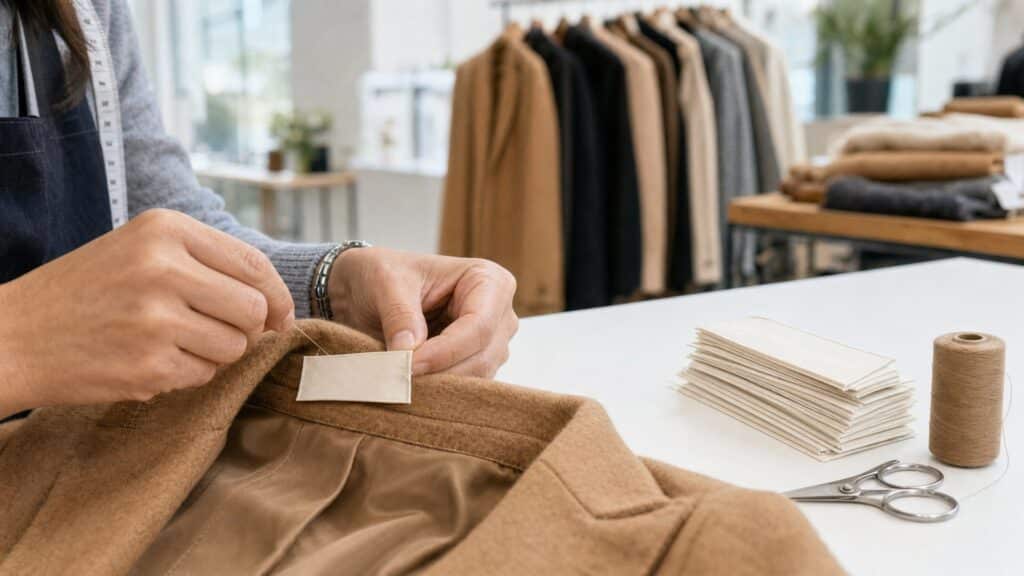
On a white label garment, the brand label at the back of the collar changes, and so do the hang tag and, if the boutique wants, the packaging. The supplier removes its own label and sews in the boutique’s, in the same position, before the goods are handed over. The tag carries the store’s name, its details and the sizes in the store’s system. This is where the garment’s identity lives for the customer, and it is enough to make a mixed selection from several warehouses read as one collection on the rail.
The care and composition label stays exactly as it is. It is sewn into the side seam by the supplier, states the fibre content and washing instructions and, where required, the country of origin, and it must remain true to the garment. This matters when an order mixes origins. The Kuwait boutique’s order included some pieces produced in China next to its Italian-made garments, so its own label carried only the store’s name, while each garment kept its supplier’s composition and origin label. White label changes the name on the product, never the facts about it.
A Kuwait City store with more than twenty years in retail, came to Prato at the end of August to buy its autumn-winter assortment in person. Over two and a half days it visited ten suppliers with our buyer, selecting faux fur jackets, feminine blazers, coordinated kimono and trouser sets, padded jackets and accessories. From the first day the owners asked which suppliers would accept their label, because they wanted the store’s name on as much of the order as possible. Where two warehouses offered similar pieces, the possibility of relabeling weighed in the choice.
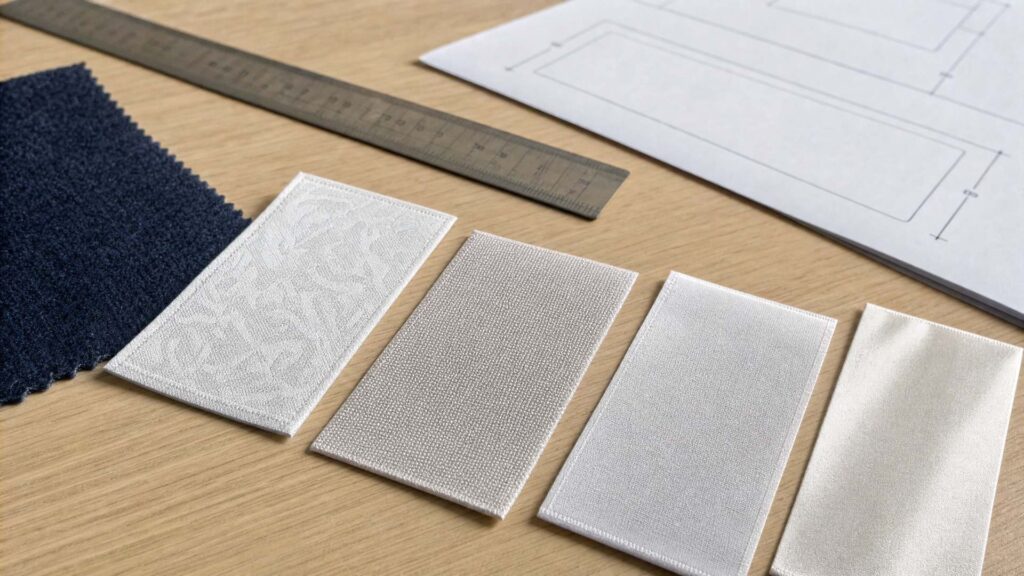
The boutique ordered enough woven neck labels for this season and the next, approved the proof after adjusting the size, and left the labels in Italy for future orders. The suppliers that accepted relabeling sewed the new labels in before the goods were collected, and every relabeled garment passed through our quality control with the rest of the order. The result, on arrival in Kuwait City, was a rail of Italian pronto moda that customers saw as the store’s own selection, with no trace of the ten warehouses behind it.
White label has limits that a buyer should accept from the start. The design is shared: the same jacket may appear in another store under another name, sometimes in the same city, and the boutique has no control over who else buys it. Some suppliers refuse relabeling, especially warehouses that sell under a registered brand of their own. Quantities and colours depend on what the supplier has available, and a style that sells out may not return. These limits are what a boutique accepts in exchange for speed and flexibility.
There are also practical costs. Relabeling adds a small charge per piece at most suppliers, labels must be produced in advance, and garments that wait for their new label stay with the supplier until the labels arrive and are sewn in. For a first order this can add a couple of weeks to the timeline. Once the labels are in stock, later orders move almost as quickly as standard purchases. Our article on launching a private label fashion brand explains when it becomes worth moving the best white label styles into dedicated production.
The simplest way to begin is to choose a few categories where the store’s name adds the most value, usually outerwear, knitwear and coordinated sets, and to relabel those while buying the rest as it is. A first label run, a clear tag and a supplier list filtered for relabeling are enough to start. During a buying session, either in person in Prato or by live video from the showrooms, the question of relabeling is asked of each supplier before the order is placed, so the buyer always knows which pieces will carry the store’s name.
When white label styles prove themselves, they become the natural candidates for private label, with exclusive fabrics or details. A blazer that sells out twice under the store’s name, for instance, is a strong reason to commission a version in a fabric or colour that only the boutique will carry, starting from a design that customers have already approved with their purchases. Our private label production team follows both stages, from relabeling ready-to-wear to developing a dedicated collection, so a boutique can grow its own brand at the pace its customers set.
White label clothing suits boutiques that already have a recognised name locally and want their customers to associate quality garments with the store rather than with the supplier. It suits buyers who purchase from many warehouses and want a coherent collection, and it suits stores that want to test a brand before investing in production. It is a weaker fit for a store whose customers come specifically for known Italian labels, because for them the supplier’s name is part of what they buy.
For most independent boutiques sourcing in Prato, white label is a practical middle ground between buying stock as it is and building a collection from scratch. Starting costs little, and because it runs on ordinary wholesale quantities the store’s name can appear on its garments from the very first order. Most of the effort goes into that first order; after it, relabeling becomes a routine part of buying, handled in Italy before the goods are packed.
Italian fashion supply, curated and delivered to your inbox.
How can we assist?
See our services