Hang Tags for Clothing: What Goes on the Tag When the Label Is Too Small
16 October 2026

Sourcing Strategy
Most white label clothing manufacturers that serve boutiques in Italy are concentrated in the Prato district, where thousands of pronto moda companies design, produce and sell women’s ready-to-wear from their own warehouses. They are not hidden, but they are hard to read from outside. There is no public directory that says which ones accept a buyer’s label, the suppliers are spread over two large areas far from each other that cannot be covered on foot, and new collections arrive every week. A buyer who arrives without a plan can spend days visiting warehouses before finding the few that fit both the style and the label policy.
What makes Prato useful for white label is its business model. Many companies there work on fast cycles, producing small runs of new styles and selling them to retailers and wholesalers across Europe and beyond. For them, a buyer who removes their name and sells the piece as their own is a normal client, not a threat. Others have invested in a brand, exhibit at international trade fairs and see their label as part of the product. Knowing which is which before the visit saves time on both sides.
The first category is the brand supplier. These companies sell under a registered name, often with a showroom designed like a boutique, catalogues and a presence at fashion fairs. Retailers buy them partly for the name, and the supplier protects it, so relabeling is usually refused or accepted only for large quantities. The Kuwait City boutique that sourced its autumn-winter order with us had bought for years from Italian pronto moda brands it met at trade fairs in Paris, and it came to Prato precisely to find collections that were not shown at those events.
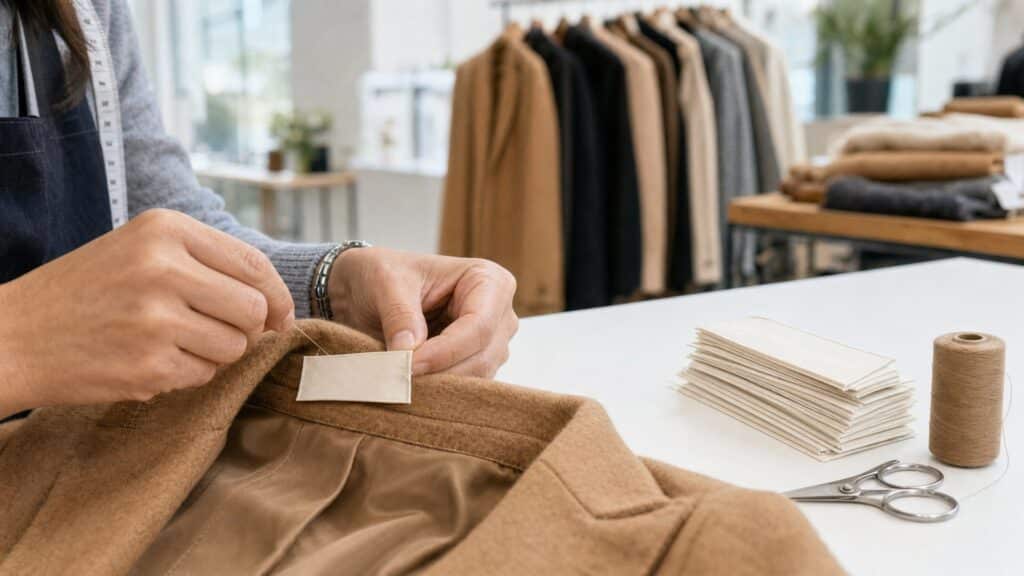
The second category is the white label supplier, which produces without investing in a consumer-facing name. Its own label is often generic, and the garments are designed to be sold under the buyer’s name. These warehouses usually relabel for a small charge per piece, and some keep a sewing team on site to do it as soon as the order is confirmed. Between the two sits a large middle ground of suppliers that decide case by case, depending on the quantity and on whether the buyer’s market overlaps with their own clients. Our guide to finding and vetting Italian clothing manufacturers describes the other signals that separate reliable suppliers from the rest.
The decisive conversation happens before the order is written. A buyer should know, for every supplier in the selection, whether the label can be replaced, who will do it, where the new label will be placed, and how long the garments will wait once the labels arrive. These answers vary from warehouse to warehouse. On the Kuwait order, the suppliers that accepted relabeling sewed the boutique’s woven label in the same position as their own, and the garments stayed with them until the labels had been delivered and applied. One collection went back for its labels to be replaced again before entering our warehouse.
The second question concerns origin. Most Prato production is made in Italy, but some suppliers also sell garments made elsewhere, often in China, alongside their Italian collections. A reliable supplier states the origin before the sale, and the buyer decides with full information. The Kuwait boutique accepted a mix of origins for its order, so the origin claim was removed from its own label and each garment kept its supplier’s composition and origin label. Our checklist on how to vet fashion suppliers includes origin among the points to verify in writing.
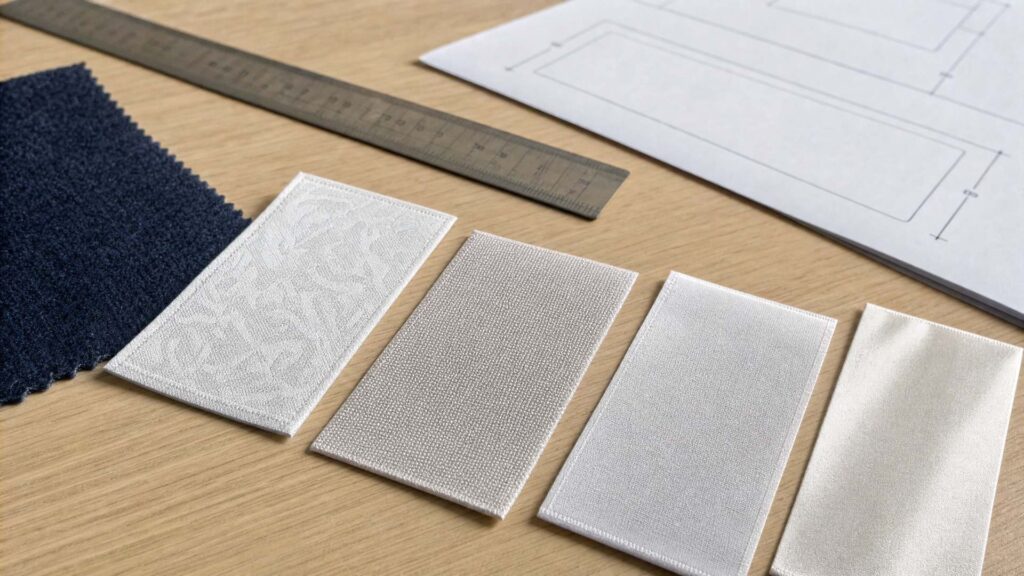
White label works with the quantities of ordinary wholesale. Prato suppliers usually sell a few pieces per size for each style and colour, which lets a boutique build a broad assortment without large commitments. Relabeling does not change these quantities, though some suppliers prefer to relabel only above a certain number of pieces per style. Time is the actual constraint. The labels must exist before they can be sewn in, so a first white label order includes the production of the labels themselves, which takes roughly two to three weeks from the approved design, depending on whether urgent or standard production is chosen.
Once the boutique has labels in stock in Italy, the timeline shortens to that of a normal purchase. For the Kuwait order, the boutique bought labels for more than one season at once, so its following orders could be relabeled within a few days of the purchase. The goods that did not need relabeling were collected and checked first, while the relabeled styles joined them as soon as the suppliers had finished, and the order left Italy as a consolidated shipment with one invoice for all suppliers.
A buyer who visits Prato alone faces a practical problem: the suppliers that accept relabeling and match the store’s style are a small share of a very large district. Visiting them efficiently means knowing in advance where they are, which collections they have this week and how they handle labels. With a car and a planned route, four or five suppliers in a day is a realistic pace. The Kuwait boutique saw ten suppliers in two and a half days with our buyer, each chosen beforehand on the basis of reference photos the owners had sent from their own store.
The alternative for buyers who cannot travel is a live session, in which our buyer walks through the showrooms on video while the client chooses in real time. The questions about labels are asked on the spot, in front of the client, and the answers are recorded in the order so that nothing depends on memory later. Either way, the supplier list is filtered before the first appointment, so the buyer does not discover at the end of the day that a favourite style cannot carry the store’s name.
A boutique that finds two or three reliable white label clothing manufacturers in Prato can build a steady supply around them. Each season it returns to the same warehouses, sees the new styles first, and relabels without renegotiating every detail. The labels are already in Italy, the suppliers know where to place them, and the quality control follows a routine. Over time the store learns which suppliers suit which categories, and its own label becomes a reliable signal for customers, whatever the source of each garment.
When a white label style performs well across several seasons, it can move into dedicated production with exclusive fabrics or details. Often the same supplier that made the original style is the best partner for the next step, because it already knows the pattern, the fit and the quality the boutique’s customers have accepted, and it can propose fabrics or colours that are reserved for one client. Our private label production service manages that step with the same suppliers, so a boutique can grow from relabeled ready-to-wear to its own collection without changing partners.
The right white label clothing manufacturers are those whose style fits the store, whose label policy is clear and whose origin statements are reliable. In Prato they exist in large numbers, but finding them takes local knowledge, a filtered list and questions asked before the order rather than after. Treating relabeling as a selection criterion from the first appointment avoids the most common disappointment, which is a well-chosen order that arrives with someone else’s name on half of it.
For an independent boutique, these suppliers offer a way to sell under its own name with ordinary wholesale quantities and short timelines. The first order takes a little longer, because the labels have to be produced and approved, and the relabeled garments wait for them at the supplier. Every order after that runs as quickly as a standard purchase, with garments that arrive already speaking with the store’s name.
16 October 2026
14 October 2026
12 October 2026
Italian fashion supply, curated and delivered to your inbox.
How can we assist?
See our services