
A Prato wholesale buying day looks nothing like a trade fair, and very little like the showroom appointments most retailers picture when they think about buying in Italy. There are no stands, no printed catalogues, no one waiting at the door with a badge. There is a warehouse with a roller shutter, a small office to one side, and several hundred styles on steel racks that were half empty ten days earlier. For a boutique owner who has never walked into the district, the first hour is disorienting. What follows is an account of what those hours contain.
How a Prato Wholesale Buying Day Begins
Warehouses in the district raise their shutters early, and the productive part of the day is over well before dinner. The buyer arrives with a written brief agreed with the client beforehand: categories to cover, target sizes, how many pieces per style, and which gaps in the shop need filling first. That brief matters because decisions get made in minutes rather than over an evening of reflection. Without it the session drifts, and the selection ends up built around whatever happened to look good in the first aisle rather than around what the shop is missing.
Preparation carries more weight here than it would in a showroom, because the stock itself will not wait. Each house replaces part of its rail continuously, so what a warehouse holds in the second week of a month has only a partial relationship with what it held in the first. The route is therefore built in advance around the houses that suit the client’s product, and the order in which they are visited is fixed before the first shutter goes up. Once the day has started, there is very little room left to reorganise it.
Inside a Pronto Moda Warehouse: Racks, Categories and New Arrivals
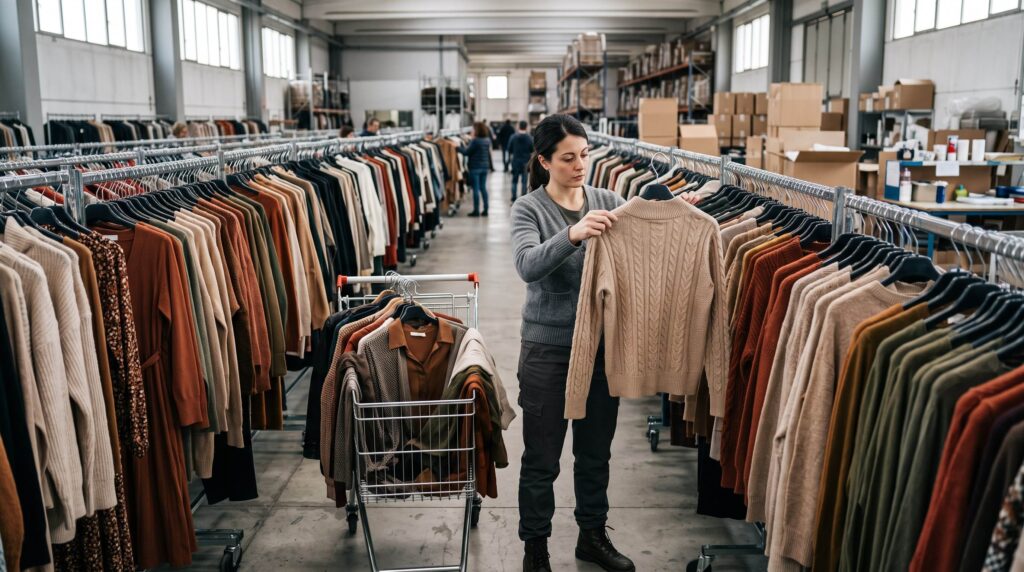
Physically, a pronto moda warehouse has almost nothing in common with a retail environment; it is a working space built for storage and dispatch. Racks run in parallel rows, usually grouped by category, with knitwear on one side, dresses through the middle and outerwear along the back wall, and the stock nearest the entrance is almost always the most recent. Lighting is functional, mirrors are rare, and the floor is shared with trolleys and cartons. Some houses keep a short sample rail near the office with the styles they are pushing. The rest you find by walking.
Understanding how the Prato district organises itself around a dense cluster of small independent warehouses explains the layout. Each house works on a limited number of styles and replaces them constantly, so there is no permanent assortment to memorise between one visit and the next. Sizes hang together on the same hook, colourways are split across the rack, and a piece you liked may exist in three other shades two rows away. Nothing is merchandised for the visitor. The selection work happens with your hands.
Why the Italian Wholesale District Has No Printed Price List
Retailers arriving for the first time usually ask for a catalogue with prices, and there isn’t one. Prices are quoted garment by garment, on request, by whoever is running the floor that morning. This is not evasiveness. Stock turns over so fast that any printed list would be obsolete within days, and the same house may buy an identical fabric at two different costs a month apart. You point at a piece, you ask, you get a number, and then you decide whether it survives the retail price your shop can realistically sustain.
Because the number arrives by voice, it has to be written down as it is heard. The buyer records each quoted price against the style, the colourway and the quantity discussed, so that nobody is left reconstructing figures from memory in the evening. That record is also what makes the second half of the day workable: with twenty prices already collected, the twenty-first can be judged against them instead of in isolation. A quotation that sounded reasonable at the first warehouse often reads differently once three houses have priced the same category.
How Negotiation Works on the Buying Session Floor
Negotiation in these warehouses is quiet, quick and almost entirely relational. Nobody haggles theatrically, and an aggressive opening offer tends to close a conversation instead of opening it. The lever is quantity and continuity: taking more pieces on a style, taking a complete size run, coming back next month. Physical presence changes the outcome, because a person standing at the rack with a loaded trolley is a different proposition from an email asking for a discount on styles nobody has touched.
The second lever is knowing what to leave behind. A buyer who spreads a couple of pieces across ten styles, where another concentrates the same budget on two, is carrying a different kind of risk, and the warehouse reads that choice immediately. Presence is also what keeps the exchange fluid: the person at the rack can point at the garment, put it back, pick up another and change the terms of the conversation in the same breath. Very little of that survives a message sent from abroad to a house that has never met the sender.
The Rhythm of a Buying Day: Several Suppliers, Fixed Closing Hours
A single day normally covers several warehouses, and the way an order is composed is what makes that necessary. Typical supplier minimums sit around 300 to 500 euro per warehouse, with two to twelve pieces per style, so a mixed selection is built across several houses rather than out of one rail. They do not all keep the same hours, several close for a long lunch, and most stop taking new customers before the official closing time because orders still have to be picked and packed. Distances inside the district are short, but the schedule bends to those windows. Reaching the last supplier twenty minutes before it stops serving produces a look at the racks and nothing else, so closing times get planned around.
Decisions are therefore made in real time. Stock is not held while a client deliberates overnight, and the whole logic of in-season buying rests on goods that move within days rather than seasons. A style seen at ten in the morning can be gone by three in the afternoon, taken by another retailer walking the same corridor. Experienced buyers confirm on the spot, keep a short reserve in the budget for something unexpected, and accept that a few misses belong to the model.
What the Client Sees During a Live Video Buying Session
Clients who cannot travel follow the session by video call. The camera moves along the rack at the buyer’s pace, stops on individual pieces, goes close on fabric, seams, zips and labels, and the client says what to hold and what to skip. Nothing about the format is polished. Warehouse lighting is what it is, the connection drops occasionally in a metal shed, and the buyer describes colours out loud because a phone screen misrepresents beige, stone and off-white with impressive consistency.
What the buyer does on the ground goes well beyond holding a camera. Checking hand feel, verifying that a size run is complete, counting available stock, negotiating the price and confirming the order are all part of the sourcing and purchasing work carried out inside the warehouse on the client’s behalf. That work is charged as a commission of 10% on the confirmed purchase value, with a minimum of 250 euro per working day. One point is fixed: supplier names are never disclosed, during the session or afterwards, and no supplier list is provided.
When the Last Shutter Comes Down on the Buying Day
Judging a garment belongs to the day as much as agreeing its price does, and it happens with the piece in hand. The buyer feels the weight of a knit, opens a zip, looks at how a seam is finished and how a print sits against the grain, then decides whether the style suits the shop it is going to. That judgement cannot be made from a photograph, which is precisely what a client following by video cannot do alone, and it is why every style is handled on the floor before it is confirmed.
By the time the last shutter comes down, the day exists as a set of confirmed selections spread across several different houses, each one agreed in the aisle where the garment was hanging. Nothing about it resembles ordering from a catalogue and waiting for production: the pieces are already made, already in the building and already counted. That is what a buying day in the district amounts to when it goes well, hours spent handling stock in a working warehouse rather than reading about it from a distance.