Silk gets filed as a summer fibre out of habit. In the pronto moda showrooms around Prato, italian silk wholesale moves in two separate waves, and the colder one is quieter and often better in margin. Boutiques and online retailers who keep silk on the rail through November are not selling a summer story out of season. They are selling the piece that completes an outfit built on wool, and that shift changes what you order and where the markup ends up.
Why Italian Silk Wholesale Reads as an Autumn Fabric
Silk is a protein fibre with low thermal conductivity, which is why it feels cool against warm skin and warm under a coat. The autumn versions are simply heavier and less transparent: crepe de chine with a matte, slightly grainy surface, washed satin with a dry hand, twill in weights that hold a pleat. Colour does much of the seasonal work. The blouse block that sells in ivory and pale blue for spring returns in burgundy, forest, rust and chocolate, and that palette alone repositions the garment.
A first silk capsule does not need to be large, and supplier minimums keep the test affordable. In the pronto moda warehouses a typical order opens at 300 to 500 euro per supplier, with anything from two to twelve pieces per style depending on the house, so four or five shapes in two colourways each is a realistic first order rather than an ambition. That structure lets a shop take the shapes it trusts in depth instead of one of everything. What a single autumn teaches you about weights, colours and the customer who reaches for them is knowledge no supplier hands over in a showroom.
Silk Blouses Wholesale and the Weight They Carry
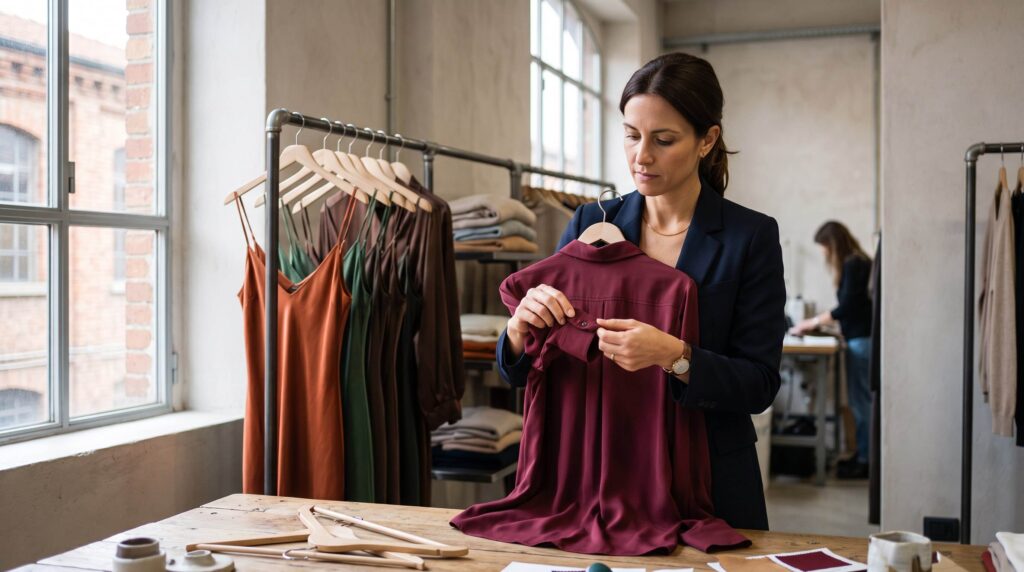
Buyers ask which silk category to start with, and for autumn the answer is the blouse. It solves a concrete problem for the customer: something to wear under a blazer or a cardigan that does not read as a t-shirt and does not need pressing after every wear. Retailers who do well with silk blouses wholesale concentrate on simple constructions, a classic collar, a mandarin neckline, a soft V with a tie, and let colour carry the variety. Prints move more slowly in winter, small geometric and animal patterns excepted.
Construction is where the price bands separate. On better pieces you find French seams or narrow overlocked seams pressed flat, buttons set into a reinforced placket, and a hem turned twice rather than cut and rolled once. On entry-level pieces the seam allowance is minimal and the finishing faster, which is not wrong in itself: it answers a different retail price. What matters is knowing which one you are buying before delivery, because a customer who pays a premium price for entry-level finishing does not come back.
Slip Dresses and AW26/27 Silk Pieces for Layering
The slip dress moved from evening into daywear when retailers began showing it over a fine-gauge knit rather than on bare skin. That styling is why it belongs among the AW26/27 silk pieces worth ordering: over a long-sleeved merino top, with boots and a coat, a bias-cut slip becomes a complete winter outfit instead of an occasion garment. Bias cutting is the detail to look for: it lets the fabric fall around the body and makes the dress more forgiving across sizes when you take only a few pieces.
Layering also widens the sell-through window. A silk dress that only works in December sits on the rail for eleven months; the same dress styled over knitwear starts moving in October and continues into March. Earlier we covered how silk behaves in everyday wear during the warm season, and the autumn logic is its mirror image: same fibre, heavier weights, different styling instructions for your sales staff. Shops that write those instructions down convert better than shops that leave the piece to explain itself.
Pure Silk and Silk Blend Boutique Buying
The difference between pure silk and a blend surfaces in three places: purchase price, hand, and what the customer must do to keep the garment alive. Pure silk costs more at wholesale, drapes with a fluid weight nothing else reproduces, and almost always carries a dry-clean or cold hand-wash label. Silk mixed with viscose brings the buying price down and keeps much of the fluidity, though it creases more. Silk with cotton, or a small share of elastane, behaves closer to a shirt fabric and tolerates domestic laundering.
For silk blend boutique buying the calculation is not cheaper against better. A blend can be the correct answer for a customer base that buys clothes to wear weekly and resents dry-cleaning bills, while a pure silk blouse justifies a higher retail price and a different conversation at the till. What does not work is mixing the two inside the same style without saying so, because the composition label is the first thing a returning customer checks. Read that label at the supplier, not after delivery.
Silk Inside a Winter Assortment Dominated by Wool and Knitwear
Most autumn orders from independent shops are weighted towards knitwear and outerwear, correctly so, because those categories carry the volume. Silk plays a different role. It lifts the average ticket, since the customer who came in for a jumper leaves with a jumper and a blouse, and it covers the evening and festive occasions that wool alone cannot serve. A minority share of the autumn budget, well below what knitwear absorbs, is the right starting point for a shop testing the category.
The pairing works in both directions. The heavier materials we examined when looking at wool, velvet and jersey for the AW26 season give silk something to sit against, and silk gives those fabrics a lighter counterweight in the window. This argues for looking at both categories in one buying session rather than treating them as separate exercises, since a blouse reads differently once the knit it will sit over is on the table in front of you.
What to Check Before Confirming an Italian Silk Wholesale Order
Four checks cover most of the risk. Seams first: on silk, a puckered seam line normally means the machine tension was wrong for the fabric, and that garment will not improve with steaming. Then the finishing: buttonholes, hems and the inside of the armhole, where rushed production shows first. Colourfastness deserves a rub test with a white cloth on deep reds and blacks, the shades most likely to transfer. Last, watch how the piece falls, since fabric that hangs stiffly on the hanger hangs stiffly on the customer.
Quality tracks the price band closely, and a buyer expecting couture finishing at low-cost pronto moda prices will be disappointed. In that segment up to 5% of the pieces can carry minor irregularities, a loose thread, an off-centre button, a small print misalignment, and that tolerance is the normal standard of the sector at that level rather than the fault of one supplier. Higher price bands tighten considerably and cost accordingly. Establishing where the line sits before confirming separates a manageable expectation from an argument after delivery.
Running those checks from abroad is the part that stops most retailers, which is why the sourcing and purchasing service puts hands on the fabric before anything is confirmed, with pieces handled, turned inside out and held to the light. A retailer buying at distance needs the same four checks applied to every style, not a catalogue photograph and an optimistic description. That is the difference between an order whose outcome is already known and a box opened with fingers crossed.
Silk for Ceremony and the Festive Occasions
The second half of the autumn silk argument sits in ceremony and festive dressing. Weddings, family celebrations and the run of parties that fills the end of the year send customers looking for something they cannot assemble out of knitwear, and a shop carrying nothing in silk watches that customer walk to another window. These pieces also behave differently once they are in store: they arrive late in the customer’s decision, they move quickly when they move at all, and the price is rarely argued over, because the garment has a date attached to it.
What works in this corner of the order is restraint. Deep satins, a long clean line, a plain surface that does not date across two seasons, rather than embellishment tying the piece to one particular year. A blouse in a festive colour frequently does the same job as a dress, at a lower buying price and with a longer life in the wardrobe. Handled this way, italian silk wholesale stops being a seasonal gamble for a boutique or an online shop and becomes a small controlled line inside the autumn budget.