
The Quiet Performer: Why Printed Cotton Is Outpacing Solid Fabrics This Season
Linen dominated the SS26 buying narrative in early spring, and it has broadly delivered on that. But the category data from independent boutiques in the UK, northern Europe, and North America is telling a different story at mid-season. Printed cotton — bold botanicals, geometric blocks, tonal graphics on a cotton or cotton-blend base — is posting faster sell-through in several key garment categories. Not because linen is slowing, but because in a season where many boutiques went heavily neutral, a strong print simply stands out on the floor.
This is a familiar pattern in mid-market retail. When a fabric or silhouette becomes heavily adopted across multiple boutiques in a given market, differentiation shifts toward print and colour. The boutique that sourced Italian printed cotton in the €28–42 wholesale price range for a well-constructed midi dress is now sitting on a garment that competes less directly with the neutrals crowding the market than it did when the season began. That dynamic rewards buyers who included printed cotton in their SS26 mix rather than going all-in on the linen trend.
For buyers who didn’t take a strong position in printed cotton at the start of the season — or who under-ordered relative to demand — a targeted late-season order is worth examining. Prato suppliers who specialise in printed wovens and cotton garments are still producing in June, though the range is narrowing. The prints that remain available tend to be the commercial standards: large floral on white or ecru ground, geometric block repeat in two-tone palettes, and tonal abstract prints that photograph well for social media.
Which Printed Cotton Formats Are Still Selling in Mid-Season
Not all printed cotton categories behave the same way in mid-season. Some formats peak early and slow sharply by June; others have a longer selling arc that extends into late summer. Understanding the difference helps buyers decide where late-season investment makes sense. The formats with the longest mid-season tail tend to be those where the print is incidental to the garment’s function rather than its primary selling point.
The printed cotton midi dress — particularly in a relaxed smock or shirt-dress construction — has consistently shown strong sell-through into June and July across multiple boutique markets. The silhouette works as holiday, occasion, and casual wear, which extends the context in which the customer will wear it and therefore the window in which she’ll buy it. Printed cotton overshirts have shown similar resilience: they’re worn open over swimwear in resort contexts, layered over vest tops in urban summer settings, and treated as a lightweight cover-up across different travel destinations. Italian light layers in SS26 have been designed with exactly this versatility in mind.
The format that tends to slow earliest is the printed wide-leg trouser sold as a standalone. Coord buyers do well with it as a set, but the trouser on its own is a harder sell — customers who aren’t committed to the full coord struggle to build an outfit around a strong print in a bottom weight. By June, most of the sets have cleared. What’s left in the singles needs either a markdown or a styling solution on the floor to move.
How Italian Pronto Moda Handles Printed Cotton Production
Understanding how printed cotton is produced in the Prato district matters practically for buyers, because it affects minimum quantities, lead times, and the consistency of print registration between pieces in a size run. The majority of printed cotton in the pronto moda segment uses pre-printed fabric purchased from specialist suppliers rather than custom-commissioned prints. This means the print designs available in a given season are shared across multiple manufacturers — which is relevant for boutiques that want a degree of exclusivity in their edit.
Pre-printed fabric purchasing allows Prato manufacturers to keep minimum order quantities low. A typical SS26 printed cotton dress will have a manufacturer minimum of between six and twelve pieces per style, with size distribution handled by the buyer. This is a significant advantage over custom print production, which typically requires runs of 100 pieces or more per colourway to be commercially viable. For boutiques buying across multiple suppliers in a single sourcing session, the ability to take a small position in a printed cotton piece without committing to large quantities makes category experimentation affordable.
The trade-off is print exclusivity. Because the fabric is purchased from shared suppliers, the same print can appear in garments from several different Prato manufacturers. Where buyers want differentiation through print, the options are to choose prints early in the season before they’ve been widely bought, to select constructions and silhouettes that are distinctive even if the print fabric is shared, or to move to a private label production approach where the print can be custom-ordered and protected. All three strategies have merit; which one applies depends on the buyer’s volume, budget, and how differentiated the store identity needs to be.
Reading a Print’s Commercial Legs Before You Order
The skill that separates experienced wholesale buyers from those who take on too much markdown risk is the ability to read a print’s commercial viability before ordering. This sounds abstract, but there are observable indicators that are reliable enough to build a buying discipline around. The first is context versatility: how many different customer occasions does this print work for? A bold tropical print in high-contrast colours has strong visual impact on a sourcing rail but tends to work in a narrow range of contexts — it reads as resort or holiday, rarely as anything else. A botanical print in muted dusty tones on a soft cream ground works for brunch, holiday, and a casual garden event. The latter travels further through the customer’s life and has a longer selling window.
The second indicator is photography performance. Bold prints photograph well as single editorial images but can be harder to wear in the customer’s own photos — which matters increasingly for boutiques whose customers share their purchases on social media. Prints with some tonal depth, where the overall impression reads differently in full light versus shade, tend to produce better customer photographs and therefore more organic promotion. This is not a reason to avoid high-contrast prints, but it’s a factor worth weighing alongside the visual impact on the rail.
The third indicator is how the print behaves in the specific construction being offered. SS26 printed poplin in structured silhouettes shows how construction affects print performance: a geometric print in a crisp cotton poplin shirt reads very differently from the same print in a soft jersey construction. Buyers who handle the fabric and check how the print registers at the seams — whether the repeat matches or breaks at joins — are getting information that’s genuinely useful for predicting retail performance.
Building a Late-Season Printed Cotton Order That Makes Commercial Sense
The right late-season printed cotton order is not a repeat of the spring buy. It’s a narrow, targeted selection built around specific gaps in the current floor. The most productive approach is to identify the two or three printed formats that have sold well from the current edit, establish whether similar product is still available from Prato suppliers, and place a small bridge order in those specific categories. Five to eight styles, with six to twelve pieces per style, is a manageable late-season position that can generate clean sell-through before the floor transitions.
The categories to avoid in a late-season order are those where the remaining stock at Prato is made up of the slower-moving prints — the ones that didn’t clear quickly when they were fresh. Late in the season, there is more slow-moving inventory in the channel than there was in March, which means buyers need to be more selective, not less. The discipline is to buy only what you have clear evidence will sell, not what seems like a good deal on a depleted rail.
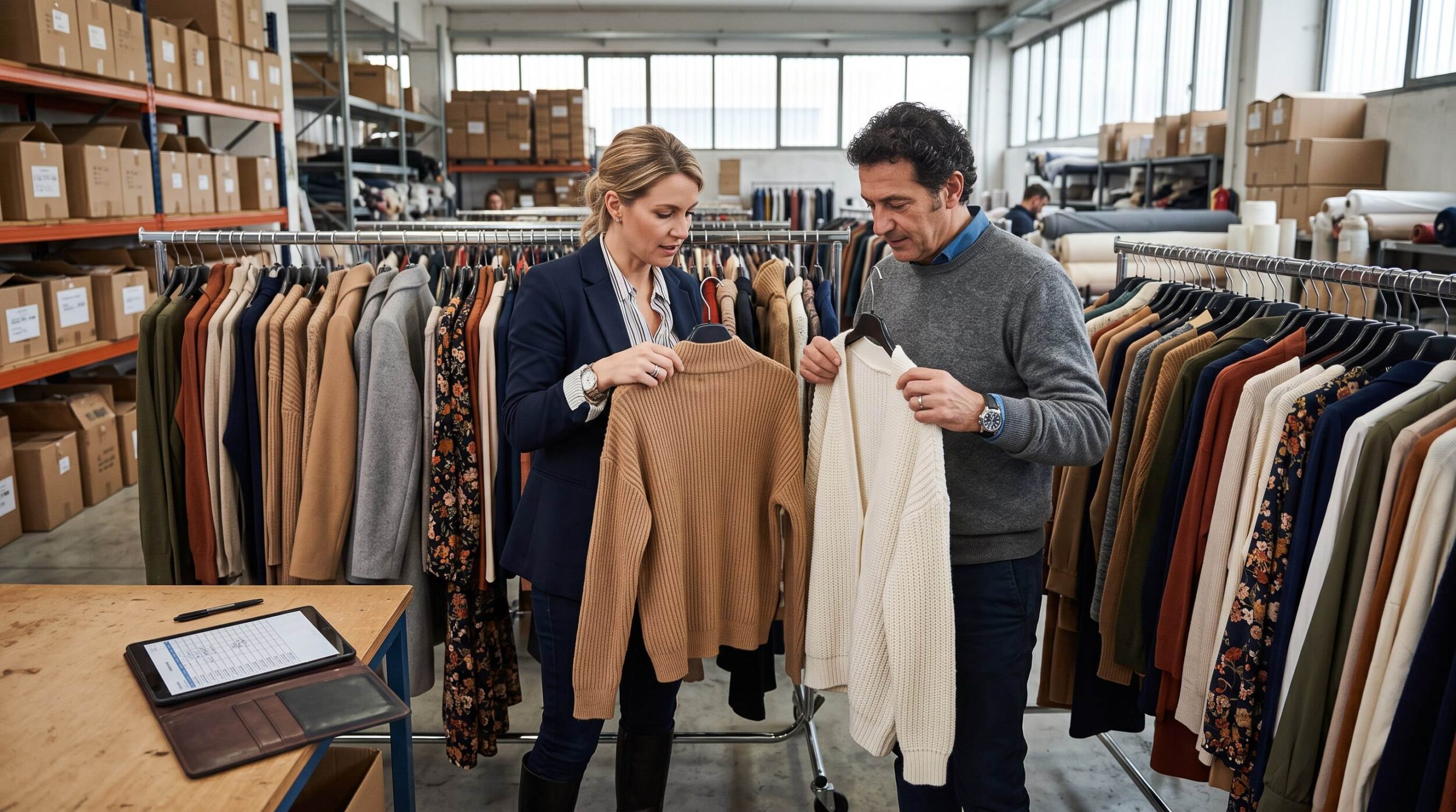
For boutiques considering this approach, a sourcing session structured specifically around late-season printed cotton, with a Prato agent who knows which suppliers are still producing versus only clearing, is the most efficient way to access what’s genuinely available. The difference between sourcing this category live versus working from static lookbooks is the ability to check real stock availability, feel the print registration and fabric hand, and confirm lead times before committing. That ground-level information is what makes the commercial difference between a late-season order that earns its margin and one that ends up in a sale event.
If printed cotton is a gap in your current SS26 edit and you want to see what’s still moving in Prato this season, Italian Fashion Sourcing can set up a targeted session for exactly this category. Book your introduction call at italianfashionsourcing.com/interview/ and we’ll confirm which suppliers are still producing and what minimum quantities look like for a late-season order.