
Custom Woven Labels for Clothing: Size, Wording and the Proof You Approve Before Production
14 October 2026
Sourcing Strategy
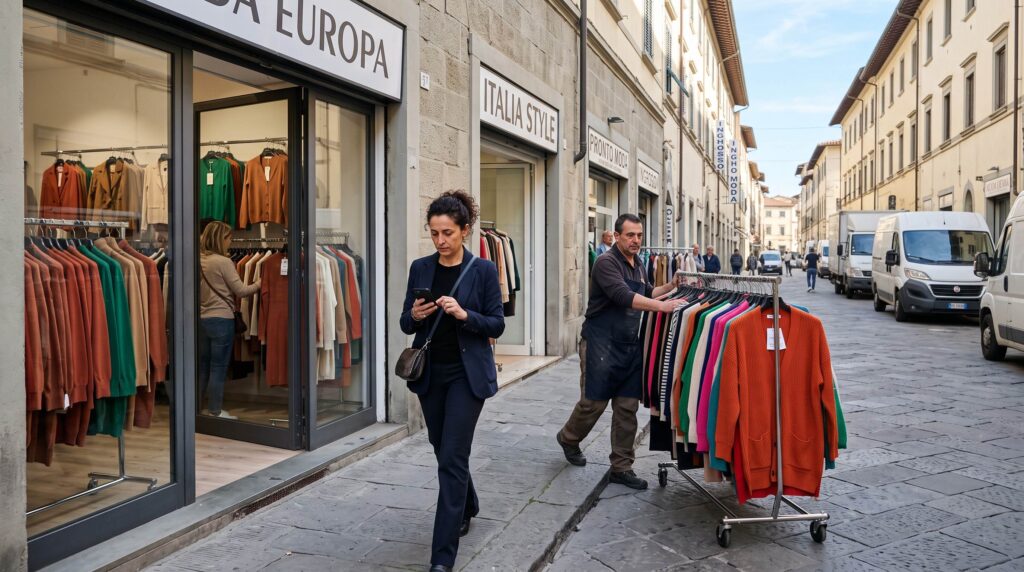
Some markets can be bought from a distance, on catalogs and previews published months ahead. Pronto moda is constructed to defeat exactly that approach. Collections appear in Prato showrooms without announcement, rotate within three to four weeks and are replaced by the next wave, so the market a buyer studied in March no longer exists in April. In an environment like this, market monitoring is not an accessory to buying. It is the condition that makes informed buying possible at all.
Distributors served by one wholesaler receive, in place of monitoring, that wholesaler’s phone calls, which arrive when he has stock worth moving. The difference between those two information flows is a large part of the complete comparison between an agent and a single trusted wholesaler drawn in our pillar guide. This article stays on the monitoring itself: what a weekly presence actually observes, and what that visibility changes for a distribution business.
The rotation speed is the defining fact of the district. Roughly 7,000 fashion companies operate around Prato, and the showrooms among them refresh collections on a cycle of three to four weeks, with finished womenswear generally priced between €10 and €45 wholesale. Strong articles can sell through in days. There is no reservation system for the future, no preview season and no guarantee that what a buyer admired on one trip will exist on the next.
For a remote distributor this pace creates a structural blindness. Between one buying trip and the next, two or three full waves of product have appeared and vanished unseen, and the trip itself samples the market on an arbitrary date, showing whatever happened to be on the rails that week. Buying this way means deciding a season’s catalog from fragments, and the fragments are chosen by the calendar rather than by relevance.
Market monitoring replaces fragments with a moving picture. A presence in the district every week registers the new arrivals by category and supplier, which articles are gaining depth in the showrooms, which restocks have landed, which availabilities are shortening and where conditions are moving. It also captures the quieter signals: a supplier whose collection is suddenly attracting other international buyers, a category thickening across several showrooms at once, a price tier going soft.
The distributor receives this as regular, usable intelligence rather than raw noise. Opportunities relevant to his brief get flagged when they appear, not when a trip happens to coincide with them; availability changes on articles he cares about reach him while there is still time to act. The information flow is built on his categories, his price architecture and his markets, which is precisely what no supplier’s promotional call can ever be.
Delivery of the intelligence matters as much as its collection. Observations arrive filtered against the distributor’s brief, in a regular rhythm rather than as promotional bursts, and they distinguish clearly between what is merely new and what is relevant: a fresh wave in his core category, depth returning on an article he sold well, a supplier he uses starting to run thin. The distributor reads minutes of signal instead of hours of noise, and his decisions inherit that clarity.
Decisions change quality when they rest on the present tense. A distributor who knows what is actually in the showrooms this week buys the market as it is, while one working from memory and phone calls buys the market as it was, or as one supplier prefers to describe it. The practical mechanics of acting on current information are covered in how in-season buying works in Italian pronto moda, and monitoring is what arms them: a purchasing session convened because the offer justifies it, rather than because a flight was booked.
Timing gains matter disproportionately in this market. Reaching a strong article in its first week rather than its third often decides whether full size curves are still available, and whether a restock can be reserved at all. Monitored buyers are consistently early for the simple reason that they knew earlier. Over a season, that repeated small advantage compounds into a catalog assembled from first choices instead of remainders.
Depth decisions improve alongside timing. Knowing that an article is present across several showrooms, or conversely that it exists in one and is thinning, changes how much of it a distributor should take now versus stage across reorders. That judgement, invisible from abroad, is routine for anyone watching the shelves weekly, and it quietly determines how much of a season’s budget ends up in winners bought at full depth.
Visibility also reorganises the calendar. A distributor who can see the district’s rhythm aligns Italian purchases with his own retail cycle, pre-order campaigns and cash flow, scheduling dedicated sessions at the moments when arrivals in his categories are richest. Buying stops being an event dictated by travel logistics and becomes a programme, with dates chosen for commercial reasons and budgets deployed when the offer is strongest rather than when the diary allowed.
Programmed buying is also calmer buying, and calmer buying is more accurate. Sessions convened against a known market remove the pressure to take whatever the rails happen to hold, because the buyer already knows what exists elsewhere and what is arriving next. The distributor plans depth on articles monitoring has shown to be strengthening, and skips categories the district is currently serving poorly, decisions that are simply unavailable to anyone buying blind.
The economics compare well against the traditional alternative. Covering the district personally means flights, hotels and days out of the office several times a season, sampling the market on whichever dates the diary allowed. The monitored model inverts the cost structure: continuous coverage comes bundled with the sourcing relationship, and physical presence becomes a choice reserved for the moments it adds most, with an accompanied sourcing day in the district priced at €250 for the first day and €125 for each additional day.
Seasonal turning points show the value most clearly. The weeks when summer stock gives way to transitional pieces, or when a trend crosses from early showrooms into general distribution, are exactly when timing errors get expensive, and exactly when remote buyers are guessing. A monitored distributor enters those windows with current information on both sides of the change, buying the outgoing season’s last depth and the incoming season’s first arrivals at the right moments rather than a cycle late.
The deeper difference is what happens when nothing is being bought. A wholesaler’s attention to a client naturally follows the order cycle; between purchases, the relationship sleeps. Monitoring inverts this: the presence on the market keeps working through the weeks when the distributor buys nothing, accumulating exactly the information that will make the next purchase sharper, and occasionally surfacing an opportunity worth an unplanned session.
The model is deliberately simple to enter. Monitoring comes bundled into the sourcing relationship rather than sold as a subscription, with the service charged at 10% of purchase value, a €250 minimum commission and no minimum order value, and every collaboration beginning with a short application interview to fix categories, markets and price architecture. From that brief onward, the district is watched on the distributor’s behalf, whether or not an order is open.
At distribution scale, information advantages translate directly into commercial ones. The distributor who sees the market weekly offers his retail network earlier trends, deeper availability on winners and fewer gaps, and his catalog reflects the district’s best current output rather than one warehouse’s aging bets. His competitors, buying on occasional trips, are working from older data by definition.
Market monitoring earns its place in the model not as a report to read but as a position to hold. In a market that renews itself every three to four weeks, someone is always closest to the shelf, and everyone else is buying at a delay. The only real question for a distributor is which side of that gap his business sits on, and the district makes the answer a choice rather than a fate.
Italian fashion supply, curated and delivered to your inbox.
How can we assist?
See our services