Custom Woven Labels for Clothing: Size, Wording and the Proof You Approve Before Production
14 October 2026
Trend Report
Knit dresses wholesale is the category buyers discover in their second Prato season, usually after watching sweaters sell well and wondering what else the district’s knitwear workshops produce. The answer is a complete dressing system: ribbed midi dresses, knitted two-piece sets and knit trousers, worked in the same kid mohair, baby alpaca and cashmere blend yarns as the sweater wall and wholesaling as finished garments between 25 and 45 euros. These formats sell as whole outfits, which changes their retail arithmetic entirely. This article examines them on their own; the surrounding category context sits in our Prato wholesale guide to kid mohair, baby alpaca and cashmere blend knitwear.
The commercial case rests on transaction value. A customer buying a sweater spends once; a customer buying a knitted set or a dress that needs only boots has completed an outfit in a single decision, and the boutique captures what would otherwise be two or three separate purchases, some of them made elsewhere. Shops tracking average transaction value consistently find dressing formats lifting it, and in knitwear the effect is amplified because the fabric itself does the styling work that separates a garment from an outfit.
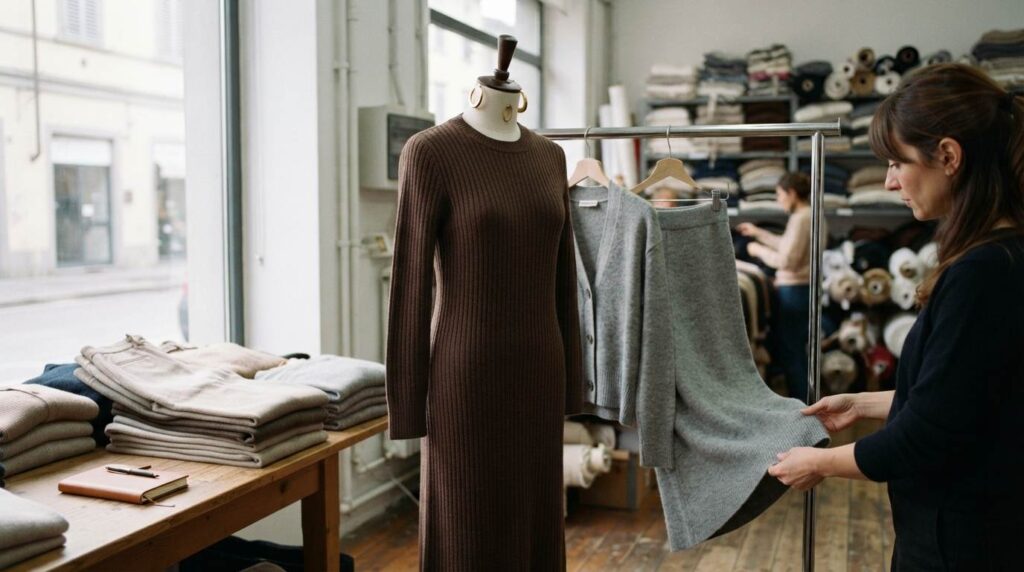
The ribbed midi is the anchor of the knit dressing offer. Fitted through the body, falling below the knee, usually in a fine or mid gauge with substantial vertical rib, it flatters through structure rather than cling: the rib’s columns elongate visually while the knit’s elasticity accommodates real bodies. In cashmere blends it wholesales around 25 to 35 euros and retails between 79 and 110, a full outfit price the customer compares against a dress plus tights plus cardigan bought separately, a comparison the knit dress wins on both money and effort.
Colour behaviour differs from sweaters. Dresses sell strongest in deep, quiet tones, chocolate, forest, charcoal, black, because customers treat them as occasionwear for offices and dinners rather than as texture statements. A supporting camel or ivory serves the minimalist customer. Buyers should resist translating their sweater colour plan onto dresses; the two categories answer different questions, and the dress rail earns its keep by being dependable rather than vivid, refreshed in silhouette rather than in shade as the season progresses.
Silhouette variety within the dress family is worth mapping before a session. Beyond the fitted rib, showrooms offer the A-line knit dress for customers who avoid body-contact fits, the polo-collared version that reads office-appropriate, and the maxi length that performs in Middle Eastern and Gulf markets where coverage and drape are the purchase criteria. Each answers a distinct customer, and a rail carrying two of these alongside the ribbed anchor covers most of a boutique’s dress demand with three styles, which is the kind of coverage-per-hanger efficiency that makes the category worth its space even in a small shop.
The knitted co-ord, a matching set of cardigan or sweater with skirt or trousers, imports into knitwear a format already proven across Italian wholesale, whose mechanics we examined in our piece on the two-piece co-ord format in Italian wholesale. Knit versions add what woven sets cannot: the pieces work as hard separately as together. The set’s cardigan lives a second life over the customer’s jeans, the knit skirt pairs with her existing basics, and this separability is the answer to the classic co-ord objection that a matching set is really one outfit at two prices.
In showrooms, sets appear in two constructions. Sold-as-set pieces share one wholesale price, typically 35 to 45 euros for the pair in blend yarns, and simplify buying but lock the size ratio. Sold-as-separates programmes price each piece individually, letting the boutique buy tops and bottoms in different size depths, which matches how bodies actually distribute. Where a supplier offers both, separates are almost always the wiser buy for an independent boutique, even at a slightly higher combined cost, because broken sets are the format’s only genuine inventory risk and separates dissolve it.
Knit dressing carries a structural sizing advantage that rarely appears in trend coverage but transforms the buying maths. Because the fabric stretches and recovers, a knitted dress or skirt fits a range of bodies a woven equivalent cannot, and suppliers commonly cut these programmes in compressed size runs, small through large rather than numeric sizing, with each size covering what two woven sizes would. For the boutique this halves the size curve per style, which either halves the capital per style or doubles the styles per budget.
The fitting-room experience improves in parallel. Knit dresses forgive between-size customers, reduce the try-on failures that end shopping trips, and give staff an honest line that the garment moves with the wearer. Returns data reflects it: shops report knit dressing among their lowest-return categories, precisely because fit disappointment, the dominant return reason in dresses, is engineered out by the fabric. Fewer returns on a 79 to 110 euro ticket is margin protection worth naming when weighing these formats against woven alternatives.
There is a display consequence too. Knit dresses need hangers with shoulder shaping or, better, a single dressed mannequin, because folded they disappear and on wire they distort; the garment that sells on drape must be shown draping. Boutiques that move one knit dress from the rail to a mannequin near the entrance consistently report the style selling through ahead of its rail-bound neighbours, an old merchandising truth that applies with particular force to a category whose entire argument is how the fabric falls.
Wholesale pricing across knit dressing follows composition, exactly as in sweaters: entry cashmere blend dresses from about 25 euros, alpaca blend versions toward 38, and set combinations reaching 45. Two cost behaviours distinguish the category. Fabric quantity is higher than in a sweater, so gauge and density checks matter proportionally more, a thin knit dress being unwearable rather than merely disappointing. And freight behaves favourably: dresses and skirts fold flat and dense, so their volumetric weight, the basis on which international courier freight from Italy is charged, stays close to actual weight, unlike lofty statement knits.
At reference rates of roughly 2 to 3 euros per volumetric kilogram within Europe and around 8.50 to North America, a folded knit dress typically carries one to two euros of allocated freight, undisturbing to its retail price point. Duty depends on the destination’s current tariff schedule and should be verified locally before final pricing, since rates can change at any time. The landed arithmetic, wholesale plus the 10 percent sourcing fee plus freight and duty, generally lands these garments comfortably inside a 2.5 times retail markup with the ticket still under the psychological 120 euro line.
Drape decides purchases in this category, and drape is exactly what a live session shows: a dress on a mannequin turned on camera, a skirt held by the waistband to display its fall, a set worn briefly by showroom staff where available. After the initial interview establishing your market and sizes, we route the session through Prato’s knit dressing specialists alongside the sweater showrooms, so the whole knitwear order builds in one day and consolidates into a single invoice and shipment. The complete process is described on our fashion sourcing and purchasing service page.
A proportionate first commitment is ten to fifteen percent of the knitwear budget: one ribbed dress in two colours, one separates-based set, sizes weighted to your known curve. Supplier minimums of a few pieces per style make that test order small in absolute terms, and there is no minimum order value on the sourcing side, with the 250 euro minimum commission applying per engagement. The sell-through will speak quickly, because dressing formats either fit a boutique’s customer or do not, and one season of evidence is enough to scale.
Knit dresses wholesale and their co-ord relatives ultimately give a boutique something sweaters alone cannot: ownership of the customer’s entire outfit at knitwear margins. Bought in quiet colours, checked for density, sized on the compressed curves the fabric allows and shipped flat at minimal freight, they are the highest transaction value per hanger in the winter knitwear offer, and the most underbought format in the district relative to what it returns.
Italian fashion supply, curated and delivered to your inbox.
How can we assist?
See our services