
Early September changes the pace of the Prato district. The AW26/27 collections in Prato have landed in the warehouses, rails are restocked daily, and the first international buyers are already moving between showrooms. What has arrived, though, has not arrived evenly. Six years of working the Prato and Bologna districts have made the pattern familiar: some categories are present in real depth from the opening week, others fill in gradually, and a number of references only reach complete size and colour coverage later in the autumn.
That distinction matters for anyone planning a buying trip around the assumption that a full winter offer is sitting ready in the warehouses. It is not, and it never is at this point of the calendar. Reading pronto moda autumn availability correctly, knowing which shelves are deep now and which are still filling, separates a session that covers the shop floor from one that leaves visible gaps in October. What follows describes how stock physically moves through the district, not what anyone expects to be fashionable.
What Is Already Deep When the AW26/27 Collections Reach Prato
The categories that rotate daily arrive first and in quantity. Light knitwear, jersey pieces, heavy viscose and transitional garments that work through a mild autumn are cut early, stocked in volume and restocked within the season. These are the items a boutique sells from the first cool week, so warehouses carry them in full size runs and several colourways. With supplier minimums normally sitting between 300 and 500 euro per warehouse and 2 to 12 pieces per style, a buyer can build genuine breadth across a handful of suppliers in a single day.
Depth here means something specific and worth stating plainly. It means the same style available in repeated sizes, in more than one colour, with a realistic chance of a second cut while the warehouse still holds the fabric. It also means the same silhouette turns up at several suppliers in slightly different versions, which gives a buyer room to compare construction and price instead of accepting the first option seen. Early September is the moment when that comparison is genuinely possible, because nothing has been picked over yet.
Structured Outerwear Arrives Later in Autumn Winter Wholesale Italy
Coats, padded pieces and constructed tailoring behave differently. They involve more components, from linings and interlinings to zips, trims and heavier finishing, and they occupy longer production slots, so they reach the warehouses in waves rather than in one delivery. In the first days of September a buyer will often see a single sample of a coat, or two colourways out of a wider range, with the rest scheduled for later. That is ordinary district behaviour and not a sign that the supplier is holding stock back.
The operational consequence is simple enough to plan around. Outerwear noted in early September should be treated as a shortlist rather than a closed order, with a direct question to the supplier about which references are complete and which are still arriving. When the missing pieces land, a follow-up purchase can be brought together into one invoice and one consolidated shipment even when several different suppliers are involved, which keeps the second buy from multiplying freight and paperwork.
Transitional pieces cover the gap in the meantime, and this is where the early-arriving categories earn their place. A heavier viscose dress, a mid-weight knit or a jersey layer sells through the weeks when the temperature has dropped but nobody is buying a coat yet, and it keeps the shop floor commercially alive while the constructed garments are still in production. Buying that bridge properly is not a compromise; it is the part of the autumn assortment that generates cash flow before the winter peak arrives.
Which Materials Are on the Rails in the Prato District Now
The material categories present are the ones already covered on this blog: wool, velvet, jersey, denim and the winter textures that return every season in new weights and finishes. None of this is a forecast. These are the fabric families physically hanging on the rails, and they map closely onto the materials we described when the autumn winter fabrics first appeared in the district. Wool and jersey dominate the early-arriving categories, while velvet and the heavier constructions cluster around the outerwear and occasion pieces that fill in later.
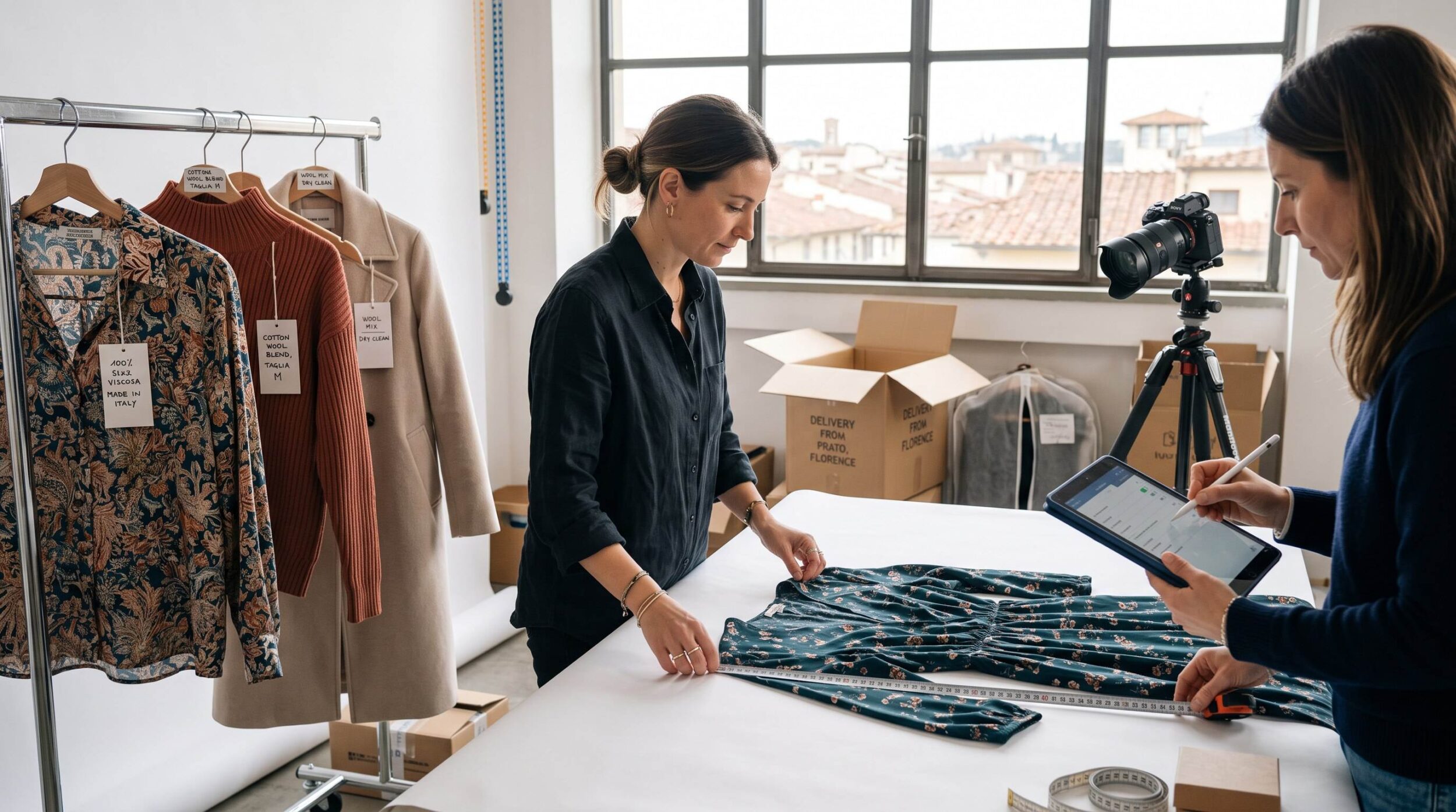
One practical detail deserves attention when buying heavier winter constructions. In low-cost pronto moda, up to 5% of the pieces in a delivery can show minor irregularities, a loose thread, an uneven hem, a small finishing defect. That is a known characteristic of the segment, not an accident. Denser fabrics and lined garments make those details harder to spot at a glance, so checking a sample piece properly during the session is worth the few minutes it costs.
How to Buy Correctly in a September Buying District
The practical answer to the question most buyers ask at this stage is that the first session should cover what rotates immediately and leave a defined share of the autumn budget uncommitted. That reserve is not caution for its own sake; it is what allows the outerwear and the late references to be bought when they actually exist. The commission follows the confirmed purchase value, at 10% with a minimum of 250 euro per working day, so splitting the season into two rounds is a decision to plan deliberately rather than improvise halfway through.
Sequencing those rounds is easier when the season has been mapped before it opens. We have written before about setting the autumn buying calendar ahead of the season, and the September dynamic is exactly why that planning pays off: a buyer who knows a second buy is coming will not spend the entire budget on the first strong selection encountered. Retailers who improvise the calendar tend to overcommit early, then find themselves short of funds when the pieces they actually needed finally arrive.
Why Pronto Moda Autumn Availability Rewards Moving Early
Pronto moda does not reproduce indefinitely, and this is the point international buyers underestimate most often. A warehouse buys a fabric lot, cuts a run of styles, sells it and moves on to the next one. When a model performs and the fabric is finished, the model is finished with it. There is no seasonal reorder mechanism of the kind a buyer working with a brand collection would expect, and no supplier will commit to remaking a style because it sold well somewhere else.
That changes how a strong piece should be treated when it is found. If a style is central to the assortment and not a filler, the depth has to be bought at the moment it is seen, not noted down for a later visit. When a retailer genuinely needs a garment to be repeatable across seasons, the route is private label production instead of pronto moda, which starts at 3.000 euro of order value and 100 pieces per model: a different commitment, and one that answers a different need.
Planning a Session While the Prato District Runs at Full Capacity
September is the busiest month in the district, and that has consequences for scheduling rather than for product. Showrooms handle a concentrated flow of visitors, suppliers give less time to each appointment, and buying sessions fill up well in advance. On-site assistance runs at 250 euro per day plus commission, and the days that matter most are the ones that disappear first from the calendar. A buyer deciding in mid-September to organise something for the same month will usually find the useful slots already taken.
A few terms are worth settling before the session rather than during it. Payment is 100% before shipment, goods travel DAP so duties and local taxes fall to the client in the destination country, and supplier names are never communicated, since the relationships built over the years are what the work rests on. Our fashion sourcing and purchasing service covers the whole sequence from pre-scouting to consolidated shipment, which is what makes a two-round autumn manageable without doubling the administrative load.
The short version of the September picture is that the AW26/27 collections in Prato are real, present and partially incomplete at the same time. Buy the rotation now, note the outerwear, keep budget aside for the completion round and treat any genuinely strong style as a one-time opportunity. Retailers who work the season this way come out of autumn with an assortment they chose, rather than a stockroom full of whatever happened to be available on the day they visited.