

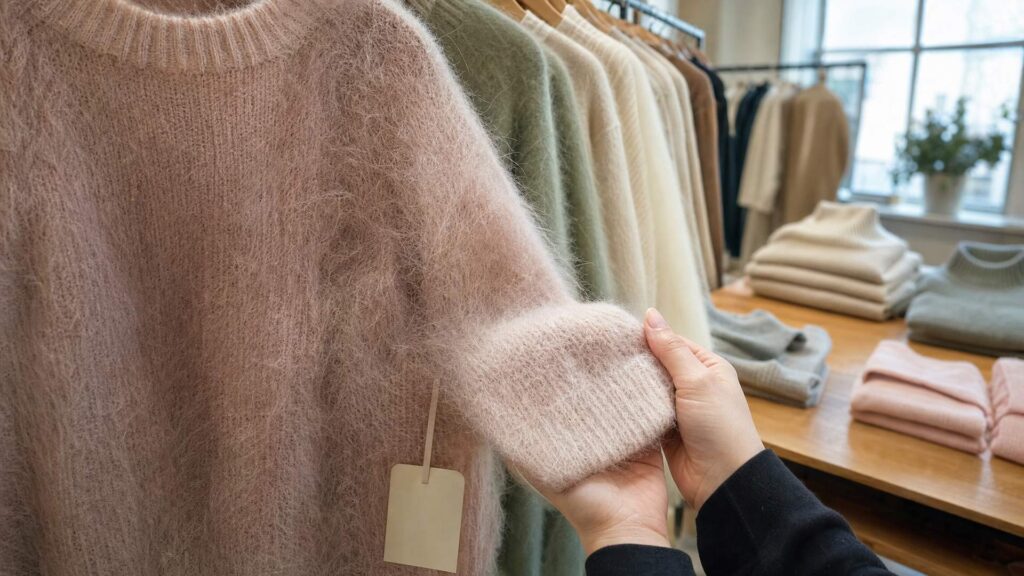
Whether mohair is itchy depends far less on the fibre’s name than on what sits behind it. The same word covers the fine fleece of a young goat and the much coarser hair of an adult animal, and it appears on everything from airy brushed cardigans to dense, budget pullovers. Some people wear a kid mohair sweater straight on the skin without any discomfort, while others feel a tickle at the neckline within minutes. This guide explains where that sensation comes from, how blends and care change the experience, and how mohair compares with alpaca.
Is Mohair Itchy: What the Fibre Actually Is
Mohair is the hair of the Angora goat, an animal not to be confused with the Angora rabbit that produces angora wool. South Africa is the largest producer, followed by the United States and a handful of other countries. Goats are usually shorn twice a year, and the fibre is long and smooth, with a remarkable lustre, because its surface scales are flatter than those of sheep’s wool. That smooth surface gives mohair its sheen and its ability to take dye in deep, clear colours. It also resists felting better than wool and insulates well for its weight.
The coarseness of mohair changes with the age of the goat. At the first shearing, at around six months, the fibre can measure roughly 23 to 27 microns, and the young goat grades sold as kid mohair generally stay below about 30 microns. Adult mohair is markedly thicker, commonly 34 microns and above, and can approach 40 microns on older animals. Those numbers matter because skin comfort is closely linked to fibre diameter. Dermatological studies on wool show that fibre ends coarser than roughly 30 microns can press hard enough on the skin to trigger prickle, while knits made from fibres around 20 microns rarely cause it.
Why Mohair Is Itchy for Some People
Diameter explains much of the problem, though not all of it. Adult mohair crosses the comfort threshold, so a sweater spun from it will feel scratchy to most people, especially around the neck and wrists where the skin is thin. Kid mohair sits near the threshold, which is why reactions to it vary so much from one person to the next. The second factor is the halo, the cloud of fibre ends raised when the yarn is brushed. Those loose ends move constantly against the skin and can produce a tickling sensation even when the fibre itself is fine. Itchiness of this kind is mechanical irritation and is not evidence of an allergy.
Yarn construction and gauge add to the picture. A heavily brushed yarn knitted loosely, the classic airy mohair cardigan, puts thousands of free fibre ends in contact with the body, while a tighter knit or a less brushed yarn keeps most of them in place. Shedding plays a part too, since new mohair garments release some loose fibres during the first few wears and these can land on the neck or face. Wearing a cotton or silk layer underneath solves the issue for most sensitive customers. A fine roll neck beneath an open mohair cardigan is the simplest styling answer.
Kid Mohair Blends with Silk and Polyamide
Pure mohair is rarely used alone in fashion knitwear. The most familiar luxury blend combines kid mohair with silk, often in proportions close to 70% mohair and 30% silk, where the silk forms a fine core that gives the yarn strength and lets the brushed halo float around it. The result is extremely light, with a soft hand that many people find comfortable even next to the skin. Polyamide plays a similar structural role in more affordable yarns, holding the brushed fibres together so the knit keeps its shape and sheds less. Wool and acrylic also appear in mohair blends, adding body and lowering cost while diluting the mohair character.
For anyone looking for soft mohair, the composition label is the first clue. A high share of mohair blended with silk usually signals a light, delicate garment, while a small percentage of mohair in a mainly acrylic yarn will look fluffy on the rail but feel and age like acrylic. The legal label normally lists the fibre simply as mohair, so the kid grade is usually stated, if at all, on a hangtag or in the supplier’s description. Touching the inside of the wrist or holding the garment against the neck for a minute remains the most reliable test before buying.
Mohair Sweater Care Without Losing the Halo
Mohair is less prone to felting than wool, yet the same principle applies to all animal fibres, since heat combined with friction damages them. A mohair sweater is best hand washed in cool water with a wool detergent, left to soak briefly and handled as little as possible. Rather than wringing, roll it in a clean towel to remove excess water, then dry it flat away from radiators and sunlight. Once dry, a light brushing with a soft brush lifts the halo again. Washing is needed less often than people expect, because airing the garment after wear removes most odours, and a short rest between wears lets the fibres recover.
Storage matters as much as washing. Mohair should be folded, not hung, because the weight of a long loose knit on a hanger can stretch the shoulders over a season. Clothes moths are attracted to animal fibres, so garments should be clean before they are put away and kept in a closed bag or box with cedar or lavender as a mild deterrent. Mohair sweater care also means accepting some early shedding as normal. It decreases after the first few wears, and a lint roller handles the fibres left on darker clothing worn beneath the knit.
Mohair vs Alpaca for Winter Knits
Mohair and alpaca often sit side by side on the same rail, and customers frequently weigh one against the other. Alpaca fibre has smoother, less prominent scales than wool and contains no lanolin, and the baby alpaca grade is generally finer than kid mohair, so it tends to feel softer against the skin. Alpaca also drapes more heavily and offers a dense, enveloping warmth. Mohair is lighter and loftier, with a lustrous halo that catches the light and a structure that holds its volume. Brushed alpaca can imitate the fluffy look of mohair, but it usually feels heavier in the hand and has a more matte surface.
The right choice depends on how the garment will be worn. A customer with sensitive skin who wants a sweater to wear directly against the body will usually be happier with baby alpaca or a fine mohair and silk blend. Someone looking for a statement piece with volume and colour, worn over a shirt or a fine knit, will find mohair hard to beat, especially in saturated shades where its natural sheen makes dyed colours look richer. Both are warmer for their weight than most ordinary sheep’s wool sweaters.
Kid Mohair in Prato Knitwear: What Buyers Should Check
In the Prato pronto moda district, mohair appears mainly as kid mohair blends in brushed cardigans and oversized sweaters, usually blended with polyamide or wool to reach accessible wholesale prices. Our wider guide to Italian knitwear wholesale covers styles and timing. In the showroom the label comes first, since a sweater described as mohair may contain anything from a majority share to a token percentage. After that, a minute against the neck and a dark sleeve rubbed on the knit reveal comfort and shedding. The checklist in our guide to judging knitwear quality in a Prato showroom covers gauge and linking in detail.
Minimums in Prato are usually €300 to €500 per warehouse with two to twelve pieces per style, so a boutique can test a small run of kid mohair before committing to depth. Payment is made in full before shipment and unsold goods cannot be returned, which makes these checks worthwhile. Buyers who cannot travel can join a live buying session, where we show labels and the texture of the halo on camera in close up, and consolidate purchases from several wholesalers into a single invoice and shipment.
Is Mohair Itchy: The Short Answer
Mohair can itch, but a soft mohair sweater is entirely possible when the details are right. Kid mohair, a fine silk or polyamide core, a moderate brush and a sensible gauge all reduce contact between coarse fibre ends and the skin, while a layer underneath removes most of the remaining discomfort. Adult mohair and heavily brushed loose knits are the likeliest to scratch. For shoppers and buyers alike, reading the label and holding the knit against the neck answer whether a particular mohair is itchy far better than the fibre name on the hangtag.



