

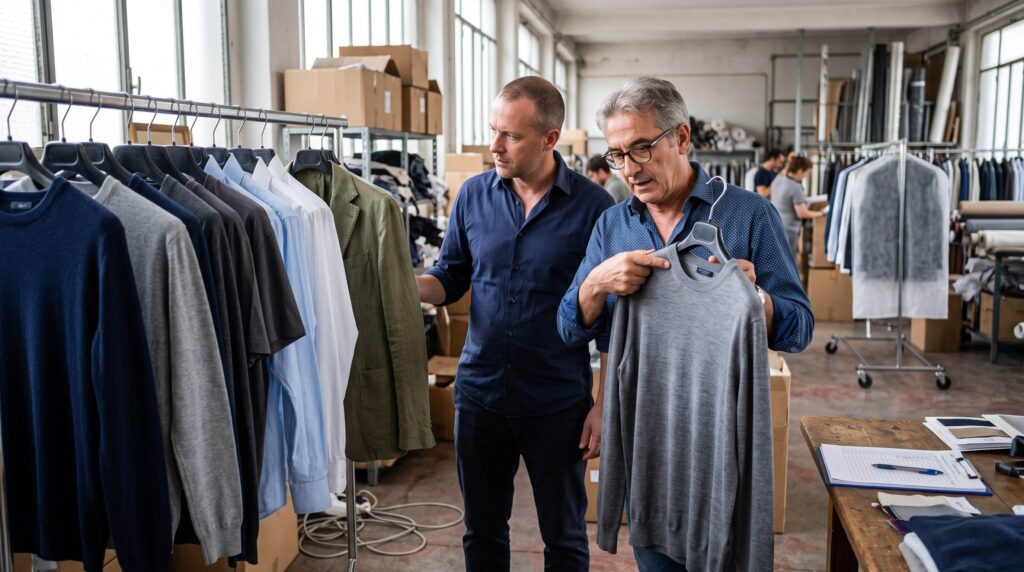
Buyers who write to us about menswear from the Italian districts usually arrive with a clear picture in mind: a men’s floor assembled the way they assembled their women’s floor, from the same warehouses, inside the same number of days. The picture is reasonable and incomplete. The pronto moda districts we buy in were built around women’s clothing, and that balance has not shifted. Some men’s requests can be handled well. Others cannot be handled at all, and the difference is worth explaining before a buyer commits a season’s budget.
This article is written to qualify a request rather than to sell one. A boutique owner planning a men’s assortment needs to know what these districts can supply, what they cannot, and how much longer the search takes when the category is thin. We would rather lose an enquiry in the first conversation than accept it, spend a buying day on it, and hand back a selection that does not fill a rail. What follows sets out where menswear sits inside the Italian wholesale system we operate in.
Why the Districts Grew Around Womenswear Rather Than Italian Menswear Wholesale
The specialisation is industrial and historical, not a matter of local taste. Prato grew first as a textile hub and then as a fast-turnover clothing hub, and the logic behind that growth — short runs, frequent restocking, quick reaction to what sells through — mapped onto women’s buying behaviour far more closely than onto men’s. Women’s collections rotate several times inside a season; men’s rotate less. Warehouses that live on weekly turnover concentrated where the turnover was. A buyer wanting the mechanics behind that can read how the Prato fashion district works as a supply system.
The consequence for a men’s buyer is structural rather than seasonal. A warehouse whose women’s offer fills rail after rail often keeps its men’s pieces on a corner of the floor, held as a secondary line for regular customers, not developed as a real proposal. Stock depth follows the same curve: sizes run out sooner and come back slower, because replenishment priority sits elsewhere. The accessory suppliers contribute a different production culture, but they do not reverse the ratio. Menswear exists in these districts as a minority category, and buying it means planning around scarcity.
What Menswear in the Prato District Usually Covers
The categories that surface with reasonable frequency are generic rather than specialised. Knitwear appears most often, since the spinning and knitting base of the area serves both genders. Jersey pieces follow, then shirting, then light outerwear of the kind that moves in transitional months. What sits inside those categories changes from one visit to the next, which is why we describe types and never promise items. Minimums do not soften because a category is thin: the usual supplier threshold stays around 300 to 500 euros per warehouse, with two to twelve pieces per style.
Formal tailoring, technical outerwear and specialised sportswear are the requests we most often cannot place. Those products belong to other supply chains, with other lead times and volume requirements, and are not what the pronto moda warehouses in Prato are set up to hold. A buyer looking for suits, structured jackets or performance layers is looking outside the network we have built, and saying that on the first call saves an entire scouting cycle. Where we can help, the men’s offer is casual and commercial in character.
Sourcing Mens Clothing in Italy Costs More Search Time per Euro Spent
The real cost of a thin category is search time. A women’s selection can come together across a handful of warehouses; a men’s selection of equivalent value normally takes more stops, more filtering and more movement between them, because each supplier contributes a smaller share of the order. Our fee structure makes that visible instead of burying it: commission is 10% of confirmed purchase value, with a minimum of 250 euros per working day. A day spent covering four men’s suppliers instead of two is still one day, and the budget does not stretch because the category is harder.
Buyers who prefer to be present rather than follow a video session pay 250 euros per day plus commission, and in menswear that presence often earns its keep, since judging fabric hand and fit on men’s basics through a screen is harder. The mechanics of working with Italian clothing suppliers serving international boutiques stay the same whatever the category; only the density of usable stock changes. Fewer relevant warehouses means a longer route to the same order value, and that route belongs in the plan at briefing stage.
When Private Label Replaces Menswear Boutique Buying From Stock
When ready-made stock does not cover the request, dedicated production is the alternative worth putting on the table. A men’s programme built to specification removes the availability problem, because the garment is manufactured rather than found, but it swaps one constraint for another. Private label starts at 3.000 euros of order value and 100 pieces per model, a different commitment from taking a few pieces of a style off a rail. For a boutique that already sells a men’s basic steadily and knows its size curve, the arithmetic can work. For a buyer testing the category, it rarely does.
Production also changes the calendar for a men’s launch. Stock buying turns a session into a shipment on a short cycle, while a private label run inserts prototype development and written sample approval before anything is manufactured, and those stages take the time they take. We do not compress them, because a men’s fit approved from a photograph tends to reappear as a complaint. Payment conditions are identical on both routes: 100% before shipment, with a single invoice and one consolidated shipment even with several suppliers.
The Limits We Declare Before a Menswear Request Goes Any Further
Some categories are refused outright, and a men’s buyer should know them before investing a call in us. Luxury is outside our field, children’s clothing is not something we handle, jewellery stays off the table and dropshipping models are declined. Supplier lists are not part of the service either, and warehouse names are never disclosed, which occasionally disappoints an enquiry hoping to become a contact sheet. Menswear itself is not on that excluded list. It occupies a narrower space: limited, sometimes workable, assessed against what the warehouses hold at that moment.
Quality expectations deserve the same plain treatment. At the low-cost end of pronto moda, up to 5% of pieces can show minor irregularities — a loose thread, an imperfect seam, a print slightly out of register — and that tolerance applies to men’s stock exactly as it applies to women’s. A retailer who needs first-quality consistency on every unit is buying at the wrong price level, and we will say so rather than let that arrive with the boxes. Shipments move on DAP terms, so local duties and taxes fall to the client.
How a Menswear Boutique Buying Request Is Assessed at the Start
Every men’s enquiry is evaluated individually, and the evaluation happens early rather than after a deposit has moved. In the initial interview we run before any collaboration begins, we ask which categories the buyer needs, at what price positioning, in what quantity and against what deadline. Those four answers usually settle the matter. Casual knitwear and jersey in commercial price bands is a workable brief; a run of structured men’s jackets in a nominated fabric is not, and the second answer is given in the same conversation as the first.
The question buyers ask most often is whether a complete men’s floor can be built in one buying session, and the honest answer is that it normally cannot. A session can produce a coherent men’s capsule — knitwear, jersey and shirting that hang together on a single rail — but a full department spanning categories and price levels needs more than one day and often more than one route to supply. Treating menswear as a controlled addition to an existing assortment, rather than a parallel business, is what makes the category behave.
Why a Timely No Is Worth More Than a Yes in Italian Menswear Wholesale
Turning down a men’s request is a deliberate part of the service, not a failure of it. A buyer told at the outset that these warehouses cannot supply what they need keeps the budget and the shelf space intact, and can spend both somewhere more productive; a buyer told yes by someone unwilling to lose the enquiry finds out well into the season, with money committed and a rail standing empty. Six years working Prato have made the pattern easy to recognise, and the filtering costs us requests we could have accepted on paper. In Italian menswear wholesale that trade is worth making.



