
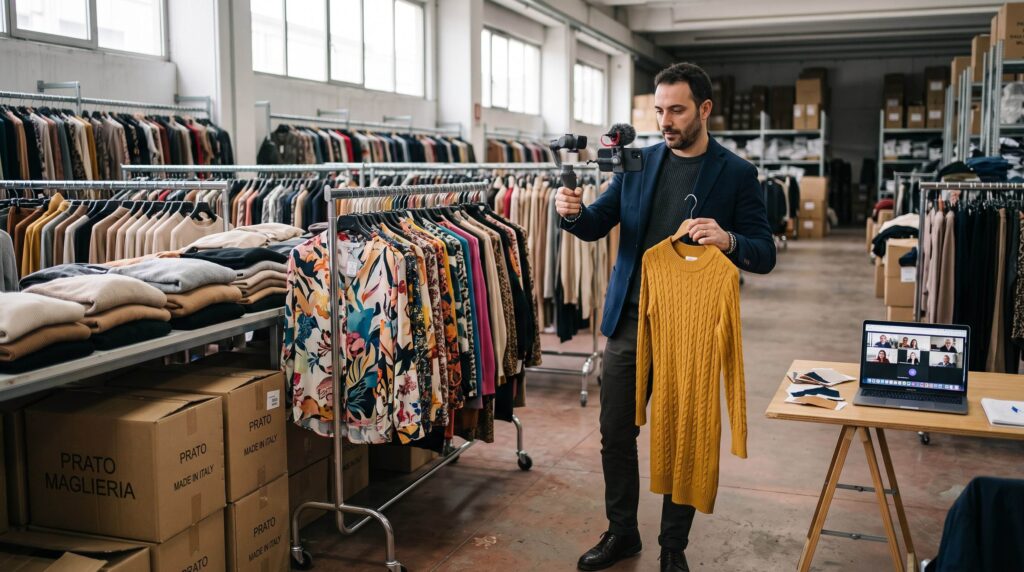
A remote buying session in Italy removes the flight, the hotel and the week away from the shop floor, but it does not remove the clock. The wholesalers of the Prato district work Italian hours, and a video call that visits several of them has to sit inside that window. For a boutique owner in Melbourne or a store buyer in Toronto, this is the single constraint that shapes everything else. Merchandise moves quickly, the warehouses open and close on their own schedule, and the session is built around them. Understanding that before booking removes most of the friction first-time clients run into.
What a Remote Buying Session in Italy Actually Involves
The format is simple to describe and demanding to run. A buyer travels to the warehouses in Prato, opens a video call, and walks the client through the rails while the client stays at the store or at home. Selections are made during the call, not afterwards from a catalogue, because what is hanging on the rail that morning is the actual offer. There is no showroom appointment to attend and no sample collection to wait for. What the client is buying is the buyer’s physical presence in the district on an agreed date, and that presence is only worth something while the doors are open.
Two things tend to surprise new clients. The first is that no supplier list exists at any stage of the relationship: supplier names are never communicated, before, during or after a session, and the route through the district stays undisclosed. The second is that the day is a working day and not a demonstration. Clients who prefer to be physically present can be accompanied through the same warehouses, but the video format was built precisely so that travelling stays optional. Everything else in this article follows from that second point: if nobody is flying, somebody has to accept a different clock.
Time Zone Sourcing Starts With Italian Warehouse Hours
Warehouses in Prato run on Italian office hours and they do not stay open late. Some close in the early afternoon, others at the end of the working day, and the difference is set by each supplier rather than by a district-wide rule. A session that visits several wholesalers must be planned inside the narrowest of those windows, because there is no point in filming a rail after the doors are shut. This is why the client adapts to Italian time and not the other way round. Time zone sourcing, in this trade, means accepting that the calendar belongs to the district.
The buyer also spends part of the day moving. Warehouses sit at different addresses across the district, and the transfer from one to the next consumes real minutes taken out of the same window. A realistic day covers a handful of suppliers, not twenty, and the number falls further when the client wants long looks at fabric and construction. Booking is therefore made for a specific date agreed in advance, with the start hour expressed in Italian time. Clients who convert that hour to their own clock at the moment of booking avoid the most common scheduling error.
From Australia to the Americas: What the Gap Means in Practice
North America sits roughly six hours behind Italy, which puts a Toronto or New York buyer in front of the screen early in the morning. A session that begins mid-morning in Prato lands before breakfast on the North American side, and West Coast clients face a wider gap that usually turns the appointment into a pre-dawn commitment. None of this is dramatic, but it needs blocking out in advance. A live buying day cannot be paused halfway and resumed at a more convenient hour, because the warehouse will have closed in the meantime.
Australia and New Zealand run eight to ten hours ahead depending on the season, so an Australian boutique owner works the session late in the evening or through the night. Midnight in Sydney corresponds to an ordinary working afternoon in Prato. The Middle East and South America are easier ground: the offset is smaller, and the appointment usually falls inside a workable stretch of the client’s day without anyone having to set an alarm. Whatever the point of origin, the fixed reference is the Italian window, and every other arrangement is built backwards from it.
How a Live Video Wholesale Buying Day Is Structured
A session is organised as one full working day, priced at 10% of the confirmed purchase value with a minimum of 250 euros per working day, and it can be extended over consecutive days when the budget or the assortment justifies it. An extension is agreed in advance, because the second day is booked against the same warehouse hours as the first. Decisions are taken during the call, since stock rotates constantly in pronto moda: a style seen this morning may be gone next week, and holding merchandise on a maybe is not how wholesalers operate. The same logic governs buying Italian fashion wholesale online without flying in, where the constraint is availability, not distance.
During the call the buyer moves along the rails with the camera, stops on the pieces that match the brief, and shows composition, colourways and finishing at close range. Prices are quoted per piece as they come up, together with the minimum quantity that wholesaler requires for the style. The client answers yes, no, or asks for a second look. Notes are kept as the hours pass, so the running total stays visible instead of being reconstructed afterwards. The rhythm is quick. It has to be, because the window is short and the route is fixed.
What the Client Sees and What the Buyer Checks on the Ground
The camera shows the garment; the buyer checks what the camera cannot. Hand feel, weight, seam quality, the way a knit recovers after being stretched: these are assessed physically and reported out loud while the piece is still on screen. Colour is the other thing a screen handles badly, because two devices will render the same viscose differently, and the buyer says plainly when a shade on the call is not the shade in the warehouse. Reporting all of this during the selection, and not after delivery, is the part of the job the video format exists to protect.
Retailers regularly want to know whether an online buying session gives them enough control to commit money without handling the goods. The practical answer is that control comes from the brief and from the running commentary: the buyer works to the style direction, price band and quantity agreed before the day starts, and anything outside those limits is proposed and never assumed. When the first warehouse turns out to be off-brief, the route is corrected during the day and the next supplier is brought forward. A useful reference point is the step-by-step account of what actually happens during a live buying session with an Italian wholesaler.
After the Session: What Gets Confirmed and How Contact Continues
Once the session closes, the selections are consolidated into a single order, whatever the number of wholesalers involved: one invoice and one consolidated shipment, instead of separate parcels leaving each warehouse on its own. Quantities are confirmed against what was agreed on the call, and anything that has moved in the meantime is flagged before the order is finalised, because stock that rotated during the day can rotate again in the days that follow. The client sees the consolidated total before anything is committed, and from that point the order becomes a logistics matter.
Communication does not stop when the order is closed. When a buyer is in the district for other work and comes across something that fits a profile already known, photos and videos are sent through, with no predefined cadence and no obligation on either side. That can happen a week after a session or three months later. Some clients assemble a second order out of these messages without booking another full day at all. The supplier behind the images still goes unnamed, and that rule holds regardless of how long the relationship has been running.
Remote Buying Session Italy: Distance Is Negotiable, Timing Is Not
The commercial point is narrow and worth stating plainly. A remote buying session in Italy removes the cost and the days lost to travel, and for most independent boutiques and online stores that is the entire reason it exists. What it does not remove is the district’s own schedule: the warehouses set the hours, the merchandise sets the pace, and the client fits into both. Retailers who want the full sequence from first interview through to delivery can see how the sourcing process is organised step by step. Accepting the Italian clock is the price of not booking the flight.