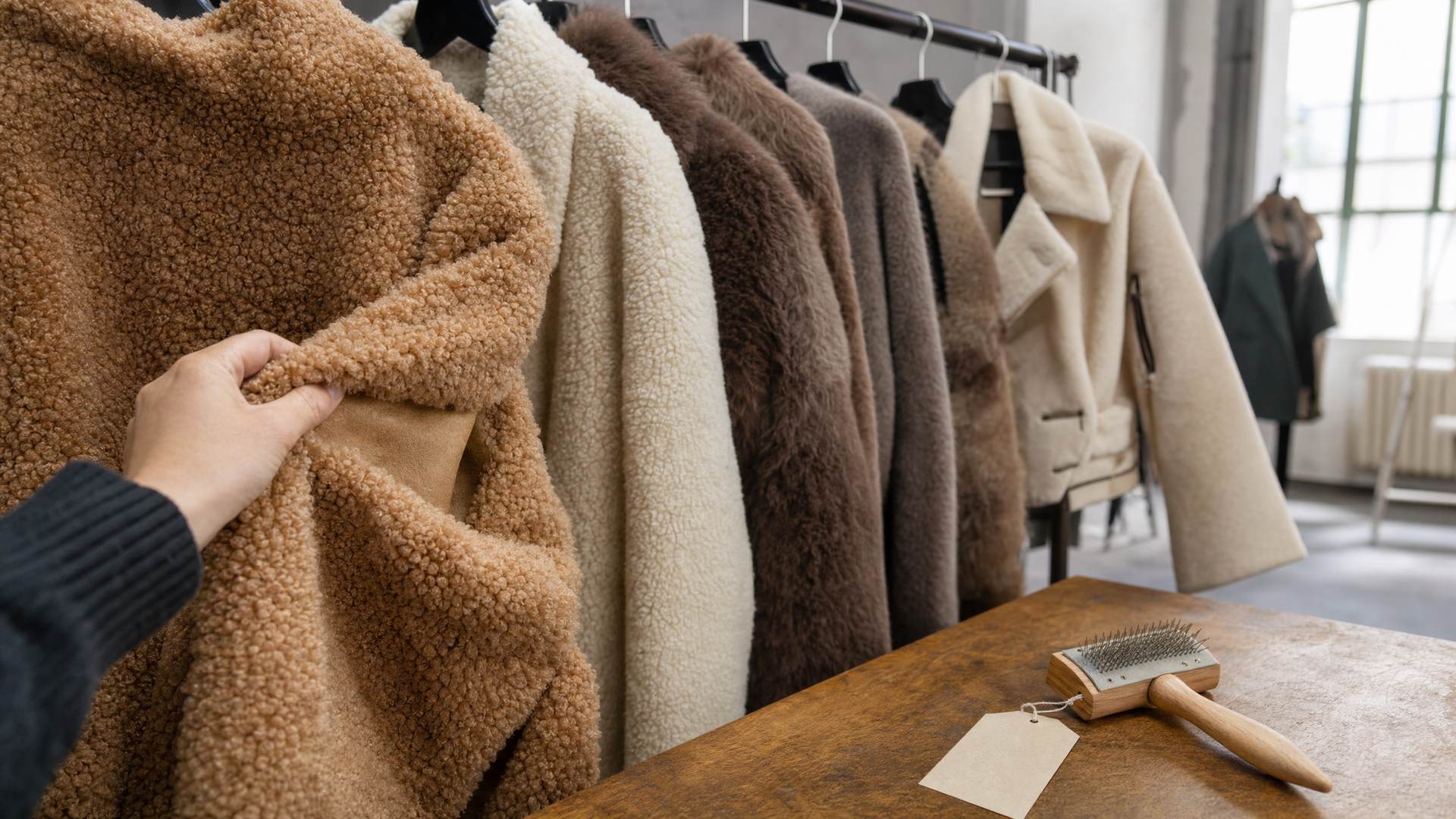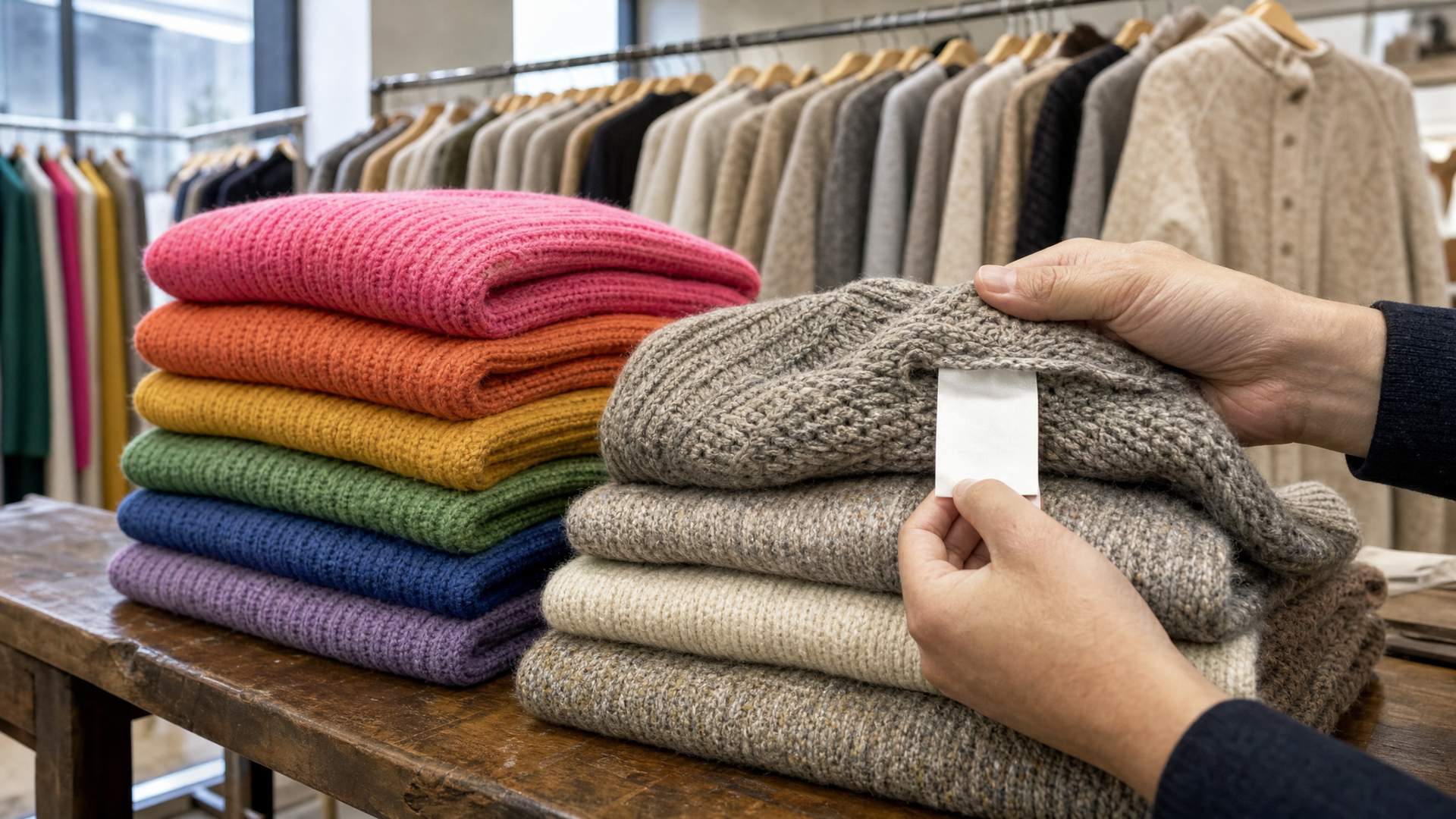
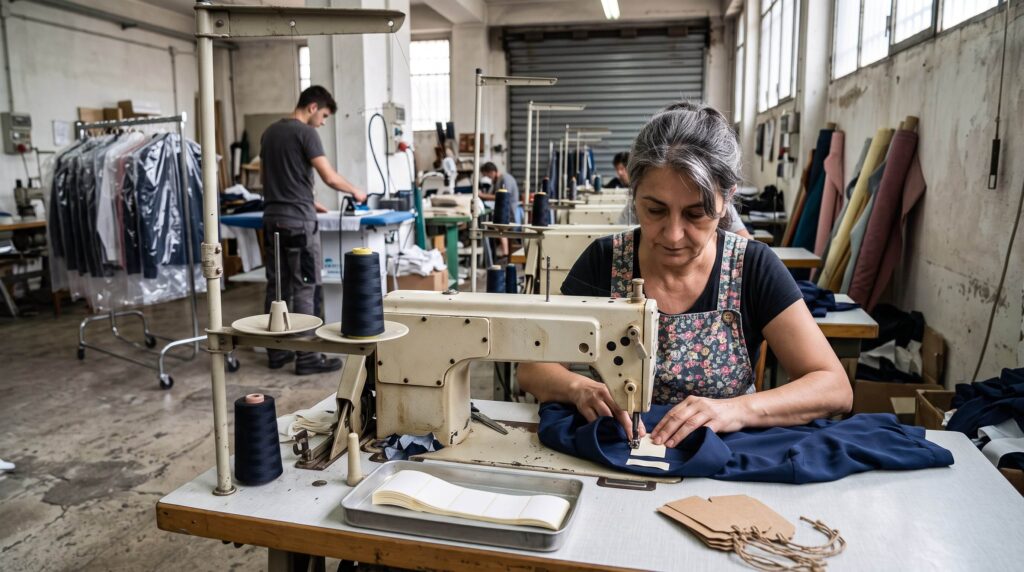
A shipment of Italian wholesale clothing can reach your door in two very different states. In the first, the boxes hold loose garments with the supplier’s own tags and nothing a scanner can read. In the second, every piece is already labelled at the neck, bagged and coded for your management system, so it moves from the delivery door to the rail in one pass. Retail-ready packaging on a wholesale order is the work that separates those two deliveries, and it happens almost entirely in Italy, inside the supplier’s own production flow.
We handle this on both sides of the business, under different conditions. On pronto moda it is assessed case by case, supplier by supplier, since the goods already exist and each warehouse has its own rhythm and its own tolerance for extra handling, and the volumes on the table weigh on the answer. On private label production the answer is always yes, because a brand launching its own line needs its own labels anyway. Understanding the difference between buying finished stock and commissioning your own line helps set expectations before the request is made.
What Retail-Ready Packaging Covers on a Wholesale Order
For a shop or an online store buying to resell, the objective is narrow. Merchandise should arrive with your neck label where the supplier allows it, a swing tag attached, an individual bag around each piece and a barcode your software recognises at the till. Nothing else should stand between the pallet and the shop floor. In operational terms that is four distinct interventions, each priced separately at the moment of the order, article by article, because the surcharge depends on the garment, the workshop and the quantity involved.
All of it is carried out by the supplier during production, not in a separate warehouse afterwards. That matters for timing: normally no days are added to the delivery schedule, and the only real exception is when labels, tags or bags are not yet physically ready when production starts. Suppliers apply a surcharge for every operation they take on, which is why we quote them individually rather than as a bundle. Because the work sits inside the production line rather than after it, each piece is handled once instead of being unpacked and finished a second time.
Neck Labels: Woven Production and Application in Italy
The neck label is the first thing a customer sees inside the garment, and it is the finishing detail that most changes how stock feels. We manage both sides of it, the production of the label itself and its application to the garment. The standard type is woven, which survives washing better than printed alternatives and reads as a considered choice. Production runs 10 to 15 working days from the moment the artwork file is approved, so it sits comfortably inside a normal order cycle.
One boundary needs stating plainly. The composition and care label is applied by the supplier according to Italian and European standards, and that is the standard it meets. Verifying that a label satisfies the labelling rules of your own destination market is not a service we provide, and we give no regulatory advice on it. Importers selling into markets with their own fibre-content or care-symbol requirements handle that check themselves, usually with a local consultant. Saying so in advance avoids a problem that becomes expensive after shipment.
Hanging Tags and Custom Packaging on Resale Stock
Hanging tags work in two modes. Either we print them in full, from artwork through to the finished card, or we simply arrange application of tags you have already produced and sent to Italy. Attachment is done with thread or cord, or with a plastic seal, depending on the garment and on what the supplier’s line is set up for. One point catches buyers out: the retail selling price is not printed on the tag. Production of tags, labels and packaging materials follows a separate quotation from the goods themselves.
There is a way around the price question. On request and with a surcharge, an adhesive label carrying the barcode can be applied, and anything the client wants can be printed on that label, price included. It is a cleaner solution than reprinting cards, because the adhesive can be updated between seasons or between markets without touching the tag design. Shops running different price points in two countries tend to go this route. The choice is usually made at the order stage, once the article list is fixed.
Barcode Labelling Starts From the File You Send Us
The codes come from you. In almost every case they arrive as an Excel file, one row per article and size, and we take it from there: printing the labels and having them applied exactly where you ask. That can be on the swing tag, on the outside of the polybag, or on an internal label inside the garment. Stores with a management system already in place tend to prefer the polybag, because the piece can be scanned in without being unwrapped, which speeds up goods-in considerably.
The limits should be explicit. We do not generate barcodes, and registering GS1 prefixes on anyone’s behalf is not part of what we handle, so the numbering has to exist before the order goes in. If you are setting up a coding system for the first time, that step belongs with your software provider or with the GS1 organisation in your country. Once the file exists, applying it across an Italian order is straightforward, and it is the single change that most reduces the labour of receiving goods.
Polybags, Boxes and the Wider Packaging Set
Individual bagging is the most requested operation after labelling, and printed polybags are available in several materials. Transparent polyethylene remains the default. Recycled or recyclable versions are widely used by shops that publish a sustainability position, and biodegradable or compostable film is available where that weighs more than cost. Opaque bags and paper bags cover the cases where the garment should not be visible until unwrapping. The material affects the surcharge, so it is better decided early than at the moment the order is confirmed.
Beyond the bag, the packaging set extends to boxes and inner boxes, tissue and interior papers, printed shipping mailers and adhesive closure labels. Loyalty cards, printed cardboard inserts, letters and promotional codes can be placed inside the parcel during packing, which is common among e-commerce clients who want the unboxing to carry something of their own. The production of these materials follows a separate quotation from the garments themselves, so the two lines of spend stay visible and can be sized independently as the assortment changes.
Private Label Neck Labels in Italy and the Graphics Behind Them
For brands producing their own line, none of this is optional and none of it is negotiated supplier by supplier. Complete finishing is part of the brief from the outset, agreed with the client before production is scheduled. Everything described above applies, with the added freedom to decide construction, placement and materials rather than fitting around what a pronto moda warehouse already does. Our private label production service in Italy treats labelling as part of the product.
The graphics work sits in-house, which is the part most clients underestimate. We start from an artwork file when there is one, and we design from scratch when there is not, covering label, tag and packaging as a coherent set rather than three unrelated jobs. Through our sister companies the same team can go further, up to full brand identity development. For anyone at the earliest stage, the practical steps involved in launching a Made in Italy clothing brand through private label deserve a read before artwork is commissioned.
Volumes, Minimums and When Retail-Ready Packaging Pays
There is no formal minimum on finishing work. The constraint is economic rather than contractual, because printing tags and weaving labels carries high unit costs on small quantities and those costs fall as volumes rise. A few dozen pieces can be done, and we have done it, but below a certain threshold the surcharge per garment stops making commercial sense and we say so plainly rather than take the order in silence. The calculation is worth running before the artwork is commissioned, not after the cards are printed.
A concept store in Canada with a structured team took the opposite view and had custom labels produced alongside its very first pronto moda order, treating the finishing as an element of the shop’s identity rather than something to add later. That approach works when the buyer already knows the assortment will repeat. The surcharge is confirmed article by article when the order is placed, and the labels, tags and packaging carry their own quotation, so the real cost of finishing an Italian order is on the table before anything is produced.