Anyone buying from Prato for the first time meets the same practical problem within an hour of the first showroom visit. The garments work, the prices work, and then the rail shows a size run that reads 40, 42, 44 and stops there. Reading Italian clothing sizes in a wholesale context is not a translation exercise. It decides how much of an order sells at full price and how much is still hanging in the stockroom at the end of the season, which is a very different conversation to have with a supplier six months later.
What Italian Clothing Sizes Mean on a Pronto Moda Label
Italian womenswear numbering runs 38, 40, 42, 44, 46 and occasionally 48, moving in steps of two. On a pronto moda label you will also find Roman numerals, the letters S, M and L, or a plain 1, 2, 3 sequence, because many Prato wholesalers produce for several private label clients and print whatever the last order required. The number on the tag is a family convention, not a regulated standard. Two suppliers three streets apart can both call a garment a 42 and cut them a full centimetre apart across the chest.
Most pronto moda styles are produced in three or four sizes, and the run is built around the middle of the range rather than the extremes. Supplier minimums in the district normally sit between 300 and 500 euro per warehouse, with two to twelve pieces per style, so a buyer taking a single piece in each size of a four-size run is often already at the floor for that supplier. That structure explains why assortment decisions and size decisions cannot be separated. You are choosing depth and range in the same movement, at the same table.
Size Run Conversion for Boutique Buyers Across Key Markets
The conversion itself is stable and worth memorising before the first buying session. An Italian 38 corresponds to a UK 6 and a US 2; a 40 reads as UK 8 and US 4; a 42 lands on UK 10 and US 6; a 44 becomes UK 12 and US 8; a 46 sits at UK 14 and US 10. Australian numbering tracks the UK scale closely enough that most boutiques relabel one to one. German and Scandinavian sizing subtracts four from the Italian figure, so an Italian 42 becomes a German 38 on the ticket.
Retailers in the Gulf tend to keep either UK or European labels depending on which one the local customer reads more easily, and several of them stock both on the same rail without any confusion at the till. Size run conversion for a boutique is a commercial decision as much as a technical one, since relabelling adds handling time and, in some markets, a compliance requirement covering country of origin and fibre composition. Keeping the original Italian label and printing a clear conversion on the price ticket is the cheapest workable route for most independent stores.
Italian Fit and the International Market: Where the Cut Runs Narrow
The number is only half the story. Italian fit is generally cut closer than what customers expect in North America, the UK and much of Northern Europe, and the difference concentrates in specific places rather than spreading evenly across the garment. Shoulders are narrower, armholes sit higher and tighter, sleeves are shorter through the bicep, and the hip measurement on a tailored trouser is usually the first thing to fail. A customer who wears a US 6 comfortably at home will frequently need an Italian 44 rather than the Italian 42 the conversion table promises.
Jersey, knitwear and anything with an elastic waist forgive that difference, which is why those categories travel better into markets with a broader average build. Buyers serving customers in the United States and Australia often shift the whole run up by one step, dropping the 38 entirely and adding a 46 or a 48 where the supplier can produce it. This is a judgement about Italian fit for an international market, not a rule, and it is worth testing on a small first order before committing an entire category to it.
One Size Pronto Moda: How Taglia Unica Fits Your Assortment
A large share of the pronto moda offer is sold as taglia unica, one size, and international buyers consistently underestimate how much of the rail it occupies. In practice a one size pronto moda garment is cut to fit roughly an Italian 40 to 44, which means a UK 8 to 12 and a US 4 to 8, with the flexibility built into the volume of the cut rather than into any grading. Oversized shirts, wide-leg trousers with drawstrings, ponchos, cardigans and most light knitwear are the usual candidates.
One size buys well because the supplier is not splitting a run, which makes the 300 to 500 euro warehouse minimum easier to reach and keeps the unit cost down. It sells less predictably, so it belongs beside graded styles rather than in place of them. Anyone building a first order should look at where one size sits within the key styles that boutiques buy from Italian womenswear wholesalers, then hold it to a controlled share of the total pieces instead of letting it fill the order because it is convenient.
Tolerances in Italian Clothing Sizes Wholesale: Half a Centimetre Is the Standard
Buyers arriving from a technical background often ask for measurement specifications the pronto moda supply chain cannot meet. Pronto moda works to tolerances of around half a centimetre, not a millimetre, and on wide or knitted garments the realistic band is closer to a full centimetre. Requesting plus or minus two millimetres on a chest measurement at this price level is not a quality standard, it is a negotiation that ends with the supplier declining the order. The tolerance follows directly from how the district produces: fast, in small runs, at a price.
The same logic applies to finishing. In low-cost pronto moda up to five per cent of the pieces can show minor irregularities, a loose thread, a print register slightly off, a button set a few millimetres out of line, and that is the industry standard at that band rather than a defect rate to be contested afterwards. Buyers who genuinely need graded specifications and a signed sample take a different route entirely: private label production, which starts at 3,000 euro of order value and 100 pieces per model, with the prototype approved in writing before anything is cut.
Size Charts Built on Real Measurements Reduce Online Returns
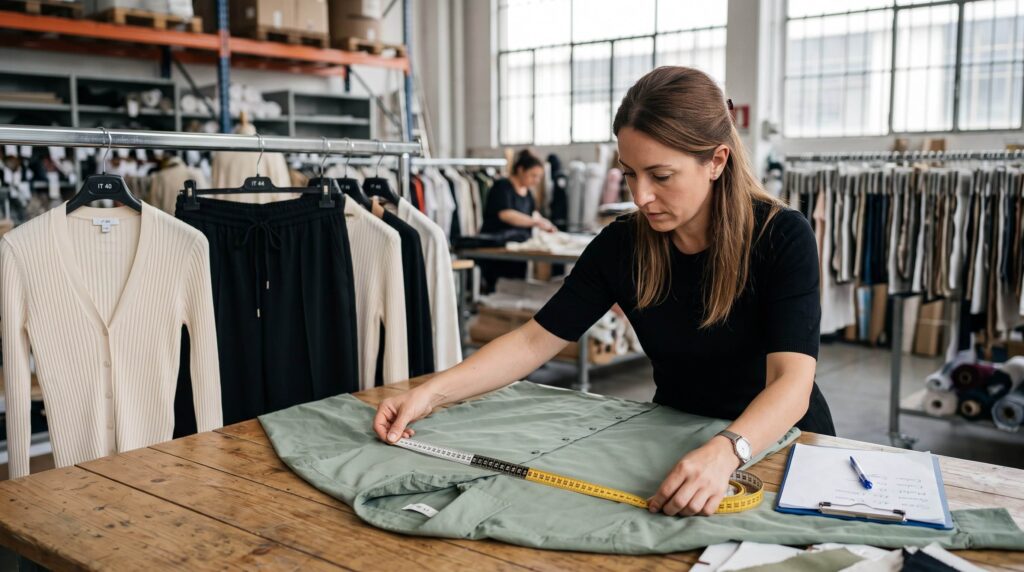
For anyone selling online, the single most useful change is to stop publishing the label and start publishing the garment. Measure each style flat on a table and record chest, waist, hip, total length and sleeve length in centimetres and inches. Two or three pieces per style are enough to see whether the cut is consistent. Customers who can compare those numbers against a garment they already own return far less merchandise than customers asked to trust an Italian 42, and the work takes a few minutes per style at goods-in.
Taking those measurements before the goods ship is considerably easier than chasing them afterwards. During a live buying session the garments can be measured in the showroom and the figures recorded against each style code, which is part of how the sourcing and purchasing service is run on the ground in the Prato district. On-site assistance is available at 250 euro per day plus commission when a buyer prefers to be present in person, and a measured spreadsheet leaving Italy with the shipment is worth more than any label.
Ordering Italian Size Runs That Match Your Customer Base
The last decision is depth. A boutique with a known customer base should buy the two central sizes deeper and treat the extremes as a test, rather than spreading one piece across every size and finishing the season with an unsellable tail. Understanding how minimum order quantities work across Italian wholesale matters here, because the supplier floor and the size run interact: reaching 300 to 500 euro at one warehouse with concentrated sizes is usually smarter than reaching it with a thin, complete run.
The commercial frame around all of this is straightforward enough to plan against. The service fee is 10 per cent of confirmed purchase value with a minimum of 250 euro per buying day, payment is 100 per cent before shipping, and several suppliers are consolidated into one invoice and one shipment. Shipping terms are DAP, so local duties and taxes fall to the buyer. Reading Italian clothing sizes correctly at the wholesale order stage costs nothing extra and removes the most common reason a first Italian order underperforms.