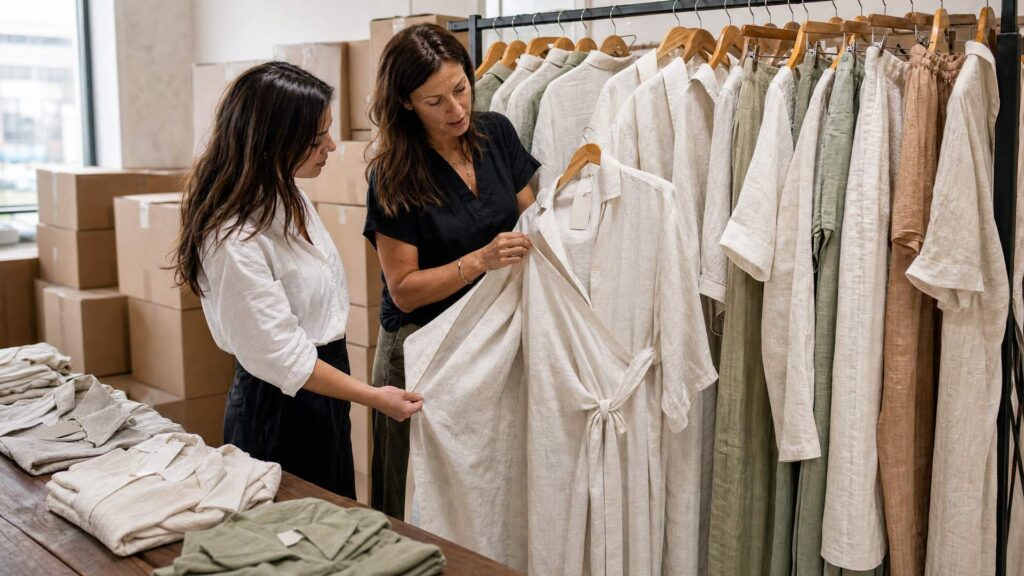
Most linen sold in independent boutiques under a Made in Italy label starts its commercial life in Prato, in a few square kilometres of showrooms where finished dresses, shirts and co-ord sets are sold by the box to retailers from every continent. Italian linen wholesale in this district works differently from buying through a brand or an agent with a seasonal catalogue. Stock is physical, it changes every week, minimums are low and payment is due before anything leaves the warehouse. This guide brings together what we have learned in more than six years of buying linen in Prato for boutiques abroad, and it is written for buyers who are preparing their first order or want to make the next one more profitable.
The sections follow the decisions a buyer actually faces, starting from where the product comes from and what the range looks like, then moving through quality, minimums, payment and the buying calendar before closing on documents, shipping and the ways of buying with us. Every topic has a dedicated article on our journal, linked at the relevant point, so this page can serve as a map of the whole subject as well as a complete answer for buyers in a hurry.
Why Prato Is the Center of Italian Linen Wholesale
Prato is the largest textile and clothing district in Italy, with around 7,000 companies working in fashion, and its strength in womenswear comes from the pronto moda model. Wholesalers design and produce in short runs, put the garments in the showroom within days, and reorder only what sells. For linen this model is a good match, because summer collections live on fast reactions to weather, colour and demand, and a retailer can buy a style in April and find a new version of it in May. Volumes per style stay small, which lets an independent store carry Italian linen without committing to hundreds of identical pieces.
There is a second reason the district matters. Prato combines fabric knowledge, finishing and garment production within short distances, and the district has worked natural fibres for centuries, long before pronto moda existed. What a boutique buys, however, is always the finished garment. Italian Fashion Sourcing works only with ready-to-wear pieces sold by the unit, never with fabric by the metre, and the advantages a retailer gets from the district are speed, variety and the possibility of buying small quantities from many different wholesalers in a single day.
What Linen Clothing Wholesale in Italy Offers Boutiques
The range covers the full summer wardrobe. Shirts and overshirts, wide-leg and straight trousers, shorts, midi and maxi dresses, jumpsuits, blazers and above all coordinated sets, which have become the backbone of many linen assortments. Our guide to Italian linen co-ords shows why sets sell so well, and the same logic applies to the linen dress, which remains the single most requested piece in our live sessions. Compositions go from 100% linen to blends with viscose, cotton or elastane, each with a different hand, drape and price.
Price levels span a wide range inside the same district. Entry-level pronto moda linen is designed for fast turnover and accessible retail prices, while mid-market and premium wholesalers use heavier or yarn-dyed linens, better finishing and more structured patterns. Neither level is better in absolute terms, and the right choice depends on the customer of the store. A resort boutique selling to tourists needs different margins and volumes from a city concept store with a loyal local clientele, and part of our work before every session is matching each client with the wholesalers whose price level fits that reality.
How to Judge Quality from Italian Linen Clothing Suppliers
Linen shows its quality quickly to anyone who knows where to look. The weight and density of the weave, the regularity of the slub, the way seams are finished on the inside and the softness after washing all say more than the price tag. Our checklist for reading linen quality at a glance covers the details we check on the rail, from the composition label to the behaviour of the fabric when it is crumpled in the hand. A blend is not automatically a lesser product: well-made linen and viscose often sells better in hot humid climates because it creases less and drapes more softly.
Expectations have to match the price level. In low-cost pronto moda, up to 5% of pieces in an order can show minor irregularities, such as a loose thread or a slightly uneven hem, and this is the accepted standard of the segment rather than a supplier failure. Higher up the range, tolerances narrow and finishing improves. What a buyer should never accept is a defect that affects the whole style, such as a fabric that shrinks badly or hardware that stains, and when it happens we handle the claim with the supplier directly on behalf of the client, which is one of the practical advantages of having a buyer on the ground.
Minimums, Payment and Costs When Buying Linen in Prato
Minimums in Prato are low compared to brand wholesale. Most wholesalers ask for €300 to €500 per warehouse, with two to twelve pieces per style depending on the supplier and the item, which allows a boutique to build a varied linen assortment by buying a few pieces from many different showrooms. A live buying session with us starts from a purchase value of €3,000, a threshold most buyers reach comfortably across four or five suppliers. Payment terms are the same everywhere in the district: 100% before shipment, with no open account, no consignment and no returns on unsold goods.
The goods are invoiced to us by each wholesaler and then invoiced by us to the client, which is the only way to combine many suppliers into a single payment and a single shipment. Clients can pay by bank transfer, credit card, Wise or PayPal, with any card or PayPal fees charged to the buyer. Our fee is a 10% commission on the value of the goods purchased, applied in the same way to live sessions and to accompanied visits. Clients who travel to Prato and want to be guided through the showrooms pay €250 for the first day and €125 for a second day if they have bought during the first one.
When to Buy: The Italian Linen Wholesale Calendar
Timing changes everything in linen. The offer is widest and deepest between March and May, when wholesalers carry complete size runs and full colour ranges, and this is the right moment for the core order of the season. Late June and early July still offer good depth at better prices before the offer thins out, and our article on timing the last linen buy of the season explains how to use that window without overstocking. In August most of the district closes for the summer break, a detail covered in our note on the Prato August closure, and from September what remains is residual stock.
Boutiques in markets where summer begins when the Italian one ends face the calendar from the other side. Retailers in Australia, New Zealand and South Africa have to buy their core linen in the Italian spring and hold it until their season opens, using the autumn only for targeted top-ups. We describe that approach in our guide to Italian linen wholesale for the southern summer. Retailers in warm markets that sell linen most of the year, such as parts of the Middle East or the southern United States, usually combine both approaches with two or three buying moments spread across the year.
Shipping, Documents and Duties for Wholesale Linen Orders
Once the selection is complete, we collect the goods from every wholesaler, check them against the order and pack them for export. The client receives one consolidated invoice with all the export details, and we keep the number of different customs codes on each invoice to a maximum of five, because couriers charge extra for complex declarations and every additional code can slow the clearance. Each invoice carries the references of the original suppliers, the EU preferential origin declaration and the DAP Incoterm, which means that duties and import taxes at destination are paid by the buyer on arrival.
Shipping cost depends on weight, destination and courier. Linen is light, which helps, and as an indication express courier shipments to the United Kingdom cost us around €2.50 per kilo, with deliveries inside the European Union considerably cheaper. Buyers in the United States should build import duties into their landed cost from the start, and our analysis of US tariffs and total landed cost for Made in Italy shows how to calculate the real price of a garment on the shop floor. Buyers elsewhere can ask us for a shipping quote before the session, so the budget is clear before any piece is chosen.
Two Ways to Buy Italian Linen Wholesale with a Local Buyer
Most of our clients buy remotely. During a live session we visit several showrooms on video, show each garment from close up, read labels, check stitching and ask the wholesaler about availability and repeat orders, while the client decides piece by piece from the store or from home. The process is described in our page on fashion sourcing and purchasing, and real examples help: one boutique built a complete linen and viscose assortment in a single live session, while a Swiss concept store used our help to build a linen assortment for a new opening.
Buyers who prefer to touch the garments can come to Prato, and we accompany them through the showrooms we have selected in advance for their style and price level. Either way, our role is the same: we act as the client’s buyer in Italy rather than as a seller, we know which wholesalers are reliable on quality and delivery, and we handle the follow-up when something goes wrong. Once the linen is in the store, a few well-chosen words on the shop floor make a difference, and our notes on explaining linen to your customers help staff turn fabric knowledge into sales.
Getting Started with Italian Linen Wholesale
A good first order of Italian linen does not need a large budget, but it does need the right timing, a clear idea of the store’s price level and a realistic view of minimums, payment terms and landed cost. Retailers who prepare those elements before the session spend their time choosing garments rather than solving problems, and they usually come back for the next season with a much sharper brief. For a view of the styles, colours and shapes that are driving demand this year, our report on linen trends for boutiques is the natural next read, and it completes this guide to italian linen wholesale from the product side.