

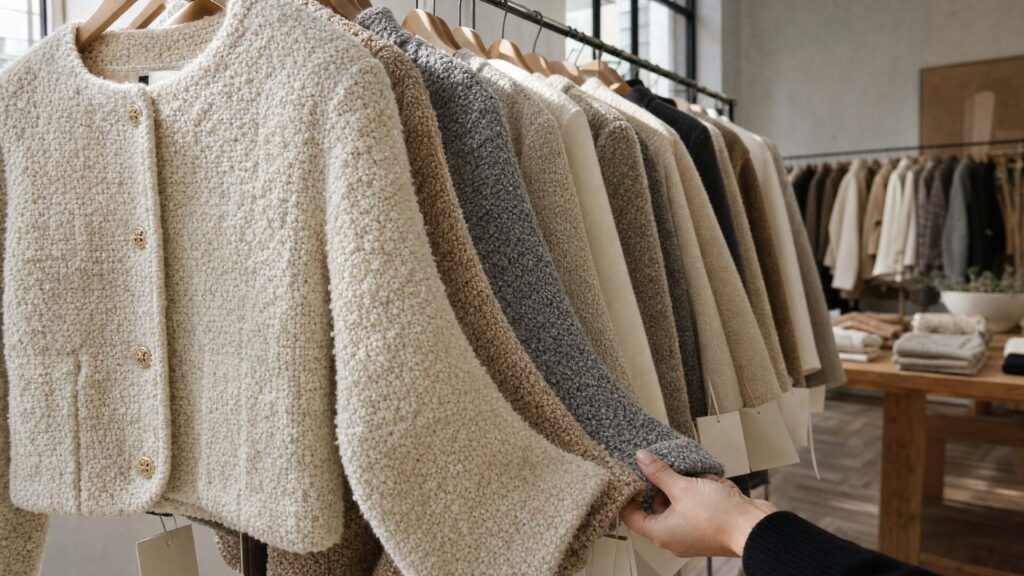
Boucle fabric is one of the few winter textures that people recognise by touch before they can name it. The surface is covered in small, tight loops that catch the light unevenly, so even a plain cream jacket looks rich and slightly irregular from a distance. Each autumn the same questions come back from customers and from the boutiques that serve them, starting with what boucle actually is and moving on to whether it lasts and how it should be cleaned. This guide answers them with the facts behind the yarn rather than the marketing around it, and closes with a section for boutique buyers sourcing boucle outerwear in Prato.
What Boucle Fabric Is and Where the Name Comes From
The name comes from the French word bouclé, which means curled or looped, and it describes the yarn before it describes the cloth. A boucle yarn is a fancy yarn built from at least two strands twisted together under different tensions. One strand, called the effect yarn, is fed much faster and more loosely than the others, so it bunches up and forms loops along the length of the thread. A finer core or binder yarn wraps around those loops and holds them in place. Depending on how much effect yarn is fed in and how tightly it is bound, the loops can be tiny circlets or large, open curls.
Once the yarn exists, it can be woven or knitted. Woven boucle is the dense, structured cloth used for tailored jackets and coats, while knitted boucle is the softer, springier version found in cardigans and knit dresses. Its strongest association in womenswear is with the collarless suits that Chanel presented after reopening her couture house in 1954. That jacket shape, boxy and edged with braid or fringe, is still the reference most customers have in mind when they ask for a boucle jacket, even though today’s versions come in many cuts and weights, from cropped shapes to long, softly tailored coats.
Which Fibres Go Into a Boucle Fabric
Boucle is a structure and not a fibre, so the loops can be spun from almost anything. Wool remains the classic choice, because its natural crimp holds the loops open and gives the cloth warmth and spring, and mohair or alpaca are sometimes added for a soft halo. Cotton boucle is lighter and more matte, which suits spring jackets better than winter coats. Synthetic fibres such as polyester and acrylic appear in most fashion boucle at accessible prices, either on their own or blended with wool, while small amounts of polyamide are often used to strengthen the binder and reduce loop breakage.
Each fibre changes how the garment behaves. A high wool content gives better warmth and recovers shape after creasing, but it costs more and needs gentler care. Acrylic and polyester keep the price down and hold colour well, though they do not breathe like wool and tend to build static in dry heated rooms. Reading the composition label is therefore the fastest way to predict how a boucle coat will perform, since two pieces that look identical on a hanger can contain completely different fibres underneath. Viscose is sometimes blended in as well, mainly to soften the hand and add a little sheen to the surface.
Why the Boucle Jacket and Coat Return Every Winter
Texture tends to take over from print in the cold months, because heavier cloth gives depth without needing pattern, and boucle delivers that depth more clearly than almost any other surface. It looks warm in photographs, which matters when many purchases begin on a phone screen, and it flatters simple shapes, since a straight coat in a single colour gains interest from the loops alone. A boucle jacket also moves easily from the office to the weekend. Our overview of winter fashion trends for 2026 and 2027 places boucle among the textures that continue to anchor outerwear and knitwear this season, with neutral shades selling steadily alongside mixed yarns with metallic threads.
How Boucle Fabric Wears Over a Season
The loops that make boucle attractive are also its weak point. Anything with a hook or a rough edge, such as a bag strap buckle or a ring, can catch a loop and pull it out of the surface, and a snag on boucle is more visible than on a flat weave because the pulled loop stands proud of the texture around it. Constant friction is the second issue, since areas like the underarms and the side where a bag sits can develop pills and a flattened look, especially in yarns with a high share of acrylic. A dense weave with a firmly bound yarn, on the other hand, keeps its loops in place for years.
Caring for a Boucle Coat or Jacket
Most woven boucle jackets and coats are labelled for dry cleaning only, and that instruction should be respected, particularly when the garment is lined or tailored, because washing can shrink wool and distort the loops. Between cleanings, airing the piece on a shaped hanger and brushing it lightly keeps the surface fresh. A pulled loop should never be cut, since cutting releases the yarn and can start a run along the row. It is better to push it through to the wrong side with a blunt needle or a small crochet hook. Knitted boucle that allows hand washing should be dried flat, because a wet knit hung up stretches very quickly.
How to Tell Good Boucle From Poor Boucle
Quality in boucle shows up in a few physical checks that anyone can make in a shop or a showroom. The loops should be evenly distributed and firmly anchored, so a light pull with a fingernail should not lift them easily. The cloth should feel substantial and spring back when squeezed, rather than feeling thin or papery, and holding it against the light reveals the density of the weave, since wide gaps between the yarns usually mean faster snagging. Seams and buttonholes deserve attention too, because boucle frays readily, and our guide to reading wool fibre, weight and finish explains how these details connect to price.
The composition label completes the picture. A wool-rich boucle will feel warmer and age more gracefully than a fully synthetic one, although a well constructed blend with polyester or polyamide can be more practical for everyday wear. Lining matters as much as the outer cloth, since a smooth viscose or cupro lining helps a jacket slide over knitwear and protects the loops from friction on the inside. The finish of the edges is the last clue. Clean tape or a properly bound hem shows that the maker has dealt with the fraying tendency of the fabric instead of hiding it under the lining.
Buying Boucle Jackets and Coats in Prato Pronto Moda
For boutique buyers, boucle is one of the easiest winter textures to source in Prato, a district with a long history in carded wool and fancy yarns. Pronto moda wholesalers offer boucle jackets and coats from early autumn, often next to coordinated knit sets, with minimums usually between €300 and €500 per warehouse and two to twelve pieces per style. Price levels follow fibre content closely. Entry pieces are mostly polyester or acrylic boucle, while the middle of the market mixes wool with synthetics, and the upper tier offers higher wool percentages with better linings and cleaner finishing on edges and buttonholes.
Before ordering, buyers should read every composition label and test a few loops on each style. In low-cost pronto moda up to 5% of pieces may show minor irregularities, an accepted standard of the segment that is worth knowing in advance with a fabric that snags so readily. Payment is 100% before shipment with no returns on unsold goods, so accuracy at selection is essential. Through our fashion sourcing and purchasing service we inspect pieces live on video and consolidate purchases from many wholesalers into one invoice and one shipment under DAP terms, for a commission of 10% on the value of the goods.
Choosing Boucle Fabric With Confidence This Winter
Boucle earns its place every winter because it pairs real warmth with a classic image that customers trust, provided the garment is built well. The decisive factors are the fibres in the yarn and the density of the weave, followed by the strength of the binder and the way edges and linings are finished. A customer who understands those points will choose a coat that lasts several seasons, and a buyer who checks them in the showroom will fill the rail with pieces that sell at full price. Read with that knowledge, boucle fabric stops being a guess and becomes one of the safest textures of the cold season.



