

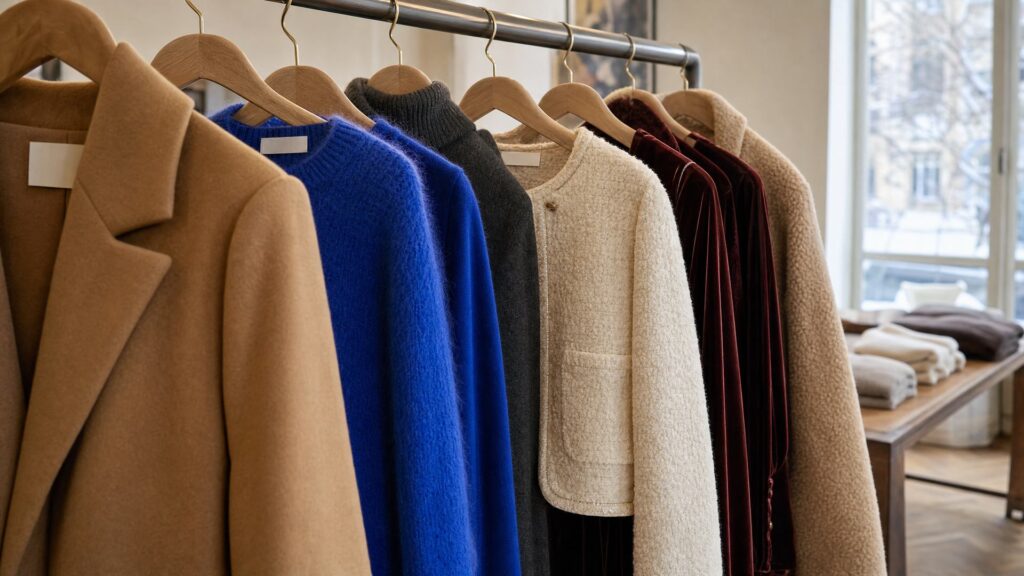
Every winter season has a few ideas that customers recognise immediately in a shop window, and the 2026-2027 season is unusually coherent. The winter fashion trends 2026 that emerged from the Italian showrooms rest on a short colour palette, on fabrics that customers want to touch, and on a quieter, more tailored silhouette than the oversized years that preceded it. This report describes what we have seen on the rails in Prato, where Italian pronto moda wholesalers translate the season into garments every few weeks, and it is written for boutique owners who need to decide which of these trends deserve space and budget in their stores.
The sections follow the order in which a buyer usually reads a season. Colour comes first, because it decides how a rail looks from the door, and texture follows, because it is what justifies a higher price once the customer has the garment in her hands. The rest of the report moves from the key pieces in outerwear, knitwear and dresses to the practical side of buying these trends without carrying too much risk into January. Each topic links to a more detailed article on our journal for readers who want to go further.
The Colour Palette of Fall Winter 2026
The season is built on three anchors. Cobalt, camel and charcoal appeared together in almost every Prato showroom from July onwards, and they work because they combine easily, whether it is a camel coat over a charcoal knit or a cobalt sweater worn with charcoal trousers. Camel carries the outerwear, charcoal carries trousers, skirts and fine knits, and cobalt is the colour that makes the rail look current. Around these three, burgundy and a deep forest green add warmth, while ivory and cream keep the palette light enough for customers who do not wear dark colours in winter.
Knitwear follows its own variation of the same story. Luxury yarns appear either in saturated jewel tones, with emerald, sapphire and ruby on mohair and alpaca, or in undyed naturals that show the fibre itself, from oatmeal to soft grey. Our analysis of colour directions for luxury knitwear explains how to balance the two on a single wall. For a boutique the practical rule is simple: build the core of the winter order in the three anchor colours, then use jewel tones in small quantities as the pieces that catch the eye and lift the average ticket.
Winter Textures: Velvet, Corduroy, Boucle and Teddy
Texture is the strongest of the winter fashion trends this year, and it is where Italian product has a visible advantage over mass-market alternatives. Velvet returned in dresses, blazers and wide trousers, while boucle became the fabric of the cropped jacket and the short coat, and corduroy quietly moved from casual pieces into tailoring. Our guide to what boucle fabric is and how it wears covers the details buyers and customers ask about most, from the looped yarn construction to snagging and care. These textures photograph well and convince in the hand, which is exactly what an independent store needs to justify its prices.
Teddy coats, faux shearling and eco-fur complete the picture on the outerwear side. They sell on warmth and comfort, and they work across ages and styles, from the short teddy jacket worn with jeans to the long faux fur coat over an evening dress. Wool, velvet and jersey remain the commercial base underneath these statements, and our article on the Italian fabrics that perform in mid-market retail shows why they deliver the most reliable margins. A balanced rail mixes one or two tactile statements with a larger share of smooth, easy pieces that customers can wear every day.
Key Pieces: Coats, Knitwear and Knit Dresses
Outerwear defines the winter rail more than any other category. The structured coat with a clean shoulder, often in camel or charcoal wool blend, is the backbone of the season, followed by quilted and padded jackets in shorter lengths and by the teddy and faux fur pieces mentioned above. Tailored blazers, worn over knitwear rather than shirts, carry the same discipline into the mid-season. Everything about sourcing these pieces, from construction to fill and quantities, is covered in our guide to Italian outerwear wholesale, which is the reference page for the category.
Knitwear is where Italian winter style is most recognisable. The season favours fine-gauge roll necks worn under coats, oversized mohair sweaters in strong colours, long cardigans and coatigans in baby alpaca, and cashmere blend basics that customers buy in several colours. Knit dresses and knitted co-ord sets, which combine the comfort of a sweater with the polish of a dress, have become one of the strongest categories for boutiques. Our complete guide to Italian knitwear wholesale explains fibres, price levels and quality checks, and it is the natural next step for any buyer planning a knitwear wall.
Italian Winter Style 2026 in Denim and Dresses
Denim follows the season’s taste for structure. Darker washes, straight and wide legs, and denim cut as tailored trousers or long skirts have replaced the heavily distressed styles of previous years, and denim pieces in winter colours sit comfortably beside wool and velvet. Our article on denim trends in Italian wholesale goes into fits, washes and price points. For a boutique, a small denim capsule styled with knitwear and coats is one of the easiest ways to make the winter offer feel complete without adding a new supplier category.
Dresses change role as the season advances. In the autumn they are mostly knit and jersey dresses, practical and warm, while from late November the rail shifts towards occasionwear, with velvet, satin and sequins for the holiday period. Viscose deserves a mention here, because it is the base of many winter dresses and blends, and our article on whether viscose works for winter explains how it behaves in cold weather. The holiday window is short, so these pieces should be bought with precision, and our guide to winter dresses and occasionwear describes how to time them.
Fall Winter 2026 Fashion Trends by Customer and Climate
The same season reads differently depending on who walks into the store. A city boutique with a professional clientele will lean on structured coats, tailored trousers in charcoal and fine knits that work under a blazer, with texture used mainly in accessories and one or two jackets. A lifestyle or resort store in a mountain or seaside town will sell more teddy, mohair and chunky knits, because its customers buy winter clothes for comfort and for the weekend. Neither approach is more fashionable than the other, and a buyer who knows the customer can take the same trends and build two very different rails from them.
Climate changes the order as much as the clientele does. Boutiques in northern Europe, Canada and the northern United States need real outerwear with weight and fill, and they sell it from October until February. Stores in milder climates, such as the southern United States, the Mediterranean or the Middle East, sell lighter layers for longer: the blazer, the long cardigan, the knit dress and the short boucle jacket replace the heavy coat for most of the season. For these markets, the coatigan and the knitted co-ord set are often the best performers of the whole winter.
Price positioning completes the picture. Italian pronto moda covers a wide range inside the same trend, so a boucle jacket or a mohair sweater can be bought at entry level for fast turnover or at a higher level with better yarns and finishing. A boutique does not have to choose one level for the whole season: many of our clients buy entry pieces in trend colours that they expect to sell quickly, and invest more in coats and knitwear that customers will keep for years. Mixing the two on the same rail gives every customer a way into the season.
How Boutiques Turn Winter Fashion Trends 2026 into an Assortment
Trends become profitable only when they are translated into quantities. A practical structure for a womenswear boutique gives the largest share of the winter budget to proven pieces in the three anchor colours, a smaller share to texture-led items, and a limited amount to statements that create attention in the window. Knitwear should follow the same logic internally, with a solid base of fine-gauge basics and a few strong pieces on top. Buyers who keep about half of the knitwear budget for reorders protect themselves against the most common winter mistake, which is committing the whole season in July and marking it down in January.
The buying calendar matters as much as the selection. Prato shows the first winter collections in early summer, deepens the offer through August and September, and keeps refreshing knitwear every three to four weeks into January, so a boutique can combine an early order for the pieces that sell out with later buys based on what is actually moving. Our complete guide to Italian winter clothing wholesale explains the calendar, minimums, shipping and payment in detail. For quality, our notes on reading wool fibre, weight and finish help buyers check value before ordering.
Buying Winter Trends from Italian Wholesalers
The Prato model suits winter trends well because wholesalers produce in short runs and react quickly to demand. A style that sells in October can be found again in November in a new colour, and a texture that appears in one showroom is often interpreted by several others within weeks, at different price levels. Supplier minimums usually sit between €300 and €500 per warehouse, with two to twelve pieces per style, which lets a boutique test many trends with limited risk. Payment is due in full before shipment, and goods from several wholesalers are consolidated into one invoice and one parcel.
Buyers who cannot travel to Italy can see the season directly in the showrooms through our buying process, built around live video sessions in which every garment is shown up close and checked before purchase. This is particularly useful for texture-led trends, where a photograph rarely shows the difference between a dense, well-made boucle and a thin one. Boutiques in the Southern Hemisphere, whose winter starts in June, follow a different calendar, explained in our guide to Italian winter wholesale for Australia and the Southern Hemisphere.
What Winter Fashion Trends 2026 Mean for the Next Season
The season leaves boutiques with a clear lesson. The winter fashion trends 2026 that sold best were not the most extreme ones but those that combined a recognisable idea with comfort and quality: a camel coat with a good shoulder, a soft roll neck in charcoal, a cobalt mohair sweater, a teddy jacket that customers wear every day. These pieces will carry into the next winter with new details rather than disappear, and stores that build a stable base around them, refreshed each season with colour and texture, will find winter easier to buy and more profitable to sell.



