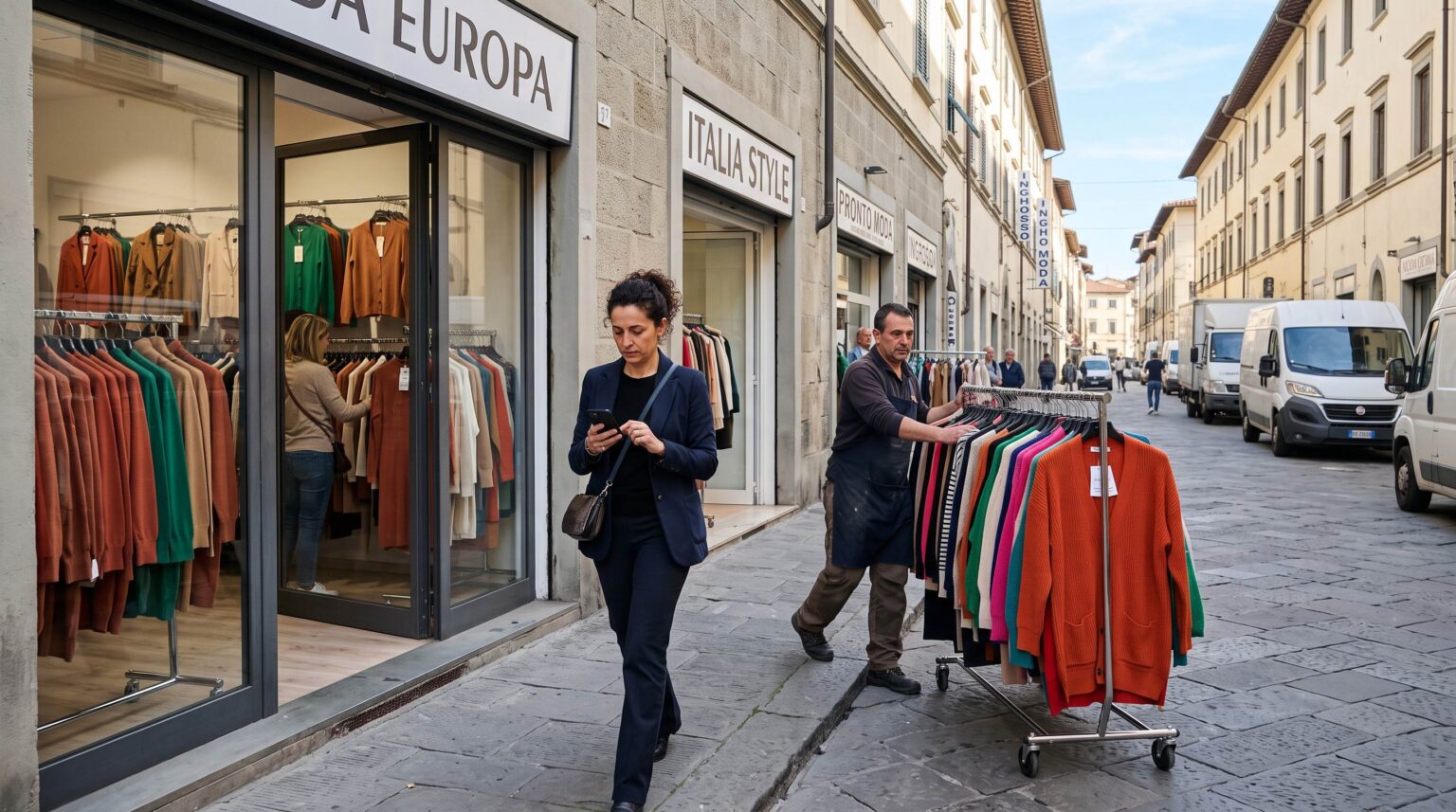
Customer touching an emerald mohair sweater on a boutique rail illustrating luxury knitwear retail pricing and merchandising

Sourcing Strategy

The Sourcing Strategy section is where we examine the decisions that determine whether an Italian wholesale buying programme generates strong returns, or doesn’t.

Good sourcing is not just about finding the right garments. It is about structuring a buying programme that maximises full-price sell-through, manages markdown risk, builds supplier relationships that compound in value over seasons, and allocates budget across categories in a way that reflects how the customer actually buys. These are strategic decisions, and most buyers make them implicitly rather than explicitly, which means they often don’t know why a season went well or badly.

The articles in this section address sourcing strategy across its full range: margin mechanics and how Italian wholesale pricing translates into retail return, supplier selection criteria and what separates a high-value Prato supplier relationship from a one-off transaction, buying timing and why the sourcing window matters more than most buyers appreciate, and the strategic logic behind Made in Italy positioning as a commercial differentiator.

We write for buyers who want to think more clearly about what they are doing and why, not for buyers looking for a quick tip. If that describes you, this section is for you.

Sourcing Strategy

Pricing and Merchandising Noble Fibre Knitwear at Retail: Margin, Story, Sell-Through

Buying well in Prato is half the knitwear margin; the other half is earned on the shop floor. This article covers the retail disciplines that convert 15 to 45 euro wholesale garments into full-price sell-through: the markup arithmetic built on landed cost, the thirty-second fibre story that justifies tickets, display choices that invite touch, the care conversation that cuts returns, and the price anchoring that lets statement pieces raise the whole wall’s ceiling.

Sourcing Strategy

Your Retailers’ Bestseller Just Sold Out: Fast Replenishment Through a Local Buying Agent

When a style starts selling through a distributor’s retail network, the commercial clock starts running. This article examines fast replenishment through a local buying agent: why a single wholesaler often cannot restock a bestseller, how the search for the same article or credible alternatives runs across the Prato district, and how remote sessions compress confirmation into days. It measures reaction time against the trend window and explains why replenishment works as a structured service rather than an occasional favour.

Sourcing Strategy

What 15, 25 and 45 Euros Buy in Prato Knitwear: A Price Architecture for Boutique Buyers

Prato knitwear in noble fibre blends wholesales along a ladder from 15 to 45 euros, and every rung buys something specific: composition, gauge, weight or silhouette. This article decodes what each price band actually delivers, how fibre percentages move cost, how the wholesale ladder translates into a readable retail ladder, and how landed cost arithmetic keeps the margins honest from showroom to shop floor.

Sourcing Strategy

Weekly Presence in the Pronto Moda District: Market Monitoring as a Distribution Advantage

Pronto moda publishes no lookbooks and follows no preview calendar: collections appear, rotate within three to four weeks and are replaced. This article explains what continuous market monitoring means for distributors buying in the Prato district, what a weekly presence actually observes, and how current information changes both individual buying decisions and seasonal planning. It closes on continuity, the difference between a supplier who calls when he has stock to move and a presence that works for the distributor between orders.

Sourcing Strategy

One Contact, Ten Suppliers, One Shipment: Consolidated Buying for International Distributors

Buying from many Italian suppliers normally means many counterparts, many invoices and many parcels. This article explains how order consolidation removes that fragmentation for international distributors: purchases from multiple Prato showrooms gathered at one point, verified, packed once and shipped as a single operation with centralised export documentation. It covers the practical mechanics, the single-referent model that replaces direct coordination, the freight economics of volumetric weight, and what consolidation changes at customs on the importing side.

Sourcing Strategy

Quality Control at Volume: What Gets Verified Before a Distributor’s Order Leaves Italy

On distributor volumes, small error rates become large absolute numbers, and a mistake discovered abroad costs many times what it costs in Italy. This article details what pre-shipment quality control covers on wholesale orders: piece counts, styles, colours, sizes and garment condition verified against confirmations before anything ships. It follows the cost curve of an error along the chain, lists the ordinary failures the check intercepts, and explains how disputes with suppliers are handled on the ground when something is wrong.

Sourcing Strategy

Building a Distribution Catalog vs Absorbing a Warehouse: Tailored Scouting Across the Prato District

Every wholesale catalog is built from one of two starting points: the client’s market or the supplier’s warehouse. This article explains how tailored scouting works for fashion distributors buying in the Prato district, from the structured brief on destination markets, categories and price architecture to the supplier-by-supplier research that follows. It also examines the warehouse bias built into a single wholesaler’s proposals, and why a scouted catalog serves a distribution network better than an absorbed one.

Sourcing Strategy

When Your Whole Catalog Depends on One Wholesaler: Supply Risk for Fashion Distributors

Fashion distributors who buy from one trusted Italian wholesaler concentrate their entire catalog on a single warehouse. This article examines how single supplier risk behaves at distribution scale, what actually happens when a wholesaler runs out of stock, changes collection direction or hardens conditions, and which warning signs deserve attention. It then shows how sourcing across the Prato district spreads that risk without multiplying internal workload, using one operational referent instead of many direct relationships.

Sourcing Strategy

When to Start Buying Autumn: A Practical Buying Calendar for Independent Boutiques

Most boutique buyers start thinking about AW26 too late. The conventional sourcing calendar — built around September trade shows and October delivery expectations — systematically misses the best Prato production. This article sets out a practical AW26 buying calendar working backward from optimal floor arrival dates to establish when to book sourcing sessions and confirm orders.

Sourcing Strategy

Sizing Up the Season: How to Analyse Your SS26 Sell-Through Before Buying AW26

The period between late June and mid-July is one of the most commercially important decision points in the boutique buying calendar. SS26 stock is still selling, AW26 orders need to be placed before the best Prato stock moves, and the data required to make both decisions well is finally available. This article guides boutique buyers through the practical process of reading their SS26 sell-through rate before committing to an AW26 buy.

Italian fashion supply, curated and delivered to your inbox.

Join the Insider List

Be the first to access ready-to-wear drops, supplier insights and private label tips. No noise—only what helps your business buy smarter.
Need help?
Chat with us