Custom Woven Labels for Clothing: Size, Wording and the Proof You Approve Before Production
14 October 2026
Sourcing Strategy
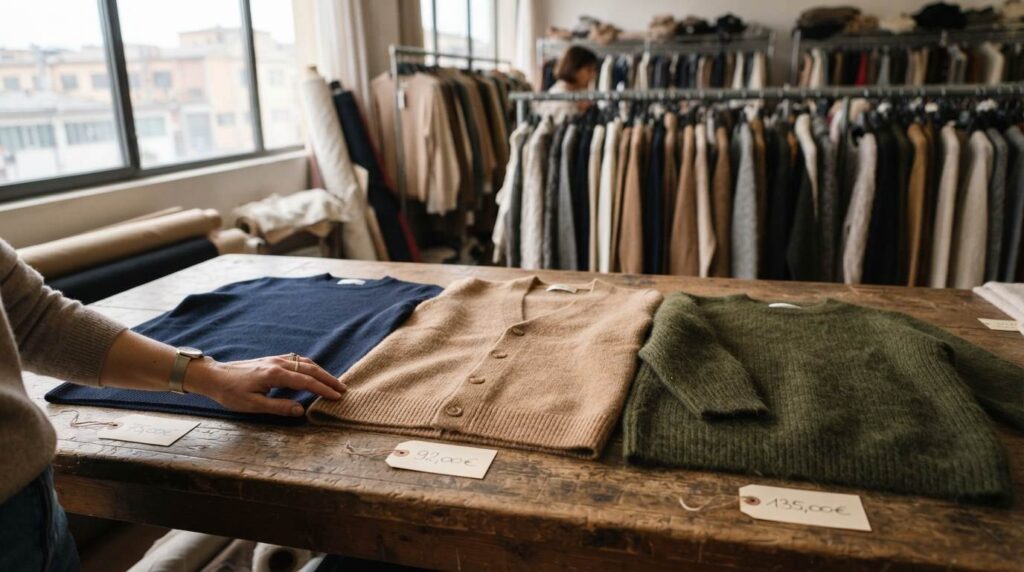
Prato knitwear wholesale prices run along a remarkably legible ladder, from about 15 euros for a fine cashmere blend basic to 45 for a heavy alpaca coatigan or high-content mohair statement, and understanding what each rung buys is the difference between an order priced by instinct and one priced by architecture. Every figure below refers to finished, labelled, ready-to-hang garments in the district’s showrooms. This article decodes the ladder band by band; the categories themselves, mohair, alpaca and misto cashmere, are covered in depth in our full guide to kid mohair, baby alpaca and cashmere blend knitwear wholesale in Prato.
The single most useful fact about this ladder is what moves prices along it. Composition dominates: in noble fibre knitwear, yarn is the majority of garment cost, so fibre percentage and yarn quality set the band while silhouette adjusts within it. Raising a crewneck from 5 to 15 percent cashmere adds roughly 5 to 8 euros at wholesale; lifting kid mohair content from 25 to 40 percent adds a similar step. Weight compounds the effect, since a heavier garment simply contains more of the expensive input. Silhouette complexity, by contrast, moves prices surprisingly little, which is why a well-chosen 25 euro garment can look considerably richer than its cost.
At 15 to 18 euros, Prato sells fine-gauge crewnecks, V-necks and slim turtlenecks in entry compositions, typically 5 percent cashmere with viscose, wool and polyamide. What the money buys is honest: a soft, current, EU-labelled garment that retails at 49 euros and outclasses high-street knitwear at the same ticket. What it does not buy is density; gauge and knit consistency vary most in this band, so the light test and cuff recovery check matter proportionally more here than anywhere else on the ladder.
This band’s role in the assortment is volume and entry. It gives price-sensitive customers a legitimate door into the shop’s knitwear story, gives staff an easy add-on suggestion, and generates the weekly sell-through data that steers reorders. Buyers should resist both extremes: an assortment built only on this band reads as ordinary, while one that skips it entirely loses the customer who needed a 49 euro yes before she could consider an 89 euro one.
Reorder behaviour is this band’s hidden virtue. Entry blends stay in continuous production across the season, colours and sizes replenish within days, and the modest unit cost makes weekly top-ups painless, so the band functions as the assortment’s always-in-stock layer while pricier tiers rotate. Treating it that way, as infrastructure rather than fashion, also removes the temptation to chase trend colours at this level, where the permanent neutrals do the volume and the seasonal experimentation belongs higher up the ladder where its success is more visible and its failure more affordable.
Between 22 and 30 euros sits the ladder’s centre of gravity: cashmere blends at 12 to 20 percent, entry baby alpaca pieces, and lighter kid mohair formats such as vests. The perceptible difference from the entry band is density and hand, the dense butteriness of a real cashmere presence, the dry slip of alpaca, and it converts directly at retail, supporting tickets from 69 to 89 euros. This is the band where the ratio of sensory quality to wholesale cost peaks, and experienced buyers concentrate the largest share of units here.
The middle band also carries the assortment’s credibility. Customers who touch a 25 euro wholesale garment priced at 79 and find it agrees with their hands begin trusting the shop’s entire price logic, upward and downward. In showroom practice, this is the band where comparing two or three suppliers’ versions of the same silhouette pays best, because workshop-to-workshop variation in yarn sourcing is widest exactly where volume is highest, and ten minutes of comparison routinely finds the garment that punches one band above its cost.
One caution belongs to this band specifically: it is where assortments drown. Because everything here looks sensible, buyers accumulate near-duplicates, four similar crewnecks from four suppliers, and the wall loses the contrast that sells. The corrective is to assign each middle-band purchase a stated role before it enters the order, the layering turtleneck, the weekend crew, the office V-neck, and to reject garments that merely repeat a role already filled. An order built on roles stays readable at any size; one built on individual appeal degrades into similarity precisely as it grows.
The top of the pronto moda knitwear ladder, roughly 35 to 45 euros, contains the garments that define the shop’s winter: 40 percent kid mohair statement sweaters in saturated colour, heavy baby alpaca coatigans, and elaborate pieces such as jacquards or full knit sets. Retail tickets run 110 to 160 euros. What the money buys here is presence, fibre content at its richest, garment weight at its most substantial, and silhouettes that function as light outerwear or as the outfit’s centrepiece.
Discipline in this band is about depth, not presence. These pieces must exist for the assortment to have a ceiling, but they are bought shallow, two or three units per style, one or two sizes, because their job is gravitational: they make the 89 euro garment beneath them feel reasonable. A boutique whose most expensive knit is 79 euros has quietly capped what its middle band can charge; one that hangs a 149 euro coatigan has given every price below it room to breathe, whether or not the coatigan itself sells quickly.
The top band is also where provenance storytelling earns its margin. A swing tag naming the fibre, kid mohair from first shearing, baby alpaca at 22 microns, and the district that knitted it gives staff a thirty-second story that justifies the ticket far better than the word luxury ever does. Customers at this price want a reason they can repeat to someone else; composition and origin are exactly that, and Prato garments carry both legitimately, which is an advantage over anonymous imports that costs the boutique nothing to use.
Translation to retail should preserve the ladder’s legibility. The standard arithmetic, wholesale cost times roughly 2.5, lands the three bands at approximately 49, 79 and 129 euros, and those tidy intervals are themselves merchandising: a customer scanning the wall understands instantly what separates the tiers, which converts price from an obstacle into information. Rounding into clean retail points, 49 rather than 47.50, costs nothing at wholesale and buys clarity, the property that broader analyses of how Italian fashion wholesale pricing works for boutique buyers consistently identify as the strongest predictor of full-price sell-through.
Landed cost completes the honest calculation. To each wholesale price add the 10 percent sourcing fee, freight allocated per garment on volumetric weight, around 2 to 3 euros per kilogram within Europe and 8.50 toward North America as reference bands, and the destination’s import duty, which changes with tariff schedules and should always be verified locally before pricing. On typical mixed knitwear orders to non-European markets, these additions total 12 to 20 percent over wholesale value. Running the sum before the session rather than after is what lets a buyer set retail tickets in the showroom itself and decline any garment whose landed cost breaks the ladder.
The architecture assembles fastest when all three bands are seen in one day, which is what a guided live session through multiple Prato showrooms provides: entry blends at one specialist, the working middle at two others, statements and coatigans at a fourth, all consolidated into one invoice and one shipment. Supplier minimums of a few pieces per style keep each rung affordable to test, there is no minimum order value on the sourcing side, and the 250 euro minimum commission applies per engagement. The sequence from initial interview to consolidated delivery is set out on our page explaining how the sourcing process works from interview to delivery.
A workable allocation for a first knitwear order is roughly thirty percent of units in the entry band, fifty in the middle and twenty at the top, adjusted by market. After one season, the shop’s own sell-through will redraw those weights with an authority no article can. What remains constant is the principle: Prato knitwear wholesale prices already form a coherent ladder, and the buyer’s task is not to invent a pricing strategy but to carry the district’s structure intact onto the shop floor, where customers reward the clarity with full-price purchases.
Italian fashion supply, curated and delivered to your inbox.
How can we assist?
See our services