A boutique owner who has just received a pallet from Prato takes on a second job the moment the cartons are open. The garments have to be explained. Linen, silk and wool retail selling points are not decorative copy; they decide whether a customer keeps a jacket or brings it back four days later complaining that it wrinkled. Six years of buying sessions in the Italian pronto moda districts have made one pattern hard to miss. Retailers who describe fibre behaviour plainly sell more of it and argue about it far less.
The problem is that fibre information usually stops at the wholesale invoice. A supplier tag reads 100% linen, or 70% viscose and 30% silk, and the transfer of knowledge ends there. Between a warehouse in Prato and a shop floor in Copenhagen or Toronto sits a gap that nobody is paid to fill. Closing it is cheap. One paragraph on a product page and two sentences at the till are enough, and they move the conversation from apology to explanation before the money changes hands. For the buying side of the same fabrics, our complete guide to Italian linen wholesale explains how these garments are selected and ordered in Prato.
Linen Selling Points Start With Creasing, Not With an Apology
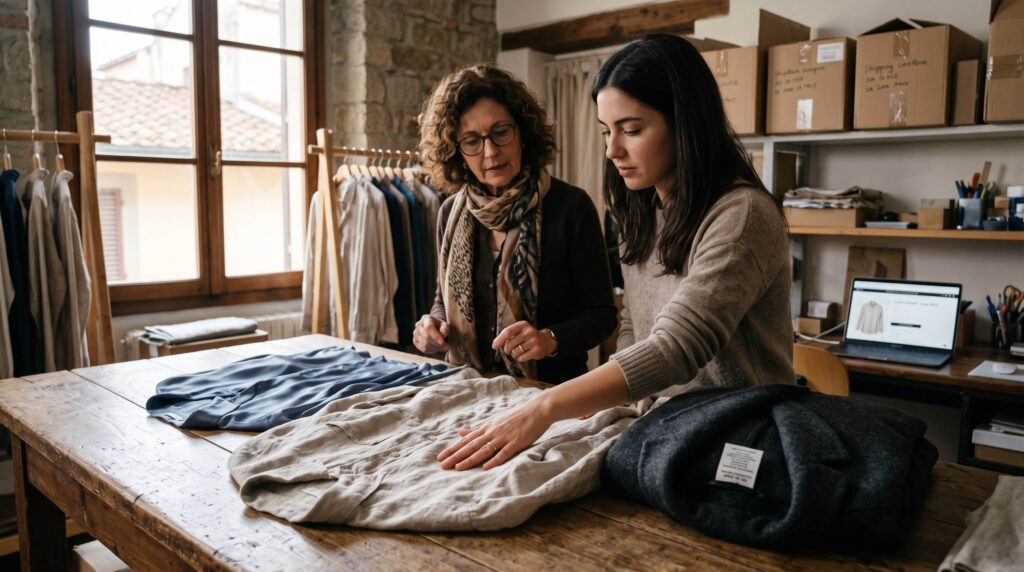
Linen creases because flax is a stiff cellulosic fibre with very little elastic recovery. That is physics, not a production fault, and it should be said out loud to a customer holding a shirt that has already picked up fold marks on the rail. The line that works in store is short. Linen relaxes into creases, it will not hold a press for a full day, and the wrinkle is the proof that the garment is not a synthetic blend pretending to be one. Customers who hear this before paying rarely raise it afterwards.
Weight matters more than most buyers expect, and it is the detail that turns a vague compliment into a reason to buy. Linen around 140 to 160 grams per square metre is summer shirting and will read semi-transparent in direct light. Linen at 190 to 230 grams becomes trousers and unlined jackets with real drape. Judging that band in the warehouse is the same skill as knowing how to read linen quality at wholesale level, and the two habits feed each other, because what you verify at the supplier becomes what you write on the tag.
Silk Care Advice a Boutique Can Give Without Overpromising
Silk is where most retail conversations go wrong, usually because the seller says nothing. The useful facts are few. Silk marks with water, it reacts to perspiration and deodorant more than to laundering, it should be pressed on the reverse at low heat, and a cool hand wash suits many lightweight styles even when the label says dry clean. State that the label instruction is the safe route and that the customer who deviates is accepting a risk. Sold that way, a silk blouse stops being fragile and becomes a garment with a protocol.
Retailers often ask whether silk is worth stocking outside the summer window, and the honest answer is that it sells all year when it is presented correctly. A crepe de chine blouse at a heavier momme count works under knitwear from October onwards, and a silk-blend skirt reads as evening wear rather than holiday wear once it is styled with wool. The mistake is filing silk under one season and discounting it in September. In the Prato warehouses the silk-blend rails do not disappear in autumn, and neither should the story you tell about them.
Wool Weight and Handle: The Selling Point That Justifies a Higher Price
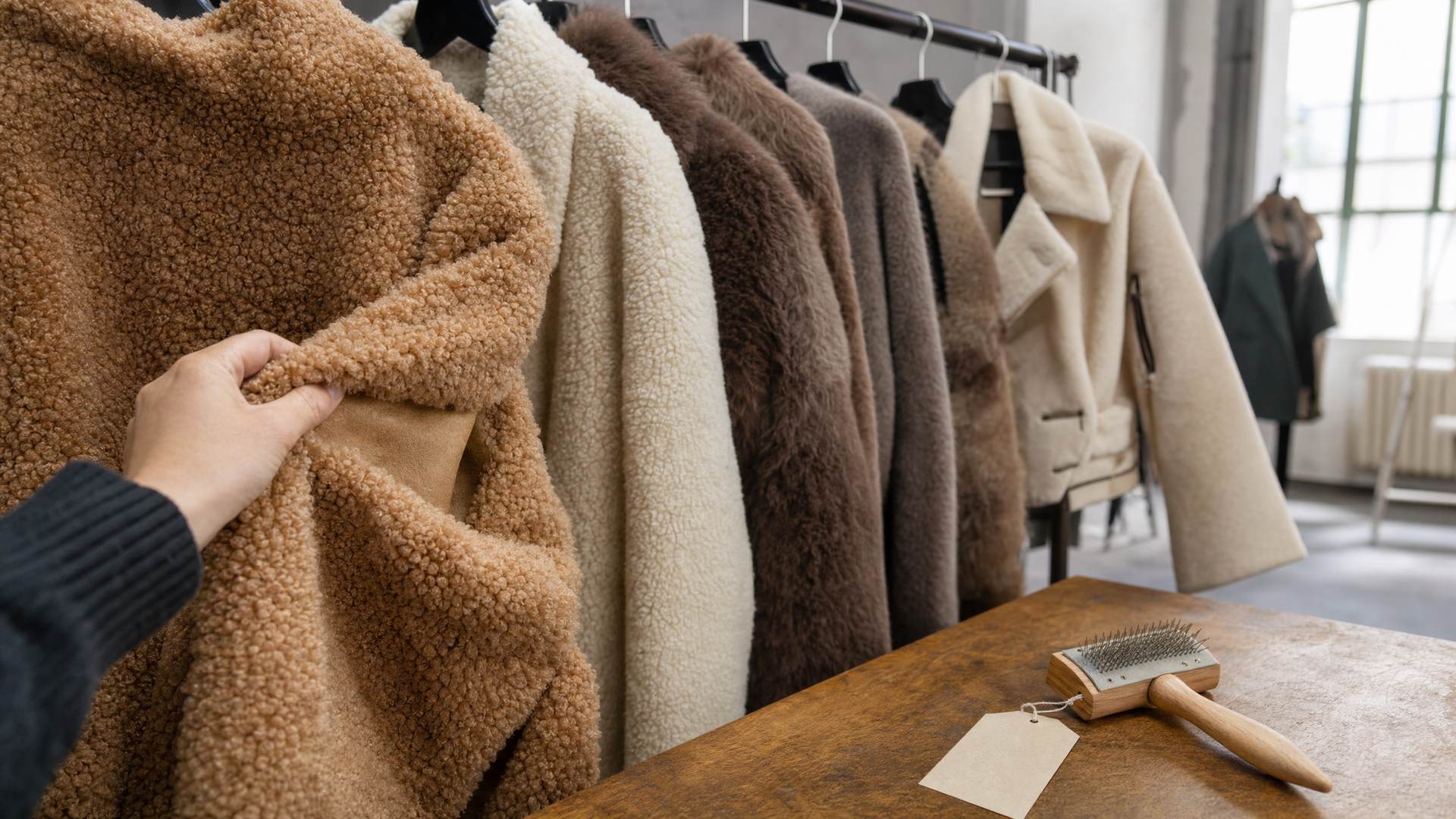
Wool is the fibre where a higher ticket has to be defended, and weight is the most concrete argument available. A coat fabric in the 350 to 450 gram range behaves differently from a 250 gram version, holds its shape across a season, and feels like the price on the swing tag. Prato built its reputation on carded and regenerated wool, so a district-sourced coat often carries a recycled fibre content that is a genuine sustainability point rather than a marketing claim. Say the weight and the blend, then let the customer feel the difference between two hangers.
Handle should be described in ordinary language, not in mill vocabulary. A carded wool is fuller and slightly hairy on the surface; a combed wool is smoother, flatter and reads more formal. Both pill at the friction points in the first weeks, which is normal for a natural staple fibre and worth mentioning alongside the suggestion to use a fabric comb rather than a razor. Retailers who explain pilling in advance handle outerwear objections better than those who wait for the first complaint, because the point has already been made inside the sale.
What a Product Page Fabric Description Should Actually Contain
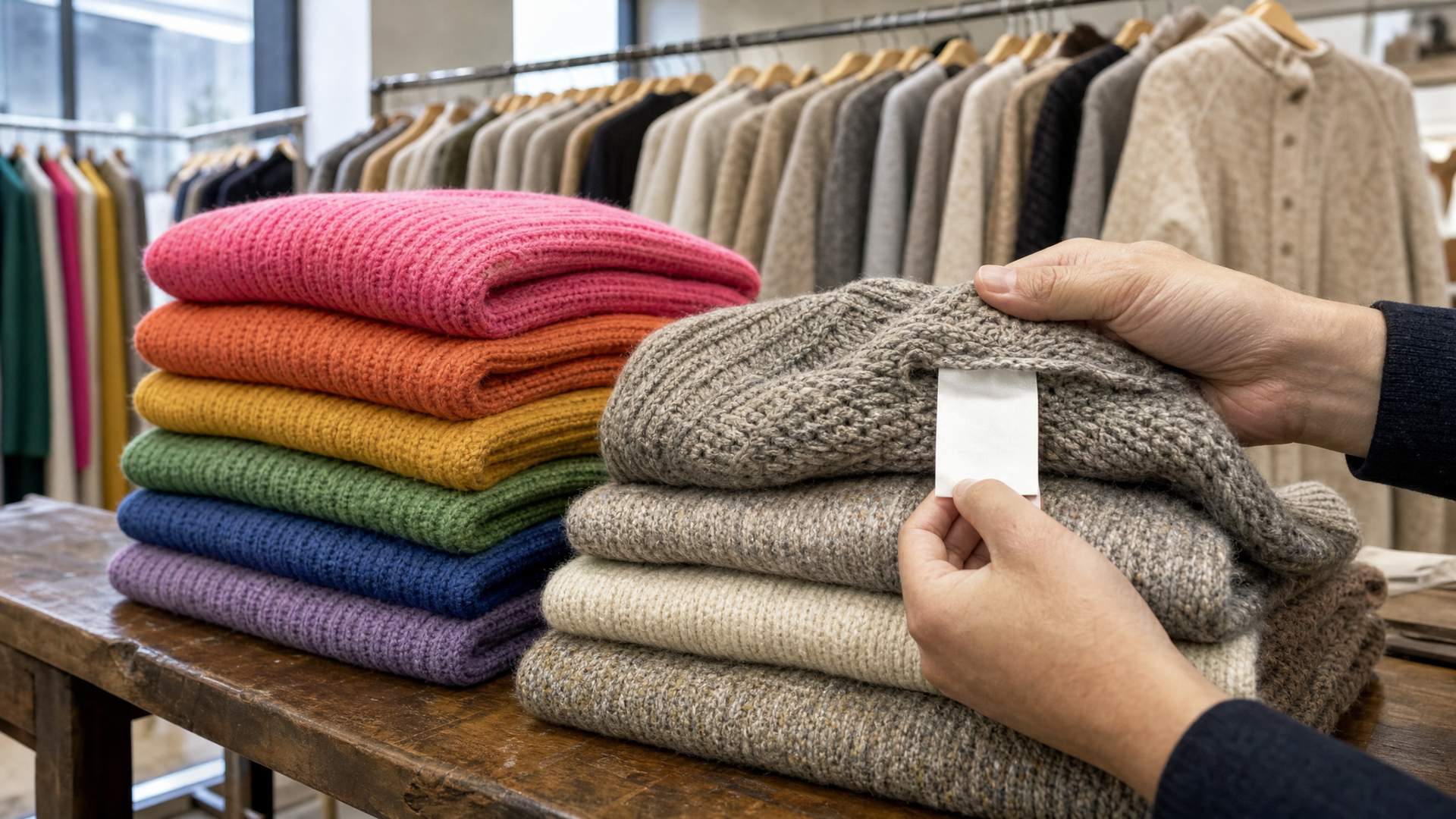
A product page fabric description that works has four jobs and takes about sixty to ninety words. It states the composition exactly as it appears on the care label, describes the handle in plain terms a person can imagine, names the occasion or season the garment is built for, and closes with the care instruction in one sentence. Nothing else belongs there. Styling adjectives can live in the headline; the fabric paragraph is where a hesitant buyer goes looking for a reason to trust the listing, and vagueness there is what sends them to a competitor.
A usable example reads like this: 100% linen, 200 gsm, with a dry hand that softens after two or three washes, cut for warm-weather travel and summer events, machine washable cold and best worn slightly creased. That single sentence carries composition, weight, handle, occasion and care without a line of filler. Use the same wording at the counter that appears online, because a customer who reads one version on the phone and hears another in the shop stops believing both of them.
Honest Fabric Copy Reduces Returns Instead of Reducing Sales
The fear behind vague copy is that describing a fibre’s limits will cost a sale. What it actually costs is the return, and returns are the more expensive item. A garment that comes back has already absorbed the landed cost of an international shipment, and under DAP terms the duties and local taxes paid on the way in are not recovered when the customer changes their mind. Add restocking labour and the lost selling week, and a single avoidable return can erase the margin on several units of the same style.
There is also a quality band that has to be handled honestly at the point of sale. In low-cost pronto moda, up to five per cent of pieces can show minor irregularities such as a loose thread or a slightly off-centre seam, and that is the recognised standard at that price level rather than a supplier failure. The practical response is a quick check before anything reaches the rail, so the piece with the flaw is priced down deliberately or held back rather than discovered by a customer at home.
Quality Is Proportional to the Price Band, and Italian Fabrics Wholesale Is No Exception
The most damaging sentence a retailer can use is that a garment is high quality without qualifying against what. Quality in this trade is relative to the band you bought in, and a customer paying a mid-market price for a linen shirt is not entitled to the finishing of a garment costing four times more. Setting that expectation is the whole trick, and it is the same logic that governs the relationship between quality and price in pronto moda. Sell the garment as excellent for its band, not as excellent in absolute terms.
This is also where sourcing decisions and retail language meet. Supplier minimums in the districts typically run from three hundred to five hundred euro per warehouse with two to twelve pieces per style, which means a buyer can build a rail from several fibre stories in one session instead of committing deeply to one. The sourcing and purchasing work that gets the goods into the shop should also extract the composition, weight and care data from each supplier while the order is open, because collecting it later is slow and often impossible.
Turning Linen, Silk and Wool Retail Selling Points Into a Routine
The routine is unglamorous and it works. While the consolidated shipment is being unpacked, write one fabric paragraph per style with the care label in hand, file it where both the e-commerce team and the shop staff can reach it, and read it aloud once so it sounds like speech rather than a spec sheet. Twenty styles take an afternoon. After that, the linen, silk and wool retail selling points are already written when the season starts, and nobody is improvising an explanation with a sceptical customer standing in front of them.