

A boutique in Melbourne, Auckland or Cape Town sells its winter collection between May and August, and that is precisely when the showrooms of Prato are full of linen dresses and summer sets. Anyone planning Italian winter wholesale for Australia or another southern market meets the same mismatch we described for linen, only in reverse: the Italian winter offer is built for a European calendar, and it is widest when the southern buyer is still selling summer. Understanding that rhythm is the difference between a coherent winter order and a handful of leftover coats bought in February. This guide explains how the calendar works, what can be bought at each moment and how to plan cash, storage, duties and shipping.
It is the winter companion of our guide to Italian linen wholesale for the southern summer, and many of our southern clients use both, buying winter in the Italian autumn and linen in the Italian spring. The principle behind both is the same: the buyer moves their own planning onto the Italian clock rather than expecting the district to adapt. Once that shift is made, the inverted seasons stop being a problem and become a predictable schedule with two main buying moments a year.
Why Italian Winter Wholesale for Australia Follows the Italian Calendar
Prato’s pronto moda wholesalers produce for the European season. The first autumn and winter pieces appear in the showrooms in early summer, the offer is deepest between August and October, and knitwear keeps refreshing every few weeks until January. From February onwards the district turns to spring and summer, and what remains of the winter offer is residual stock: limited quantities, broken size runs and styles that cannot be repeated. Nobody keeps a full range of coats and knitwear in Prato through the Italian spring waiting for orders from the Southern Hemisphere.
For a southern boutique this means that the main winter order has to be placed between August and October, roughly eight to ten months before the goods are sold. It is the same discipline a European buyer applies to the same collection, shifted by half a year, with one real difference: the stock has to be stored and financed for much longer. Payment in the district is always 100% before shipment, with no open account and no consignment, so a boutique that buys in September for a May opening carries that inventory through the whole southern summer.
What a Southern Buyer Can Still Find Between February and April
A southern boutique that has missed the main window still has options, but they need to be understood honestly. Between February and April, Prato offers the remains of the winter season: a coat in two colours instead of six, a knit in S and L without the M, a few dozen pieces of a style that sold well in Europe. These pieces are real merchandise in good condition and often at better prices, but they cannot be reordered, and they rarely form a coherent collection on their own. Our article on Prato’s January to July showroom season describes what is on the rails in those months.
The way to use this residual stock is as a supplement, not as the foundation. Buyers who arrive with a precise list of gaps, such as a few extra coats in a colour that is already selling or a handful of statement knits to refresh the window in June, get good value from it. Forgiving shapes work best in broken size runs, so oversized knitwear and wrap coats are safer than fitted pieces. Transitional items, such as blazers, lighter jackets and long cardigans, are also easier to find in early spring, because they straddle the European seasons and stay in production longer.
Planning Cash and Storage for a Southern Winter
The financial side of inverted seasons buying is where most of the difficulty sits. A boutique that buys its winter collection in September and sells it from May carries the cost of that stock for seven to nine months, plus storage. Many of our southern clients deal with this by splitting the winter budget into a main order in August or September, focused on coats and core knitwear, and a smaller top-up in January or February for transitional pieces and residual opportunities. This keeps the core of the assortment coherent while limiting the capital committed far in advance.
A South American client shows how this works in practice. He first contacted us in February looking for coats and knitwear for his approaching winter, and found only the remains of the Italian season. The following year he changed his calendar, ordering winter pieces between August and September and summer pieces between March and June, and the sourcing problem largely disappeared. His case, which also combined pronto moda with a small production run, is told in our article on autumn buying in Italy for a South American boutique.
Which Winter Pieces Suit Southern Climates
Southern winters are milder than European ones in most of the cities where our clients sell. Sydney, Brisbane, Perth and Durban rarely need heavy outerwear, so knitwear, blazers, long cardigans and lighter coats carry the season, while Melbourne, Wellington, Christchurch and Johannesburg on cold evenings justify warmer coats and padded jackets. For most southern boutiques the strongest categories are fine-gauge knits, statement sweaters in mohair or alpaca blends and coatigans, all covered in our guide to Italian knitwear wholesale, with a smaller selection of coats.
Outerwear should be bought with particular care, because it is the most expensive category to store and to ship. A few structured coats in camel or charcoal, some short textured jackets such as boucle or teddy, and a limited number of padded jackets for colder markets usually cover the demand. Our guide to Italian outerwear wholesale explains how to read fabric and fill and how many coats to buy. Southern buyers also have an advantage: by the time their season opens, European retailers have already shown which winter styles sold through, and that information can guide the January top-up.
Duties and Taxes on Italian Winter Wholesale in Australia, New Zealand and South Africa
Australia currently applies a general customs duty of 5% to most clothing, and GST at 10% on the total value including freight and duty, with a full import declaration required above AUD 1,000. The European Union and Australia concluded a free trade agreement in March 2026 that will remove almost all tariffs on EU goods once it enters into force, which may take up to two years, so budgets should be built on current rates. New Zealand has applied no customs duty on European clothing since its agreement with the EU entered into force in May 2024, provided the goods carry a valid statement of origin, while GST at 15% still applies.
South Africa requires the most careful planning, because apparel is among the most heavily protected categories in its tariff, with rates around 40% on many clothing lines and VAT at 15% at import. Whether EU origin brings a reduced rate depends on the specific tariff line, so a South African boutique should ask its clearing agent to confirm each category before ordering. Goods travel under DAP terms, which means duties and taxes are paid by the buyer on arrival. South American markets each have their own rules, often with significant duties on apparel, and should be checked case by case.
Shipping Bulky Winter Orders to the Southern Hemisphere
Winter orders are heavier and bulkier than summer ones, and shipping is where the difference shows. Couriers calculate cost on volumetric weight, the space a parcel occupies, so a carton of padded jackets or lofty mohair sweaters can cost two or three times what its scale weight suggests. As a reference band, shipping from Italy to Australia, South Africa and South America runs around €9 per volumetric kilo, against roughly €8.50 towards North America. Our article on shipping knitwear worldwide explains how to calculate landed cost per garment.
We consolidate purchases from all the wholesalers visited into a single invoice and a single shipment, with one set of export documents and a maximum of five customs codes per invoice to keep the declaration simple. Express courier service usually reaches Australia and New Zealand in about a week, plus clearance. For a boutique holding stock for months, it can make sense to ship the main order as soon as it is complete and store it locally, so the goods are checked on arrival and any claim with the supplier is raised while there is still time to resolve it.
Buying Italian Winter Wholesale from Australia Without Flying to Prato
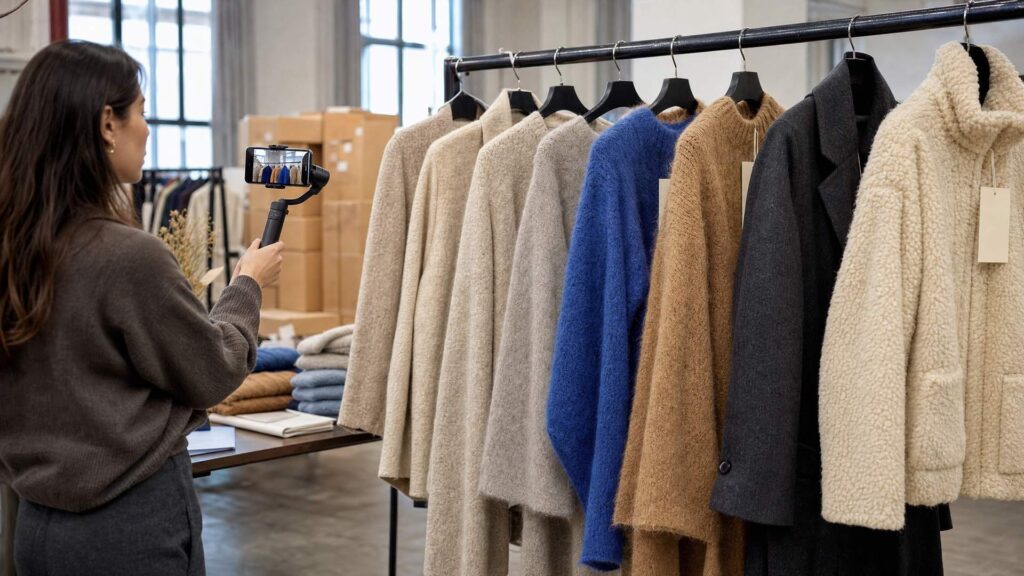
Few southern boutiques can justify a buying trip to Italy for every season. In a live buying session we walk through the showrooms on video while the client watches, opens each coat, checks the knit and the label, and decides piece by piece. The time difference works well: during the European autumn, a session starting at 9:00 in Prato begins between 17:00 and 19:00 in Sydney, depending on daylight saving in the two countries, and South Africa is at most one hour ahead of Italy. A session starts from a purchase value of €3,000 and our fee is a 10% commission on the goods purchased.
The complete picture of the Italian winter season, from prices to minimums and quality checks, is set out in our guide to Italian winter clothing wholesale. Southern boutiques that treat Italian winter wholesale for Australia and the rest of the hemisphere as a fixed annual schedule, buying the core in the Italian autumn, topping up in the Italian winter and budgeting duties and freight from the start, find that the inverted seasons give them more time to plan, not less.



