Where Boutiques Buy Their Clothes: Trade Shows, Showrooms and the Prato District
26 October 2026

Sourcing Strategy
Independent boutiques far from Europe often build their assortment around European ready-to-wear, because their customers associate it with design, fabric quality and a certain kind of styling that local or Asian supply does not offer. Searching for wholesale clothing suppliers in Europe is the first step, and it quickly shows that the European market is fragmented: Spanish, French, Portuguese and Italian producers, brands that sell through fairs, wholesalers that sell online, and districts where hundreds of small companies make and sell their own collections. Each has a different way of working with buyers who are not in the European Union.
The difference matters because a buyer outside the EU cannot simply order and wait for a courier, as a buyer in Germany or France would. Goods leaving the EU need an exporter, an export declaration and documents that will satisfy customs at destination. Many small European suppliers are set up to sell domestically or within the EU and have little experience with export paperwork for distant markets. A buyer who chooses suppliers without considering who will handle the export can end up with goods ready in a warehouse and no practical way to move them.
Trade fairs in Paris, Milan, Madrid and other cities are the most visible meeting points. They present established brands with export departments, which makes ordering from abroad straightforward, though the collections are often widely distributed and ordered months ahead. Brand showrooms and agents offer similar advantages between fairs. Online platforms list many European wholesalers, but the product is seen only in photographs and the supplier’s export capacity is often unclear until the order is placed.
Production districts are the other option, and Italy’s Prato district is one of the largest for women’s ready-to-wear. Its suppliers produce and sell from their own warehouses, refresh their collections every week and sell in small quantities per style, which suits boutiques that want variety and frequent renewal. Most of them sell to buyers who collect the goods or ship within Europe, so buyers from further away usually work with a local agent who consolidates purchases and handles the export. Our article on consolidated wholesale buying in Italy explains how that consolidation works.
The central difficulty for a non-EU buyer in Prato is that each supplier issues its own invoice, and a typical order involves several suppliers. Shipping each purchase separately would multiply costs and paperwork, and few suppliers would prepare export documents for a distant customer. The practical solution is a single exporter. The goods are bought through one company in Italy, which invoices the buyer for the whole order and appears as exporter on the customs declaration, so the shipment leaves Europe as one consignment with one set of documents.
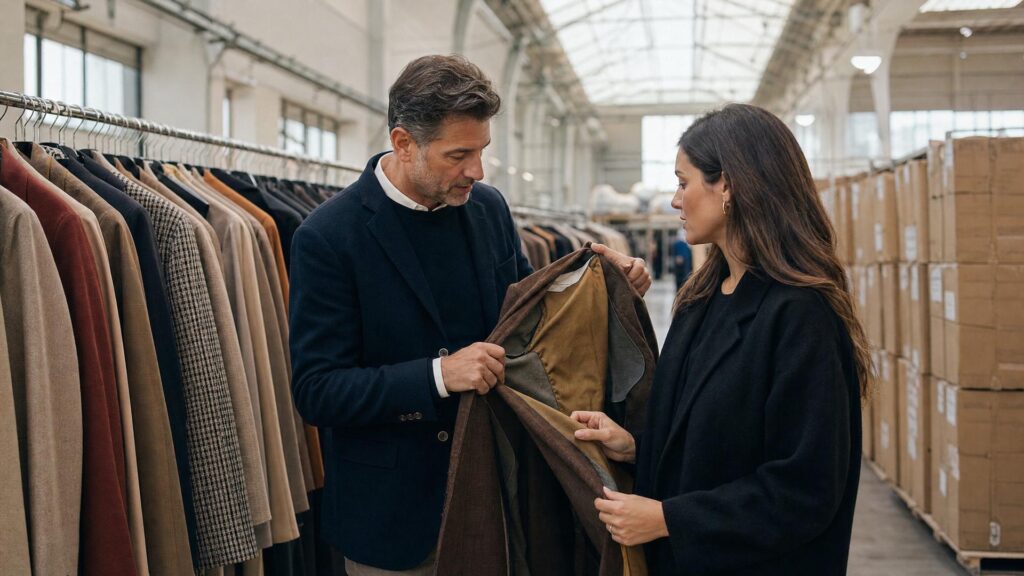
We handled the autumn order of a boutique in Kuwait City in exactly this way, from the first appointment to the export file. The owners visited ten suppliers in Prato over two and a half days, selecting their autumn-winter assortment with our buyer. Every purchase was invoiced to us by the supplier and then to the boutique on a single commercial invoice, with the supplier references kept for our records. We collected the goods, checked them, repacked them into as few cartons as possible and prepared the export file. For the boutique, ten suppliers became one counterpart and one payment.
Each destination has its own requirements, and a European supplier used to domestic sales may not know them. The Kuwait order is a good example. Customs at destination required a commercial invoice in English with a description, quantity, value, customs code and country of origin for each line, a packing list whose gross weight matched the air waybill, a certificate of origin issued by a chamber of commerce, and original documents signed by hand and stamped, since electronic signatures were not accepted. We prepared each of these and sent the signed originals by courier separately from the goods, as the boutique had asked.
Origin is a detail worth particular attention. Some of the Kuwait styles were produced in China rather than Italy, the owners knew it from the start, and the invoice said so line by line. The certificate of origin was issued by the Florence Chamber of Commerce on the basis of our invoice and the suppliers’ documents. Our guide to Italian fashion export documentation, VAT and duties explains why goods exported outside the EU leave Italy without Italian VAT, and what the buyer pays at home.
Buyers outside the EU often have their own freight forwarder at home, and many prefer to use it. This is possible, provided the forwarder and the exporter coordinate from the start, because the exporter must receive the customs proof that the goods have left the EU. For the Kuwait order, the boutique chose to ship through its own forwarder, and we coordinated directly with its office in Italy on collection times, documents and carton details, so that the shipment left with everything the forwarder and customs needed.
Timing can also follow the buyer’s needs. Because other suppliers were delivering to the boutique in the same weeks, it asked for its Italian order to arrive in two shipments, the first with the goods already collected and checked, the second a few weeks later with the rest of the order. Each shipment had its own invoice, packing list and certificate of origin. The first shipment reached Kuwait City complete, and the second was prepared in exactly the same way, so the boutique could receive and check each delivery at its own pace.
When comparing wholesale clothing suppliers in Europe, a buyer outside the EU should look beyond the collection and the price list. The questions that decide whether an order arrives smoothly are who will be the exporter, whether purchases from several suppliers can be consolidated, whether the documents required at destination can be prepared, and whether the shipping can be coordinated with the buyer’s own forwarder if needed. Suppliers or agents who answer these questions clearly before the order are the ones worth working with, because every unanswered point becomes a delay once the goods are packed and waiting to leave.
Through our fashion sourcing and purchasing service, buyers in the Gulf, the United Kingdom, North America and Australia buy from Prato suppliers in person or by live video, and receive their goods as consolidated shipments with export documents prepared in Italy. The suppliers stay focused on making clothes, and the buyer deals with one company for everything that happens between the showroom and the destination, from the first selection to the moment the documents reach the customs broker at home.
For a boutique outside the EU, European suppliers offer design, quality and variety that are hard to find elsewhere, and Italian pronto moda adds speed and small quantities per style. The obstacles are practical rather than commercial: export, consolidation, documents and coordination with carriers. Once these are handled by a single exporter in Italy, buying from many European suppliers becomes as simple for a distant buyer as it is for one across the border.
The Kuwait order shows how this works on a large scale, with ten suppliers, two shipments and documents tailored to the destination’s customs. The same structure applies to a first order of a few cartons, and to buyers who start with a live video session before deciding whether to visit in person. For any boutique comparing wholesale clothing suppliers in Europe from a distance, the test is the same: the collection has to be right, and the route from the showroom to the shop has to be clear before the order is placed. What changes from one buyer to another is the destination’s paperwork, and that is the part a buyer should expect the exporter to have mastered before the goods leave Italy.
Italian fashion supply, curated and delivered to your inbox.
How can we assist?
See our services